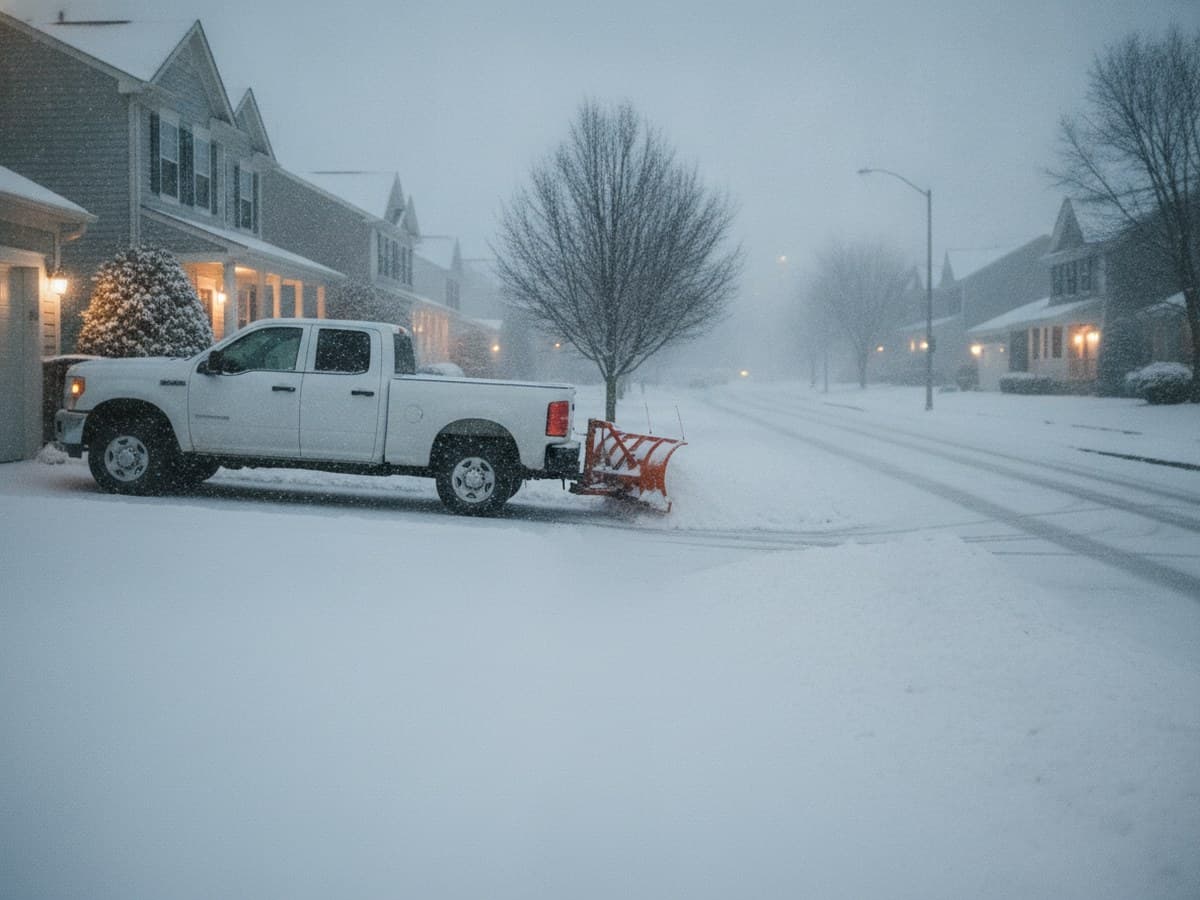
How many driveways can you plow in one storm?
Short answer: one truck in a six-hour window can clear about 20 standard two-car driveways when the hops are about four minutes, and about 12 when the hops are about fourteen.
That gap is eight driveways a storm, and it comes from shorter hops, not a faster blade.
A 2015 Lawn & Landscape piece quoted Callahan's at about 70 driveways per route after optimization, with an average drive of about 27 seconds between stops. The article does not say how long the route ran or whether walks were on the truck. Treat 70 as one company's old ceiling, not a number you can sell.
The same clock, in summer clothes, is how many lawns a crew can mow in a day. Fall's version is how many leaf jobs a crew can finish.
Set the window before you set the cap
Residential plow nights are short because people leave for work. Decide the clock first: when the truck leaves the yard, and when the last driveway on the list must be done.
This planning model uses a 6-hour window and holds back 30 minutes for a city-plow berm, a blocked drive, or fuel. That leaves 330 minutes to divide.
Until you have timed your own stops, plan 12 minutes on site for a standard two-car driveway, plow only, one pass, no walks. A September 2026 route guide uses 10 minutes on site as its worked example, and it tables older operator reports: 15 driveways inside about a quarter mile finished in roughly 70 minutes with no shoveling, while 12 driveways across four towns took 2.5 to 4.5 hours. Those reports are door-to-door, not blade time, and they are old. Use them to see the spread. Then replace them with your clock.
| Route shape | Minutes on site | Minutes to the next stop | Minutes per driveway | Driveways in 330 minutes |
|---|---|---|---|---|
| Tight streets | 12 | 4 | 16 | 20 |
| Scattered pins | 12 | 14 | 26 | 12 |
330 ÷ 16 = 20.6, rounded down to 20. 330 ÷ 26 = 12.7, rounded down to 12. Round down. A route that only works if nothing goes wrong is already oversold.
If the hop from the yard to the first driveway is longer than your between-stop number, subtract the extra minutes from the 330 before you divide. The table counts a normal hop into every stop, including the first.
What eight driveways are worth
Angi's snow removal page, updated October 15, 2026, puts the national average at $126 a visit across 5,994 projects, with most homeowners paying $51 to $203. A two-car driveway on that page runs $75 to $125 a visit.
Eight extra driveways at the bottom of that two-car band is $600 in tickets per storm (8 × $75). At the $126 average, which mixes job sizes, the same eight tickets are about $1,008. Both figures are revenue, not profit, and not a quote.
The scattered route also spends more of the window in the truck:
- Tight route: 20 hops × 4 minutes = 80 minutes of travel.
- Scattered route: 12 hops × 14 minutes = 168 minutes of travel.
The Bureau of Labor Statistics puts the May 2025 median wage for grounds maintenance workers at $19.27 an hour. At that median, the tight route's travel is about $26 (80 ÷ 60 × $19.27). The scattered route's travel is about $54. Per finished driveway, travel wage is about $1.28 when the hop is four minutes and about $4.50 when it is fourteen.
That median is an employee wage, not loaded payroll and not an owner's draw. If you drive the truck, the hour is still yours, and you cannot bill it twice.
Fuel is the other windshield tax. EIA's November 9, 2026 weekly update put U.S. on-highway diesel at $6.127 a gallon and regular gasoline at $3.995, taxes included. Two extra gallons of diesel on those hops is $12.25. Use your truck's own burn rate. This model does not assume one.
The margin write-up for the rest of the year is how route density affects landscaping profit and what drive time costs.
Walks and a second pass eat the cap
Add 15 minutes of shoveling to every stop and the tight cycle goes from 16 minutes to 31. 330 ÷ 31 = 10.6, rounded down to 10 driveways. The tight-street advantage disappears.
Price walks and steps as their own line, or put a shoveler on the stops that need them and time that labor separately. The same route guide notes one operator's 29-driveway night took 4.5 hours with a shoveler and 5.5 hours without. That is one route, not a formula. It is enough to stop burying walk time inside "driveway clearing."
The 20-and-12 counts above are one pass. A storm that needs two loops inside the same commute window does not get to use the one-pass cap twice. Until you have timed a second loop on your streets, do not promise both clears before 7 a.m. on the full list. Sell the return pass on its own, or cut the address count until both loops fit.
Homeowners comparing a season price to a per-storm price are already reading when to line up driveway plowing and what driveway snow removal costs. Your contract should name the trigger depth and what a return visit costs. Angi's seasonal band of $300 to $700 is what homeowners are shopping. It is not permission to write "unlimited."
A route can fit the window and still miss the nurse
Start the truck at 1:30 a.m. On the tight cycle, driveway number 10 is done around 4:10 a.m. (10 × 16 minutes). On the scattered cycle, driveway number 10 is done around 5:50 a.m. (10 × 26 minutes).
If that household leaves at 5:30, the scattered list misses them even though all 12 stops still finish inside the six-hour window (12 × 26 minutes lands near 6:42 a.m.). Put early departures first, then recheck the hop you just lengthened. A total that fits is not the same as a promise you can keep.
How to raise the count without a second truck
- Time on-site and travel separately for one storm. A single "minutes per driveway" number hides whether the blade, the walks, or the hop is the problem.
- Sell the next door before you sell the next town. Four contracted driveways on one street beat twelve that cross the county. The winter ask to people you already mow is how to sell snow removal to lawn customers.
- Cap the list from the slower storm, not the easy one. Light snow and open streets lie. Set the published cap from a run that included a berm or a second pass.
- Split the map before you buy the second truck. A second truck that still crosses town has the same travel problem with twice the fuel. Draw two areas that do not meet in the middle of the night.
- Skip plow promises in markets that do not fund a plow. If you do not have the truck, the insurance, and a winter that pays for both, keep the off-season on leaf cleanup and keeping lawn customers through winter.
Where BlockBundle fits
The cap goes up when several homes on the same street are already yours to clear. BlockBundle does not hand you a filled plow route, and it does not promise a storm count.
You draw the streets you cover and set your price. Homeowners book one address at a time. When neighbors on that street book driveway clearing, the stops show up next to each other instead of as random pins. You keep the difference between a 16-minute cycle and a 26-minute one. The homeowner-facing version of the same street is getting a block on one plow route.
In this planning model, about 20 standard two-car driveways in a six-hour window when hops are about four minutes, and about 12 when hops are about fourteen. Time your own stops and round down.
Plan 12 minutes on site for a two-car driveway with no walks until you have a clock of your own. Door-to-door time is that plus the hop, which is where route shape shows up.
Yes. Fifteen extra minutes of shoveling on every stop cuts the tight-route count in this model from about 20 driveways to about 10. Price walks separately or staff them on purpose.
Only if each truck gets its own compact area. A second truck that still drives across town doubles fuel and payroll without fixing the hop.
Sources
- U.S. Bureau of Labor Statistics, Occupational Outlook Handbook, Grounds Maintenance Workers, May 2025 median wage $19.27 an hour: https://www.bls.gov/ooh/building-and-grounds-cleaning/grounds-maintenance-workers.htm
- U.S. Energy Information Administration, Gasoline and Diesel Fuel Update, November 9, 2026: U.S. on-highway diesel $6.127 a gallon, U.S. regular gasoline $3.995 a gallon, taxes included: https://www.eia.gov/petroleum/gasdiesel/
- Angi, How Much Does Snow Removal Cost? [2026 Data], updated October 15, 2026: national average $126 a visit (5,994 projects), typical range $51 to $203, two-car driveway $75 to $125 a visit, seasonal contracts $300 to $700: https://www.angi.com/articles/how-much-does-annual-snow-removal-contract-cost.htm
- Lawn & Landscape, "Integrate new technologies," November 4, 2015: Callahan's reported about 70 driveways per optimized residential route and about 27 seconds of average drive time between stops: https://www.lawnandlandscape.com/news/ll1115-snow-operations-new-technologies/
- RouteLeads, "How many driveways can you plow in a storm?", September 28, 2026: 10-minute on-site example and a table of 2014 operator reports (quarter-mile route versus multi-town route; shoveler versus no shoveler): https://routeleads.io/guides/how-many-driveways-per-plow-route