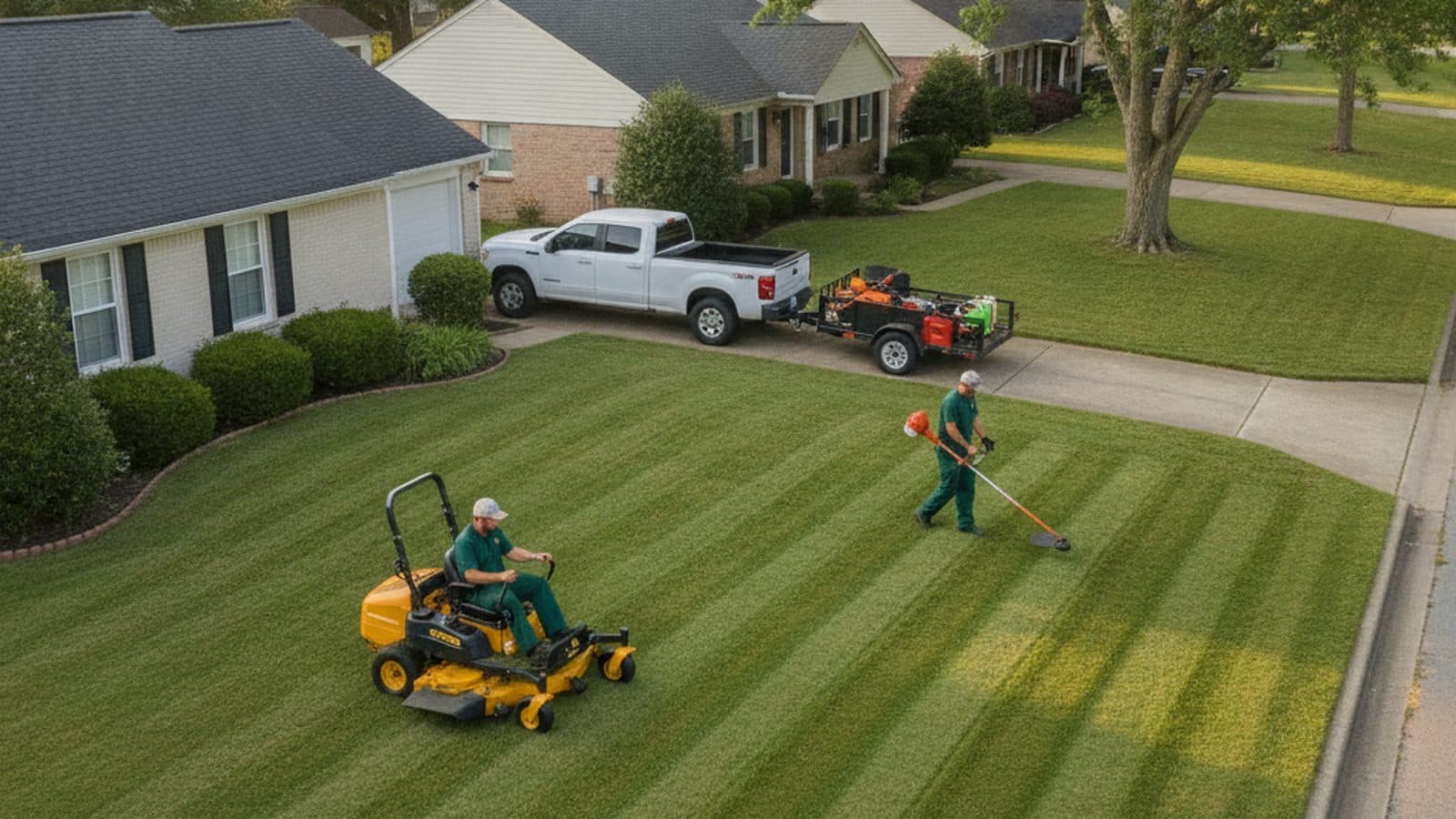
How many lawns can a crew mow in a day?
Short answer: a solo operator mows 5-8 average lawns a day, and 8-22 small lots on a tight route. A 2-person crew handles 10-15 average properties, and 20-28 small residential lawns when the stops sit close together.
That is a wide range, and the spread is not about how fast anyone pushes a mower. It is almost entirely route density - how far the truck drives between stops. Two crews with the same equipment and the same hours can finish the day 40% apart because one route is a tight cluster and the other is scattered across town.
Here is the math, why drive time sets your ceiling, and how to lift the number without buying a second truck or hiring a third body.
The real bottleneck isn't mowing - it's driving
The mowing part is fairly fixed. A small residential lot under 5,000 sq ft is roughly a 20-30 minute stop for a solo operator with a zero-turn once you count edging, trimming, and blowing off. A quarter-acre takes 20-30 minutes solo, or 10-15 minutes with a two-person crew splitting mow-and-trim.
What you cannot control from the seat of the mower is the drive between jobs. And it is bigger than most owners think: drive time commonly eats 30-50% of the workday.
Run the numbers on a normal day:
- 12 jobs, 12-minute average drive between stops = 2 hours 24 minutes in the truck. That is 30% of an 8-hour day spent driving, not billing.
- 15 stops at 12-minute drives = 3 hours of windshield time - 37.5% of the day gone before a single blade turns.
Every one of those minutes is fully loaded: you are paying wages, fuel, and truck wear to move equipment that only earns money when it is running on a lawn. In the trade the shorthand is blunt - windshield time will kill you.
The per-day math, worked out
Take a two-person crew, a realistic 7 productive hours (420 minutes) after loading, lunch, and dump runs, and a 20-minute small-lot stop. The only variable we change is the drive between homes.
Scattered route - 12 minutes between stops:
- Cycle per lawn = 20 min mow + 12 min drive = 32 min
- 420 ÷ 32 = ~13 lawns
Tight route - 6 minutes between stops:
- Cycle per lawn = 20 min mow + 6 min drive = 26 min
- 420 ÷ 26 = ~16 lawns
Same crew, same truck, same 8 hours: 13 lawns versus 16. Cutting drive time in half added three lawns a day - about a 25% jump in output with zero new payroll. Industry write-ups land in the same place: trimming average drive from 12 minutes to 7 through better sequencing tends to add 2-3 jobs a day, worth roughly $130-$195 in extra daily revenue.
Stretch that across a season. Three extra lawns a day, five days a week, at a $45 ticket is $675 a week - over $17,000 across a 26-week Texas mowing season - off a route change, not a price increase.
Why bigger crews aren't the fix
The instinct when you want more lawns per day is to add a person. It helps less than you would guess, because production efficiency drops as crew size grows. A second body cuts mow time on a lot from 25 minutes to maybe 12, but it does nothing to the 12-minute drive between houses. You are now paying two wages to sit in the same truck for the same windshield hours.
The lever with real leverage is the map. Density compounds:
- Less drive time per stop -> more billable minutes per day.
- More billable minutes -> lower labor as a share of revenue (the line that usually decides whether a landscaping company nets 8-12% or scrapes by).
- Same crew, more invoices -> the fixed cost of the truck spreads over more jobs.
We break the margin side of this down in how route density affects landscaping profit margins, and the pure driving cost - fuel, wages-in-transit, and the IRS 76-cents-a-mile vehicle line - in the drive-time cost breakdown.
How to raise your lawns-per-day
You do not need new software to start:
- Time the hops, not the mows, for one week. Most owners already know their mow times. The number they are missing is average drive between stops. Measure it.
- Sequence by geography, not by signup order. Group a day by street and cul-de-sac, not by which customer called first.
- Prune the outliers. One account 20 minutes off your cluster can cost you a full extra lawn every visit. Replace it with a home that fits the route.
- Chase same-street density. Two houses on one block beat two houses across two ZIP codes every time - the second one is a driveway roll, not a drive.
Step 4 is the hard one, because you do not control where your customers live. That is the part BlockBundle is built to fix.
How BlockBundle hands you a dense route
BlockBundle is not a lead marketplace that scatters random pins across your week.
You draw the streets you already cover and set your per-square-foot rate plus a route cost. Homeowners on those streets book their own homes individually. When neighbors on the same block book, the work arrives already clustered - several properties you serve in one trip, one park, one unload. You are not discounting to win the street; you are cutting the cost of serving it and keeping the difference.
That is density by design instead of density by luck. The homeowner-facing version is what home-service bundling is; the provider mechanics are in how providers book whole-street routes at the price they set.
We launch in Collin County first - McKinney, Trinity Falls, and the inner-ring DFW towns around them - so the first clustered routes sit on streets a crew can actually keep tight.
An experienced solo operator mows 5-8 average lawns a day, and 8-22 small lots when the route is tight and the drives are short. The low end is a scattered route; the high end is a dense one.
Roughly 10-15 average-sized properties, and 20-28 small residential lawns on a good, tightly-sequenced route. Drive time between stops is what moves you from the bottom of that range to the top.
No. A second and third person cut mow time per lawn but not the drive between houses, and production efficiency per worker falls as the crew grows. Tightening the route usually adds more lawns per day than adding a body.
Shorten the drive between stops. Sequence each day by street, drop accounts that sit far off your cluster, and add homes on blocks you already serve. Half the drive time can mean 2-3 more lawns a day on the same hours.
Sources
- Service Autopilot - How Many Lawns Can I Mow in a Day? (solo 5-8, 2-3 person crew 10-15 average lawns; drive time as the primary constraint): https://www.serviceautopilot.com/lawn-care/how-many-lawns-can-i-mow-in-a-day/
- Mowzey - How Many Lawns Can You Mow in a Day? Real Numbers (20-30 min small-lot stop, solo 8-22, 2-person 20-28 on tight routes, 12 jobs x 12-min drive = 2h24m/30% of the day, 12->7 min sequencing adds 2-3 jobs / $130-195): https://www.mowzey.com/resources/guides/how-many-lawns-can-you-mow-in-a-day
- Level - Landscape Company Benchmarks 2026 (net 8-12% typical, labor 50-58% of revenue): https://levelcfo.com/benchmarks/landscaping/
- IRS - Standard mileage rates (business rate 76 cents/mile, July 1-December 31, 2026): https://www.irs.gov/tax-professionals/standard-mileage-rates