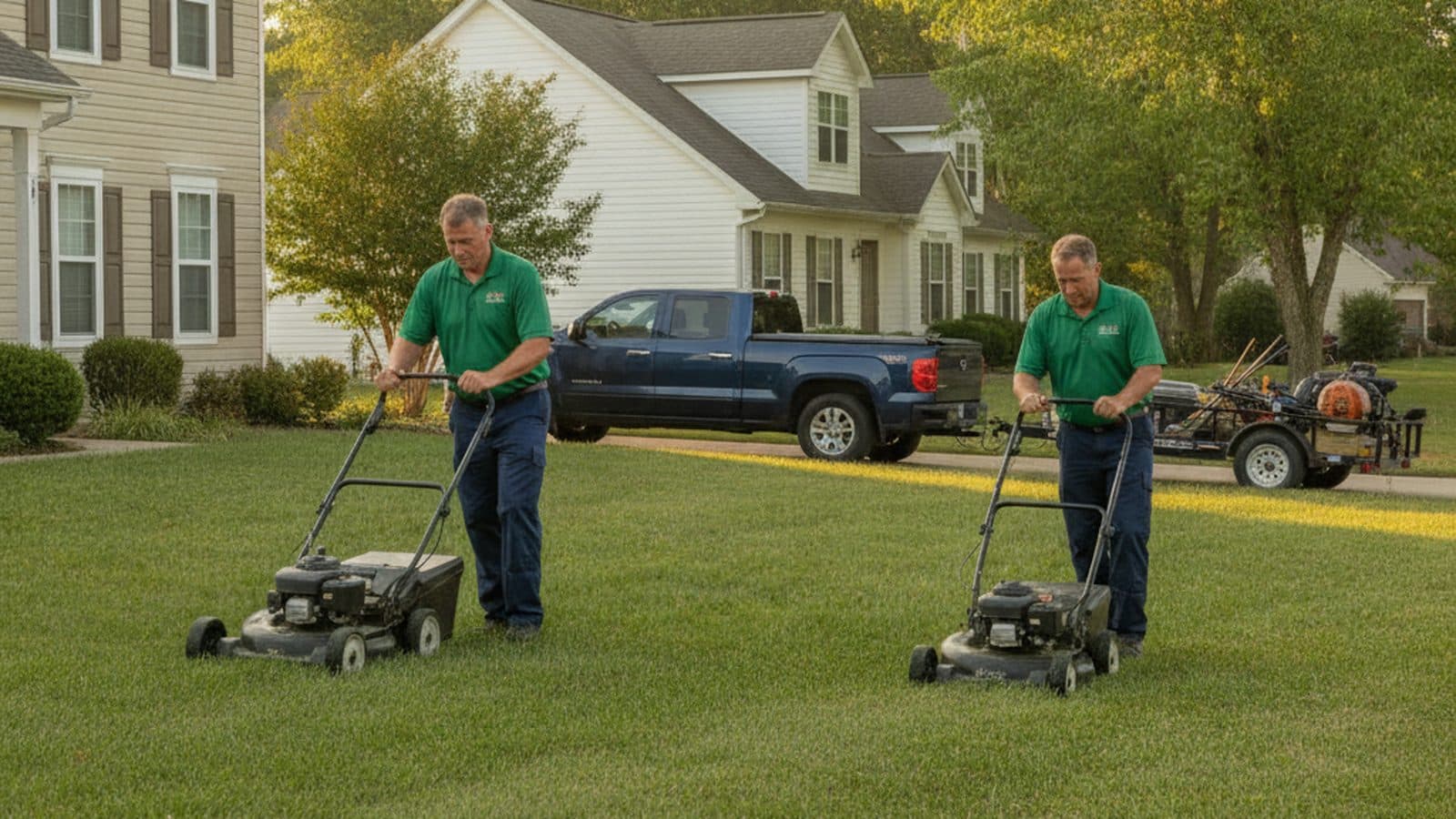
How much does drive time cost a landscaping company?
Most landscaping companies do not lose money on the mow. They lose it on the minutes between mows.
Drive time - windshield time, dead miles, the hop from one scattered stop to the next - is paid labor and a running truck that produces no invoice. The work looks busy. The day feels full. The P&L still leaks.
This article puts a number on that leak with public wage and mileage figures, then shows what changes when the same crew works neighboring homes instead of crisscrossing a zip code.
What you are actually paying for between jobs
Every hop between properties has two costs that show up whether or not anyone is cutting grass:
- Crew wages. A two-person crew is still on the clock in the truck. The U.S. median wage for landscaping and groundskeeping workers is $18.82 per hour (BLS / O*NET, 2025). That is $37.64 per hour in wages for two people - before payroll tax, workers' comp, or benefits.
- The truck and trailer. The IRS optional business mileage rate for July through December 2026 is 76 cents per mile. That figure is a proxy for fuel, depreciation, insurance, maintenance, and tires - not just diesel.
Fuel is the line item operators notice. Labor is the larger one. A routing-software vendor that works with landscape companies, Aspire, puts it plainly: extra fuel might be a few hundred dollars a month, while the same loose routes can burn $15,000 to $20,000 per month in productive crew hours across a larger shop.
A worked example: loose route vs. one street
The numbers below are an illustrative example, not a promise about your book of business. The assumptions are stated so you can swap in your own.
Shared assumptions
- Two-person crew at the BLS median of $18.82/hour each ($37.64/hour in wages, not fully loaded)
- Vehicle cost at the IRS rate of $0.76/mile
- Eight stops in a day
- 5-day week and a 30-week mowing season (150 working days) - a common planning window for recurring maintenance
Loose route: about 10 minutes and 5 miles between stops. That is 80 minutes and 40 miles of inter-job driving.
Dense street route: about 2 minutes and 0.2 miles between neighboring homes. That is 16 minutes and 1.6 miles of inter-job driving.
| Cost | Loose route | Dense street | Difference |
|---|---|---|---|
| Vehicle / day | 40 mi × $0.76 = $30.40 | 1.6 mi × $0.76 = $1.22 | $29.18 |
| Crew wages / day | 80 min × $37.64/hr = $50.19 | 16 min × $37.64/hr = $10.04 | $40.15 |
| Combined / day | $80.59 | $11.26 | $69.33 |
| Combined / season (150 days) | $12,088 | $1,689 | $10,399 |
That is more than $10,000 per crew, per season, in wages and mileage alone, on the same eight stops. It does not include payroll burden, which would widen the gap. It also does not include the work you never sold. The P&L version of that leak - labor percent and net margin - is how route density affects landscaping profit margins.
The recovered time is 64 minutes a day, or about 160 hours across a 30-week season. That is the slot where a ninth stop fits - if the work is sitting on the same street instead of two towns over.
Why 45 to 90 minutes a day is a common range
You do not need a dramatic disaster route for this to matter.
Aspire's operations writing uses 45 minutes of daily windshield time per crew as a baseline for enterprise landscape shops, and treats that as 10 to 15 percent of productive capacity. Other lawn-care operators publish examples in the 90 to 120 minute range when routes sprawl. A finance benchmark circulated to $1M–$25M landscape operators in 2026 puts the same idea in revenue terms: a crew spending 60 minutes between jobs instead of 20 loses more than an hour of billable time a day, or roughly $18,000 to $28,000 in lost revenue per crew over a 30-week season.
Treat those as industry analyses, not BlockBundle customer results. The point is directional and boring: if your hops are measured in neighborhoods instead of driveways, the leak is large enough to show up in labor percentage.
Labor is already 50 to 58 percent of revenue at many maintenance shops. Drive time is how that ratio quietly blows past 58 percent even when wage rates look fine.
Density beats discounting
The usual reaction to thin margins is to cut price, add a travel surcharge, or chase more leads.
Price cuts do not fix a route that spends an hour a day unpaid. A travel surcharge on an outlying property can be the right call for that one job, and it still leaves the crew in the truck. More leads in the wrong zip codes make the leak worse.
Route density attacks the cost directly:
- Shorter hops. Five homes on one street beat five homes across a county. Every time.
- One setup. Mowers, trimmers, and blowers come off the trailer once and stay off while you work down the block.
- More billable minutes in the same shift. You are not asking the crew to work later. You are asking the map to stop wasting the hours you already pay for.
- Lower acquisition cost per job. Several neighboring bookings spread the cost of winning the street, instead of paying to win each house as a one-off.
This is why adding one well-located account on a street you already serve is usually worth more than two scattered new accounts at the same price.
How BlockBundle feeds this without you organizing the block
BlockBundle is built around that map, not around a lead marketplace.
Homeowners book individually. You set your per-square-foot rate and your route cost, and you draw the streets you actually cover. When neighboring homes on those streets book, the work arrives already clustered - several properties you can serve in one trip - instead of a scatter of one-offs you have to re-route by hand.
We will not quote you a volume, an earnings figure, or a guaranteed dollar recovery. We launch in Collin County first - McKinney, Trinity Falls, and the inner-ring DFW towns around them - so the first clustered routes sit on streets a crew can actually keep. Those numbers have to come from live routes, not from a blog post. What we can say is the same thing the math above already says: windshield time is a cost you can design out of the day when demand sits on the same street.
If you want the product version of this argument, read how providers book whole-street routes at the price they set. The homeowner-facing explanation of the same economics is what home-service bundling is, and the booking flow is how BlockBundle works.
Run your own numbers this week
You do not need software to see whether this is your problem.
- Pull last week's route sheets.
- Time or estimate the minutes and miles between stops, not including the first drive out of the yard.
- Multiply minutes by your real loaded crew rate.
- Multiply miles by $0.76, or by your actual cost per mile if you track it.
- Annualize across your season.
If the between-stop line is larger than you like, the fix is not another marketing channel that drops pins across town. It is more work on the streets you already drive.
Sources
- IRS - Standard mileage rates (July 1–December 31, 2026 business rate, 76 cents/mile): https://www.irs.gov/tax-professionals/standard-mileage-rates
- O*NET / BLS - Landscaping and Groundskeeping Workers (37-3011.00), median wage $18.82/hour (2025): https://www.onetonline.org/link/summary/37-3011.00
- BLS Occupational Outlook Handbook - Grounds Maintenance Workers (May 2024 median $18.50/hour for the broader group): https://www.bls.gov/ooh/building-and-grounds-cleaning/grounds-maintenance-workers.htm
- Aspire - Routes Are a Margin Lever, Not a Logistics Task: https://www.youraspire.com/blog/landscaping-route-optimization-margin-lever
- Level - 2026 Landscaping Benchmarks (labor share and 30-week season revenue-at-risk range): https://www.levelcfo.com/downloads/level-landscaping-benchmarks-2026.pdf