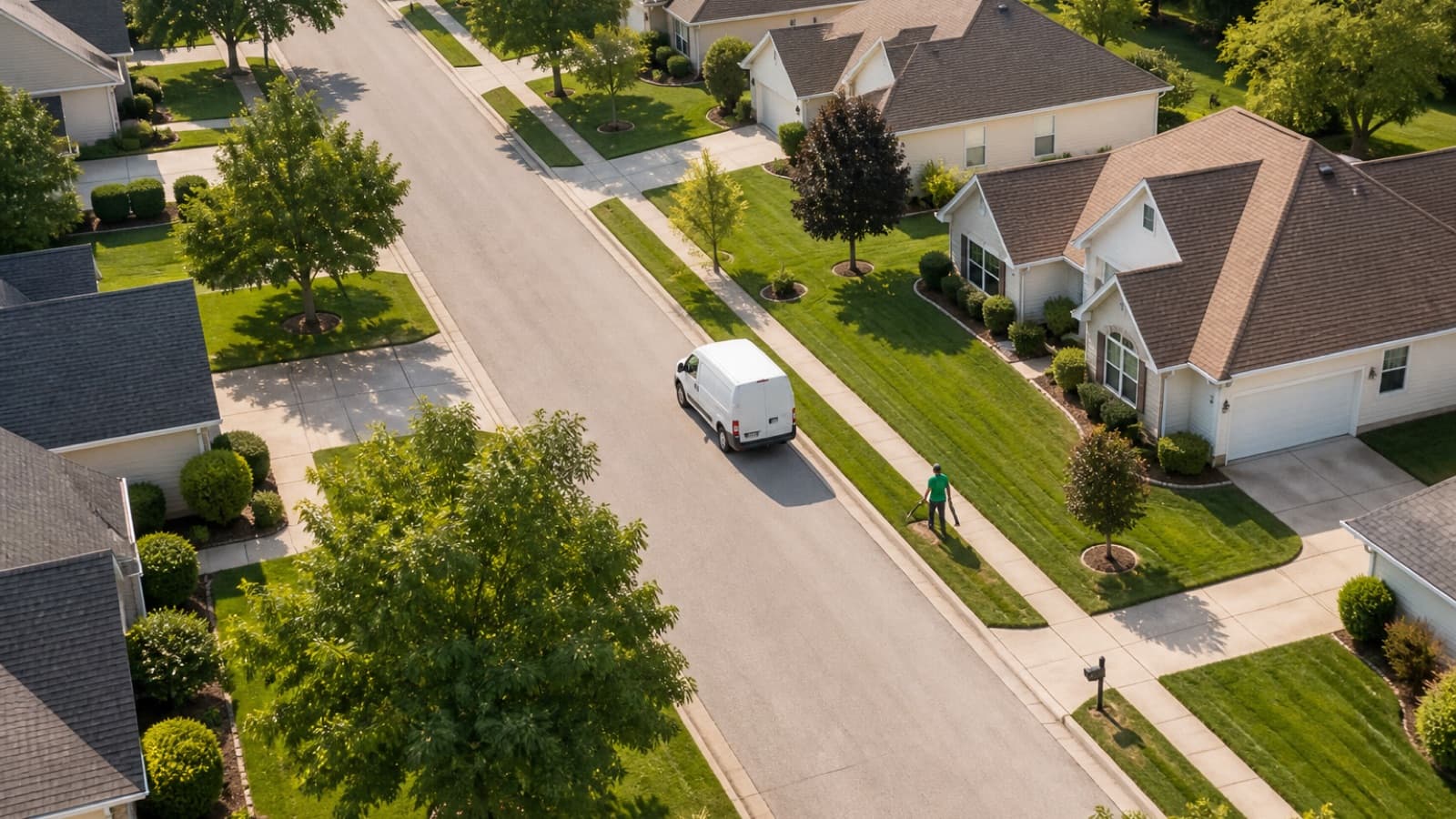
Serve a whole street at the price you set
BlockBundle books homeowners on the streets you cover - and you set the price. You draw your service area on a map and set your rate by the square foot plus a route cost; when homeowners on those streets book, you get clustered, recurring work you can serve in a single trip. Instead of chasing scattered one-off jobs across town, you get several neighboring homes on one route, and you cut the two things that quietly eat your margin - windshield time and dead miles between jobs. You are not lowering your price to win more clients. You are lowering your cost per stop and keeping the difference.
The problem is not demand - it is drive time
Most home-service pros do not lose money on the work itself. They lose it on everything around the work:
- Windshield time. Every mile between two scattered jobs is unbillable. A day capped at how far you can drive is a day capped on income. For a worked example, see how much drive time costs a landscaping company.
- Repeated setup. Ladders, hoses, mowers, and blowers get loaded and unloaded at every stop. Neighboring homes let you set up once and work down the block.
- Chasing one-offs. Single jobs mean constant re-selling and re-scheduling. The acquisition cost per job stays high.
Route density attacks all three. When five homes on one street are on one route, the drive that used to be split across the city collapses to a few doors, setup happens once, and you land several jobs from the streets you already cover.
What BlockBundle actually gives you
- You set your price. Set your rate per square foot and your route cost. BlockBundle is not a provider and does not undercut you - homeowners see a price built from your numbers.
- Map-based service areas. Draw the streets and neighborhoods you cover. You only see demand where you actually work.
- Clustered, routed demand. Homeowners book individually, but BlockBundle aggregates those bookings by street - so what lands on you is already clustered into an efficient route, not scattered leads.
- A path to recurring routes. Seasonal and recurring services - lawns weekly, leaf cleanup in fall, snow in winter - mean the same street becomes a route you keep, not a job you re-sell.
- Lower acquisition cost. Several homes per route spreads whatever it costs to land the work across multiple jobs, not one.
We are honest about stage: we launch in Collin County first (McKinney, Trinity Falls, and the inner-ring DFW towns around them) and roll out neighborhood by neighborhood from there. We are not going to quote you a volume or earnings figure we cannot back yet. What we can show you is exactly where the efficiency comes from - and it is the same math you already run in your head when two jobs happen to land on the same street.
Why the homeowner side matters to you
Your routes only stay full if homeowner demand keeps landing on your streets. That side is built to feed yours: homeowners get an instant, property-specific price from just their address and can see how their price improves as their street fills, and estimate it with the savings calculator. Because they book individually and instantly - no group to organize, no waiting - demand forms faster and clusters on the streets you cover. When you want to explain the model to a homeowner or an HOA, how BlockBundle works is the plain-language version.
Getting started as a provider
Draw your service area on the map and set your per-square-foot rates and route cost. When homeowners on the streets you cover book, you get the work - clustered and routable - and the recurring services turn those streets into routes you keep. No lead fees to chase scattered one-offs; just work you can actually route.