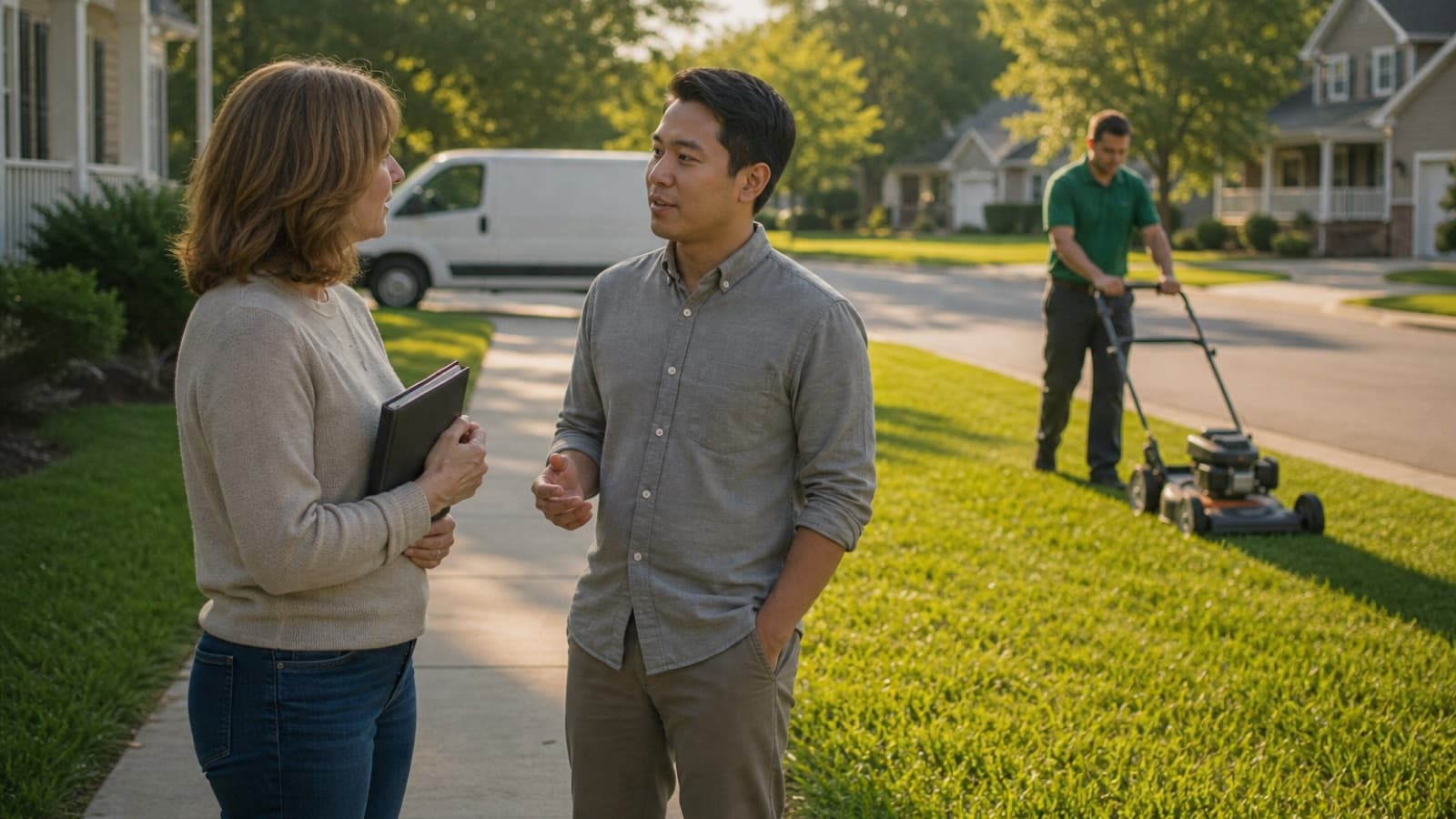
How much can your street save on lawn care?
Lawn care gets cheaper on a dense street because a mowing crew's real cost is not the 20 minutes behind the mower - it is the drive out, the trailer setup, and the gap before the next job. When several homes on one street are mowed back-to-back, that fixed cost gets split across the block instead of loaded onto your single lawn. You book individually at a real price today; the more of your street that joins the route, the more of that saved drive time a provider can hand back as a lower price. Use the calculator below to estimate the number for your own street.
With 4 homes on the route, the provider shares the drive and setup across the block, so you pay $18 less than booking this property solo. Add one more neighbor and your price drops to $40.80.
What a solo mow costs first
To see the savings, start with the baseline. Standard residential lawn mowing runs roughly $45 to $90 per visit, with a national average near $50, and small yards often landing in the $30 to $40 range while larger lots climb past $100.
Most of that price is not the cutting. It is:
- Drive and load time to reach your yard and get the trailer set.
- Setup and teardown of mower, trimmer, and blower at each stop.
- Schedule gaps - the unbillable minutes between one job and the next.
Those three are exactly the costs a dense route shrinks.
Where the route discount comes from
Picture a crew that would drive 20 minutes for one lawn on your street. If four more neighbors are on that same street, the crew mows five lawns on one stop. The drive that used to be charged to one household is now spread across five, and the crew's mowers never go back on the trailer between houses. That recovered time is real, and a provider serving the route can price some of it back.
The savings scale with two things:
- How many homes are on the route - more homes, more drive time to split.
- How tightly clustered they are - five homes on one street beats five homes scattered across a zip code, every time.
This is the same route logic behind all home-service bundling, applied to the most routine outdoor job there is. And you capture it without organizing anyone - you book, and density does the rest.
An illustrative example
Say a solo mow on your street is about $55. If a provider serving five neighboring homes can shave their per-home cost meaningfully by mowing them in one stop, part of that efficiency shows up as a lower price per lawn - and the calculator above estimates that figure for your inputs rather than us quoting a fixed number here.
The honest version: we will not promise you a set discount before real routes run in your area. What we can say is where the savings come from and that they grow with density - so the useful move is simply to book and let your street fill in.
How to actually get the price
You do not organize a co-op, collect anyone's money, or wait for a group. Enter your address, get a free lawn report and an instant, property-specific price, and book. If you are in McKinney or Trinity Falls, skip the estimate and go to the McKinney lawn-care page or the Trinity Falls lawn-care page - same instant-price flow, already scoped to those streets. Here is the full step-by-step of how BlockBundle works. As more neighbors book the same service, your per-visit price can drop - and we tell you when it does.
Sources (for cost figures):
- Angi - Lawn Mowing Price Guide (2026): https://www.angi.com/articles/how-much-charge-lawn-mowing.htm
- LawnStarter - How Much Does Lawn Mowing Cost in 2026: https://www.lawnstarter.com/blog/cost/lawn-mowing-price/