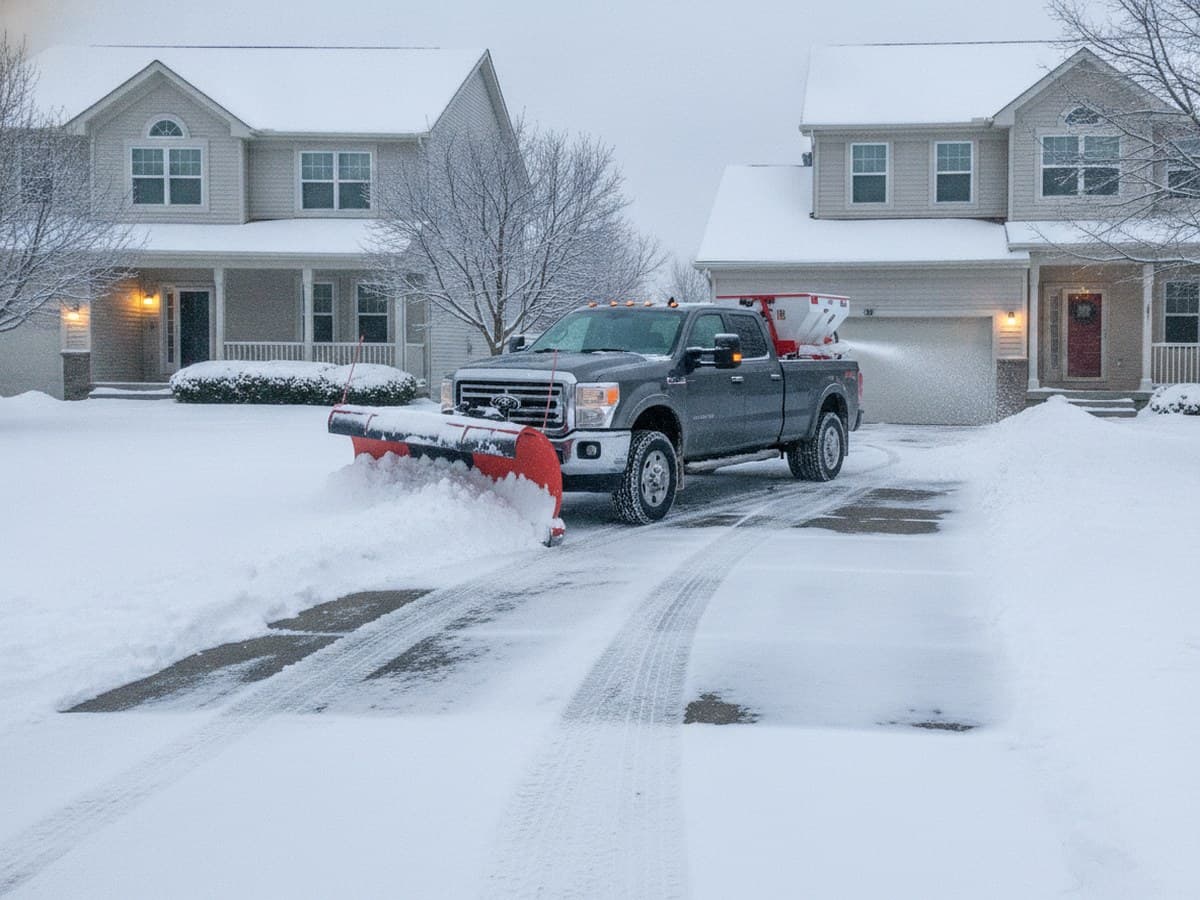
How to sell snow removal to your existing lawn customers
Short answer: sell a named seasonal snow contract to the people who already trust your truck, not a cold "snow plow near me" blast the night of the first storm. Text or email your active mow list before the first freeze with a clear per-season price, a trigger depth, and a yes/no reply. The accounts you already mow convert cheaper than a random pin across town, and clustered driveways are the only way a plow night stays profitable.
In 2026, Angi puts professional snow removal at a national average of about $126 per visit, with most homeowners paying $51 to $203, and residential seasonal contracts commonly landing around $300 to $700 (Angi 2026 snow removal costs). Your job is not to invent a new metro price book. It is to capture that spend on streets you already serve, before a Facebook lead sends the driveway to someone who has never seen the apron.
This is the winter companion to selling leaf cleanup to lawn customers and selling sprinkler winterization to lawn customers. Homeowners reading the other side of the decision land on driveway snow removal cost, when to line up driveway plowing, and how to get a block on one plow route.
Why your mow book beats a storm-night lead
Snow margin lives on how many driveways you clear before you leave the neighborhood, not on how many cold calls you take at 4 a.m.
An existing lawn customer already solved three expensive problems for you:
- Access and trust. They know your truck and that you show up.
- Property knowledge. You have already seen apron length, slope, curb cuts, and where snow can pile.
- Route position. They sit on a street you already visit. The second and third yeses on that block are where a plow night pays - the same density math that makes clustered mowing profitable.
A paid snow lead twenty minutes off your mow map recreates the scatter problem in lawn care CAC and drive time cost. Winter is the wrong season to relearn it with a plow on the bumper.
What to offer (contract beats panic pricing)
Do not sell "we'll plow if it snows." Sell a named seasonal product with trigger depth, inclusions, and what happens after the push cap.
A package that works for most suburban residential books:
| Offer | Typical 2026 band | Who it fits | Why it keeps density |
|---|---|---|---|
| Per-push driveway | ~$40–$100 (often ~$75–$125 for a two-car) | Light-snow markets; customers who want flexibility | Easy to quote; weak for route planning |
| Seasonal contract | ~$300–$700 residential | Most existing mow accounts | Locks cash and priority before the first storm |
| Driveway + walk/steps add-on | Walk add often ~$40–$80 per visit or a season line item | Homes with long walks or medical access needs | Labor-heavy; price separately so the plow loop stays fast |
| Salt / de-ice add-on | Rock salt often ~$10–$25 per app; pet-safe higher | Icy markets; HOA walk rules | Recurring margin; do not bury it inside "unlimited" |
Public 2026 bands put single-car drives roughly $40–$75 per visit / $300–$400 per season, and two-car roughly $75–$125 / $400–$600, with larger drives higher (Angi). Use the bands to sanity-check your book, not as a national price list.
Spell out trigger depth (often 1–2"), driveway vs walks/steps, salt billing, response window after snow stops, a push cap or heavy-season clause, and what happens when the city plow refills the apron. If you only quote "call us when it snows," you invite Nextdoor shopping at 11 p.m.
When to ask (before the first freeze)
September through early November is the sell window in most snow markets. By the first forecast that sticks, priority routes are full. Mid-November still works as a last-chance "route is filling" pass. Storm-night marketing is overflow only, and only on streets where you already have a contract.
Cadence:
- Late September / early October: Text the full active mow list with a season price.
- Mid-October: One-sentence follow-up to every driveway that has not replied.
- First hard freeze or plowable forecast: Final "route is filling" touch. Stop new off-route one-offs.
- After first storm: Neighbor ask only on streets you already cleared that night.
Early booking is how you keep plow nights on streets instead of scatter.
The message that actually gets a yes
Long brochures lose to a specific, priced ask. Use something you can paste into SMS:
Hi {Name} - it's {Your name} from {Company}. We're locking snow contracts on your street this winter: driveway cleared after {trigger}" for ${season_price} (up to {cap} pushes; extras at ${per_push}). Reply YES to hold a spot, or STOP and we'll leave you on lawn only.
Rules that keep it clean:
- Name the street or block, not "your area."
- One season price for the standard driveway. Put walks, salt, and steep clauses in the confirmation.
- Reply YES / NO. Forms kill warm upsells.
- Soft-open on the last mow: "We'll text snow contracts this week for your street."
Operators who sell snow to the existing maintenance book treat early outreach as the high-ROI winter campaign because trust and route position are already paid for (PinPoint Promote; More Landscaping Clients). Close rates still depend on snow history, price, and street density.
Price the contract so a dry winter still pays
Build season price from your own per-push cost:
- Price a fair per-push (time + fuel + wear + salt if included).
- Multiply by a realistic plowable-event count for your county.
- Decide who carries weather risk: uncapped season (you), capped season with extras (shared), or per-push only (customer).
- Keep existing customers inside public homeowner bands. A loyalty fire sale that cannot fund a dry January trains a bad habit.
Illustrative math: $70 true per-push × 10 expected events = $700 uncapped floor before risk buffer. Cap at 10 pushes with $70 extras, or price uncapped in the local $550–$700 band. Mild winters punish uncapped contracts; heavy winters punish uncapped per-push customers. Write the structure clearly. Homeowners comparing options already have seasonal vs per-storm and driveway cost bands.
Density saves travel; it does not invent free plow hours. The capacity side of that street is how many driveways one truck can plow in a storm.
Thicken the street after the first yes
The upsell is not finished when one house replies YES. That afternoon, text the two doors on either side with the same season price and trigger. Keep snow nights on the same loop as the mow route when you can.
That is the density flywheel in winter clothes: one warm yes funds the neighbor ask, the neighbor ask fills the block, the full block drops minutes-per-driveway. Four contracted driveways on one street is a product. Twelve scattered one-offs is windshield time - same lesson as route density.
Equipment, insurance, and markets that should skip this
Only sell snow if you have real plow or blower capacity, winter liability coverage, and a market where snow funds the truck. In mild southern markets, keep the winter menu on leaf, gutters, sprinkler winterization, and off-season retention instead of promising a plow you do not own.
Where BlockBundle fits
Selling snow contracts to people you already serve is the right first move. The hard part at scale is still landing several homes on the same street without a neighborhood group chat.
BlockBundle lets homeowners book one address at a time while work arrives clustered on streets you cover. You draw your service area and set structured pricing. When neighbors book driveway clearing together, you keep the winter margin because the product was the route, not a single apron.
If you run a snow market, register as a provider and put snow on streets you can keep tight. Homeowner-facing price and timing live in driveway snow removal cost and bundling snow with neighbors.
September through early November in most snow markets - before the first freeze and before priority routes fill. Use a final "route is filling" touch at the first plowable forecast.
Prefer a seasonal contract (often capped) for existing mow accounts so you lock cash and plan the block. Keep per-push for overflow or light-snow markets.
Stay inside 2026 homeowner bands: roughly $40–$100+ per residential push and about $300–$700 per season for typical driveways, adjusted for size, trigger, walks, and salt. Match the market; win on trust and street density.
Existing accounts first. Cold storm-night leads recreate the scatter problem that kills mowing margin.
Skip the plow promise. Sell leaf, gutters, winterization, and spring prepay on streets you already serve instead.
Sources (for 2026 winter planning):
- Angi - How Much Does Snow Removal Cost? [2026 Data] (national average ~$126/visit; $51–$203 typical; seasonal contracts ~$300–$700): https://www.angi.com/articles/how-much-does-annual-snow-removal-contract-cost.htm
- PinPoint Promote - Landscaping Off-Season Revenue Guide (snow contracts to existing maintenance clients as high-ROI winter campaign): https://pinpointpromote.com/resources/landscaping-winter-revenue-guide
- More Landscaping Clients - Get snow removal in front of mowing customers (priced SMS ask; common residential bands): https://morelandscapingclients.com/blog/next-30-days-snow-and-holiday-lights/
- BlockBundle - Driveway snow removal cost, When to line up driveway plowing, Bundle snow with neighbors, Sell leaf cleanup, Keep lawn customers through winter, Route density