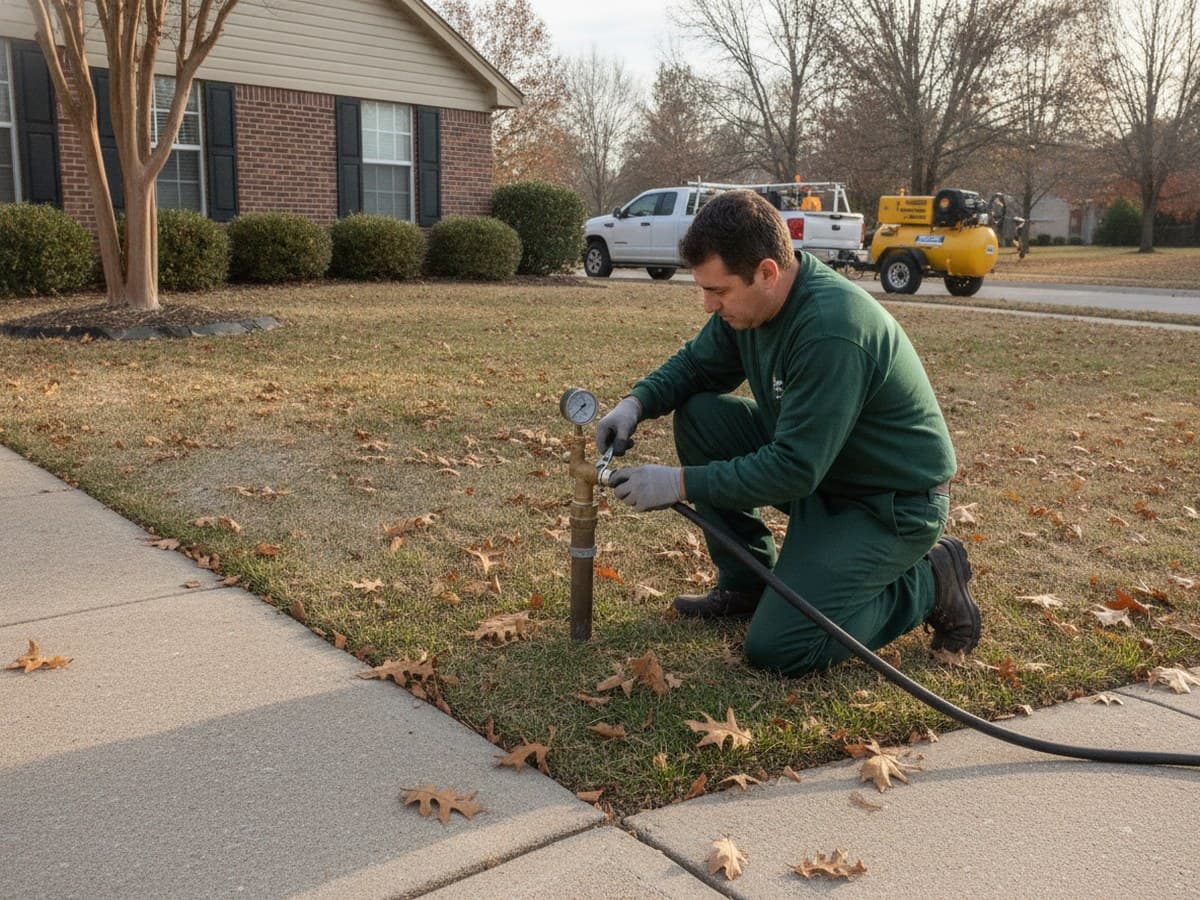
How to sell sprinkler winterization to your existing lawn customers
Short answer: sell a dated blowout package to the people who already let you on their property, not a cold "sprinkler winterization near me" campaign. Text or email your active mow list in late September through mid-October with a clear zone band, a written scope, and a reply path that takes under ten seconds. The accounts who already know your truck convert cheaper than a one-off pin that forces you to tow the compressor across town.
In 2026, homeowners typically pay about $56 to $137 to winterize, with a national average near $93, according to Angi's 2026 cost data. Blowout-method work commonly runs $100 to $250. Your job is not to invent those numbers. It is to capture that spend on streets you already mow - as an add-on while you are nearby, or as a tight winterization day on a block you already know - before an irrigation specialist books the whole cul-de-sac without you.
This is the sales companion to how much a lawn care company should charge for sprinkler winterization. Homeowners shopping the other side of the street will see how much sprinkler winterization costs. The density lesson matches selling fall leaf cleanup to lawn customers: warm accounts beat cold leads when the product has a fixed setup cost.
Why your mow book beats a cold winterization lead
Winterization margin lives or dies on how many times you stage the compressor, not on how fast you can purge one head.
An existing lawn customer already solved three expensive problems for you:
- Access and trust. They know your truck and that you show up. That removes the "who is connecting air to my backflow" friction that kills cold quotes.
- Property knowledge. You have already seen the controller location, the fence gate, the dog, and whether the backflow sits in a rose bed. Your first quote is honest instead of a hopeful drive-by.
- Route position. They sit on a street you already visit for mowing or leaves. The second and third yeses on that block are where the day rate jumps - the same density math that makes clustered mowing profitable.
A paid irrigation lead across town has the same problem as a cold mow lead: you win a pin, then pay for windshield time, a tear-down, and a compressor tow that only covers one house. That CAC story is already written in what a new lawn account really costs. Peak freeze week is the wrong time to relearn it.
What to offer (dated package beats "sometime before it freezes")
Do not sell "we'll blow out your system eventually." Sell a named package with zone band, method, and a calendar window.
A package that works for most suburban accounts:
| Package | What's included | How to sell it |
|---|---|---|
| Standard blowout | Up to 8 zones, compressor purge, controller winter setting | Default for most mow accounts with irrigation |
| Large system | 9–12 zones, same scope + per-zone adder past 8 | Bigger lots, multi-bed layouts |
| Fall + spring pair | Blowout now + spring activation later | Locks next April on the same street |
| Add-on stop | Same scope, add-on price if you are already on that street for lawn or leaves | Best margin; compressor already nearby |
Spell out, in writing, for every package:
- Method: compressor blowout vs drain-only (do not let "winterization" mean either without saying which)
- Zone band and the per-zone adder past it
- Whether backflow insulation or remove/store is included or a separate line
- That repairs found during the blowout are quoted separately - November is not free rebuild season
- Whether a spring startup is paired now or sold later
If you only say "around a hundred," you are inviting the customer to shop you against Angi's $93 average every time a freeze warning hits the weather app.
When to ask (calendar, not vibes)
Late September through mid-October is the sell window in most freeze climates. By the morning of the first hard freeze, serious books are full and urgency pricing is the only lever left - which is a terrible way to treat customers who already pay you every week.
A simple cadence:
- Week of Sept 20–Oct 10: Text or email the full active mow list that has irrigation. Subject line energy: "Sprinkler winterization - lock your street window."
- Mid-October: Personal follow-up to every irrigated account that has not replied. One sentence, one price, one reply keyword.
- First freeze watch: Offer add-on stops only on streets where you already have a yes. Do not reopen the whole map for one-offs that force a solo compressor tow.
- After peak: Finish package customers. Close new scattered pins unless they sit next door to a stop you are already doing.
Shoulder-freeze markets (including much of North Texas / DFW) still have a window - exposed backflows crack even when buried laterals rarely freeze. Pitch the scope locals actually need (shutdown, insulation, controller winter setting, and blowout where the system warrants it), not a Colorado hard-freeze script pasted onto a Dallas ranch.
If you wait until everyone is panicking, you are competing with every desperate crew and every homeowner with a garage compressor that cannot hold the CFM. Early booking is not a discount gimmick - it is how you keep jobs-per-day honest when the product is air instead of bags.
The message that actually gets a yes
Long brochures lose to a specific, priced ask. Use something you can paste into SMS:
Hi {Name} - it's {Your name} from {Company}. We're booking sprinkler winterization on your street before the first hard freeze: up to 8 zones with a compressor blowout for ${price}. Reply YES to lock your window, or STOP and we'll leave you on mowing only.
For the pair:
Same visit price for fall blowout, plus spring startup locked for ${pair_price} total (two visits). Reply PAIR to book both.
Rules that keep it clean:
- Name the street or block, not "your area." Density sells when the customer can picture the compressor already on the curb.
- One price for the standard band. Put pumps, second controllers, and backflow remove/store in the confirmation text, not in the first ask.
- Reply YES / PAIR / NO. Forms and "schedule a free estimate" links kill warm upsells.
- Crew mention on the next mow. "We'll text winterization this week" soft-opens without a driveway pitch.
Price the add-on so the compressor day still pays
Use the book from how much to charge for sprinkler winterization. Do not invent a "loyalty discount" that erases the tow.
| Stop type | Typical 8-zone band | Why the number differs |
|---|---|---|
| Add-on (already on street) | $85–$120 | Drive and first park are paid |
| Standalone winterization pin | $100–$145 | Compressor tow carries itself |
| Fall + spring pair | ~5–10% off the sum of both visits | Locks April without fire-saleing fall |
Stay inside public homeowner comps: Angi $56–$137 typical, average near $93; blowouts often $100–$250. Your add-on column should sit inside those bands. Your standalone column can sit at the top when the tow is the product. Match the market, win on trust and timing, keep the drive-time arithmetic intact.
A typical 4–8 zone blowout runs about 15 to 30 minutes once you are staged. The day is set by tear-downs, not by how fast one head spits mist. Three houses on one cul-de-sac can share one compressor stage; twelve scattered one-offs will feel busy and still miss margin.
Thicken the street after the first yes
The upsell is not finished when one house replies YES. That afternoon, text the two doors on either side with the same window and price. Note irrigated lots not on your mow book as next year's lawn targets, not this week's distraction. Keep winterization days on the same weekday pattern as the mow or leaf route when you can.
That is the density flywheel in freeze-week clothes: one warm yes funds the neighbor ask, the neighbor ask keeps the compressor staged, the staged compressor drops cost per home.
If you already sold leaf cleanup on that block, stack the ask: "We're on your street for leaves the week of - want the blowout the same window?" Dual-purpose days are how small crews beat specialists who only tow compressors.
Where BlockBundle fits
Selling winterization to people you already serve is the right first move. The hard part at scale is still landing several homes on the same street without you organizing a neighborhood group chat.
BlockBundle lets homeowners book one address at a time while work arrives clustered on the streets you cover. You draw your service area and set structured pricing. Lawn is the live instant-price path today; fall outdoor demand rides the same map. When neighbors book, you keep the add-on margin because the truck was never the product - the route was.
Sprinkler winterization is not a live instant-book category on BlockBundle today. The density lesson still applies: streets that already share a fall outdoor crew are the streets where compressor days pay. Collin County homeowners who book McKinney lawn care on a shared route or land on the Trinity Falls lawn care page are the warm accounts your compressor day should chase first. Register as a provider, keep your map tight, and put winterization on the books of the accounts who already trust you.
Late September through mid-October in most freeze climates - before the first hard freeze fills every serious book. Shoulder-freeze markets still have a window for shutdown, insulation, and blowouts where the system needs them.
Prefer a fall blowout with an optional spring activation pair. A 5–10% discount on the combined total is enough to lock April without giving away November margin.
About $85–$120 for a typical 8-zone add-on when you are already on the street, and $100–$145 as a standalone stop. Stay inside homeowner comps (Angi typical $56–$137, average ~$93) rather than running a loyalty fire sale.
Existing accounts first. Cold irrigation leads recreate the scatter problem that kills mowing margin - the compressor tow is the fixed cost that density solves.
Yes when the street is already dense. Stack the ask on leaf-package customers so one curb stage covers bags and air. Do not drag a compressor across town for a single add-on.
Sources (for 2026 cost bands and method guidance):
- Angi - How Much Does It Cost to Winterize a Sprinkler System? [2026 Data] (avg ~$93; typical $56–$137; blowout ~$100–$250; spring activation ~$50–$230): https://www.angi.com/articles/how-much-cost-winterize-sprinkler-system.htm
- BlockBundle - How much should a lawn care company charge for sprinkler winterization, How much does sprinkler winterization cost, How to sell fall leaf cleanup to lawn customers