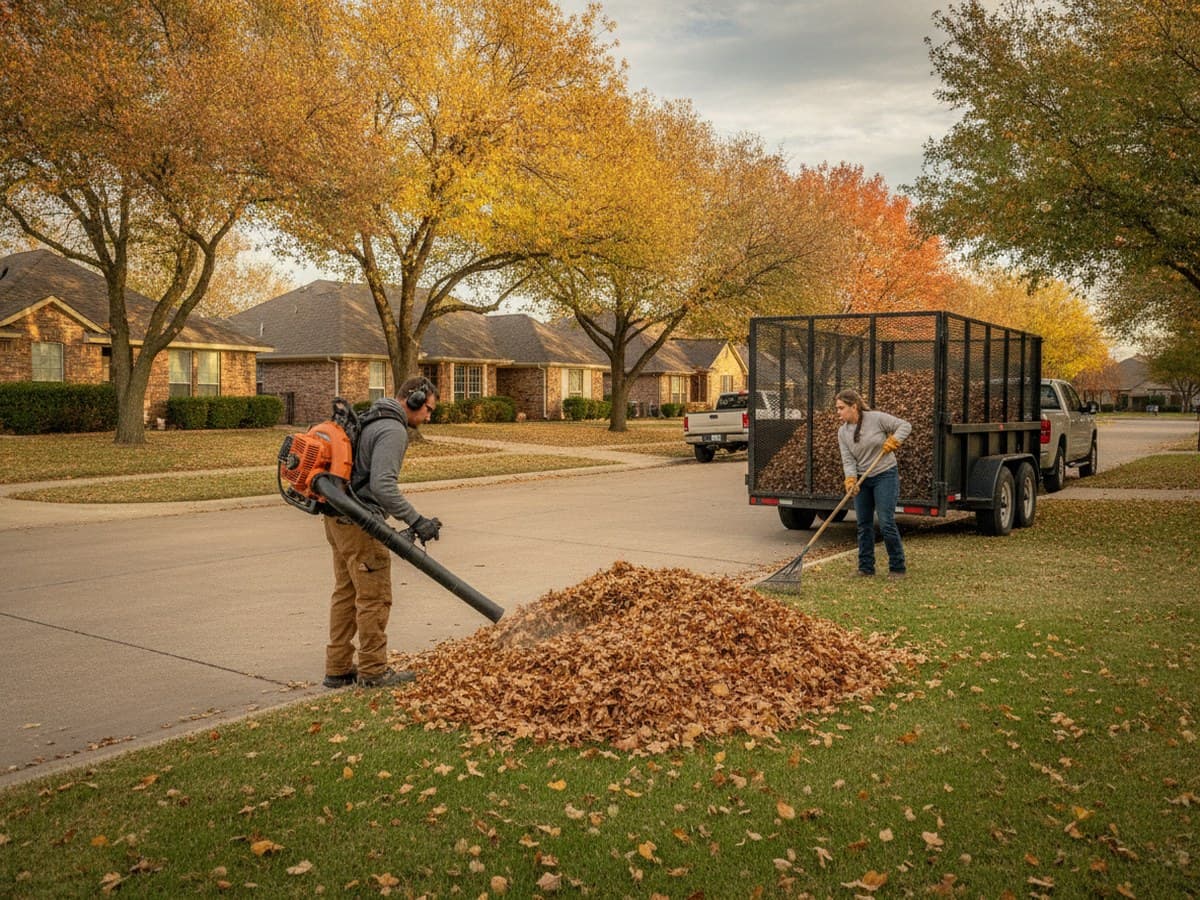
How many leaf cleanup jobs can a crew finish in a day?
Short answer: a two-person crew finishes about 2-4 average residential leaf jobs on a scattered route, and 4-6 when the stops sit on the same few streets. A solo operator with a blower and a trailer usually lands at 1-3 average yards, and maybe 4 small lots if the leaves are dry and the dump run is short.
That spread is not about how hard anyone works. Leaf cleanup is slower than mowing, and the ceiling is almost always hauling - dump runs, bag loads, and the drive between stops - not the minutes spent blowing. Same crew, same trailer, same day length. The map decides the count.
Here is the production math, what kills throughput, and how clustering neighboring homes lifts the number without hiring another body. The pricing companion is what to charge for fall leaf cleanup in Collin County. The homeowner-facing cost post is leaf cleanup cost in Collin County.
Why leaf days look nothing like mow days
Mowing is a short, repeatable stop. A small residential lot is often 20-30 minutes once you count edge and blow-off, which is why a tight mow route can clear 10-15 average homes with a two-person crew. We broke that out in how many lawns a crew can mow in a day.
Leaf cleanup is a different animal:
- Volume, not grass height. A quarter-acre under oaks and pecans can throw several cubic yards of leaves in peak drop. You are moving material, not trimming it.
- Moisture doubles the work. Wet leaves clog blowers, pack into heavier piles, and slow every load into the trailer.
- Disposal is a second job. Bagging to the curb, tarping a dump trailer, and sitting in a landfill queue are billable crew hours that produce no second invoice.
- Beds and fences. Leaves trapped under shrubs and along fence lines eat time that a open-lawn blow never sees.
Industry production-rate tables put spring and fall cleanup in a much slower band than mowing. SynkedUP's contractor benchmarks list seasonal cleanup at roughly 2,000 to 6,000 square feet per man-hour, versus 8,000 to 15,000 for residential mowing. That gap is the whole day.
The production math for a normal residential yard
Use a Collin County-style quarter-acre as the baseline - about 8,000 to 11,000 square feet of turf and beds that actually collect leaves, not the full lot survey number.
At 3,000 sq ft per man-hour (mid-band seasonal cleanup):
| Crew | Man-hours for ~9,000 sq ft | Elapsed time on site |
|---|---|---|
| Solo | ~3.0 | ~3 hours |
| Two-person | ~3.0 | ~1.5 hours |
That is collection and consolidation only - blowing, raking beds, and loading the trailer at the curb. It does not include the dump run.
Published time ranges line up with that math. Operator and guide data for fall leaf removal on a quarter-acre commonly land around 2-5 hours of crew time on site depending on tree cover and whether disposal is on-site or off-site. Small lots with light drop can finish in 1-2 hours. Half-acre wooded lots push 4-7 hours.
So for a two-person crew doing average North Texas yards in peak oak/pecan drop, plan on roughly 1.5 to 3 hours elapsed per home before you count the gate.
An 8-hour day, two routes
Assume an 8-hour paid day for a two-person crew, and 60 minutes reserved for one dump run (drive, gate queue, unload) - the same overhead model we used in the Collin County pricing post.
Scattered route - homes in different subdivisions, 15-25 minutes between stops:
| Block | Time |
|---|---|
| Three average yards at ~2.25 hrs each | 6.75 hrs |
| Drive between stops (3 hops × ~20 min) | ~1.0 hr |
| One dump run | 1.0 hr |
| Total | ~8.75 hrs |
That day overruns. In practice you finish two solid average yards, maybe squeeze a small third if leaves are light and you skip a dump until tomorrow. Call it 2-3 jobs.
Tight route - three to five homes on the same street or adjacent cul-de-sacs, trailer stays parked, short walks between lots:
| Block | Time |
|---|---|
| Five average yards at ~1.75 hrs each (shared setup, less re-park) | 8.75 hrs raw |
| With shared park + one consolidated dump | bring it under 8 hrs for 4 homes, or 5 if drop is light |
The win is not blowing faster. It is:
- One unload for the street instead of re-staging the trailer five times.
- One dump run that actually fills the trailer (three Collin quarter-acres at ~5 cubic yards each fill a 15-cubic-yard leaf trailer - see the pricing post).
- Minutes, not miles, between the next driveway.
Same 8 hours. Same wages. Roughly double the finished jobs when the map cooperates.
What actually moves the number
Ranked by impact for most crews:
- Route density. Neighboring stops beat a faster blower. Drive and re-park time is pure loss - the same lesson as drive time cost for landscaping companies.
- Leaf condition. Dry leaves on a calm day are a different job from wet leaves after a front. Price and schedule for moisture, or your "4-job day" becomes a 2-job day.
- Tree cover and beds. Open Bermuda lots with a few street trees are fast. Mature pecan canopies over beds are slow. Your average is not your worst house.
- Disposal method. Curbside bagging for the homeowner's municipal pickup is a different product than hauling off-site. In Collin County, contractor hauling is usually the real path - and the landfill clock matters.
- Crew size. A third person helps on heavy yards and bed work. It does not cut the dump run or the drive between subdivisions in half. Tightening the route usually adds more finished jobs than adding a body.
How to lift capacity without cutting price
You do not need a cheaper quote. You need more billable yards inside the same payroll day.
- Sell the street, not the pin. When you already have one leaf account on a block, the next two doors are the highest-margin work you will book this fall.
- Batch by dump geography. Sequence the day so the trailer fills before you point it at the gate - especially under a one-ton minimum.
- Separate light passes from heavy pulls. A mid-season blow-and-go for HOA streets is a different SKU from a full haul-away after peak drop. Mixing them on one day wrecks your average.
- Protect the gate window. A crew that finishes Prosper at 4:15 and needs a 4:30 transfer-station close did not "almost" make it. They burned the load into tomorrow.
BlockBundle is built for the first item on that list. You draw the streets you cover and set your rate. Homeowners book their own homes. When neighbors on the same block book leaf cleanup, the work arrives already clustered - several properties, one trip, one park, one dump. You are not discounting to fill the trailer. You are cutting the cost of filling it and keeping the difference.
The provider mechanics are in how providers book whole-street routes. The homeowner pitch for the same street is what home-service bundling is.
We launch in Collin County first - McKinney, Trinity Falls, and the inner-ring DFW towns around them - so the first leaf routes sit on streets a crew can actually keep tight through October and November pecan drop.
About 2-4 average residential yards on a scattered route, and 4-6 when stops sit on the same streets and you consolidate the dump run. Heavy tree cover or wet leaves pull you to the low end.
Plan on roughly 1.5-3 hours elapsed for a two-person crew on a typical quarter-acre in peak drop, before disposal. Small light lots can finish in 1-2 hours. Half-acre wooded lots often run 4-7 hours.
Yes. Seasonal cleanup production rates commonly land around 2,000-6,000 square feet per man-hour, versus 8,000-15,000 for residential mowing. Volume and hauling are the difference.
Cluster the stops. Shared parking, one full trailer, and one dump run beat buying a third blower. Sell the neighboring homes on streets you already serve.
Sources
- SynkedUP - Free Production Rate Calculator for Landscapers (spring/fall cleanup 2,000-6,000 sq ft per man-hour; residential mowing 8,000-15,000): https://synkedup.com/production-rate-calculator-for-landscape-contractors/
- Lawnity - Yard Cleanup Cost 2026 (fall leaf removal 1/4 acre often 3-5 hours on site; small-lot visits 1-2 hours; half-acre 4-7 hours): https://www.lawnity.com/services/yard-cleanup
- LambtonLawn - How Long Does a Fall Yard Clean-Up Take? (2-3 person crew: small lot ~1-1.5 hrs, medium ~2-3 hrs, large ~3-5 hrs; wet leaves and disposal as major slowdowns): https://lambtonlawn.com/blog/how-long-does-a-fall-yard-clean-up-take/
- One and Done Prep - Leaf Removal Cost Guide (two-person crew coverage examples; hourly and flat-rate framing): https://oneanddoneprep.com/leaf-removal-cost-pricing-per-hour/
- BlockBundle companion posts: /blog/what-to-charge-for-leaf-cleanup-collin-county, /blog/leaf-cleanup-cost-collin-county, /blog/how-many-lawns-can-a-crew-mow-per-day