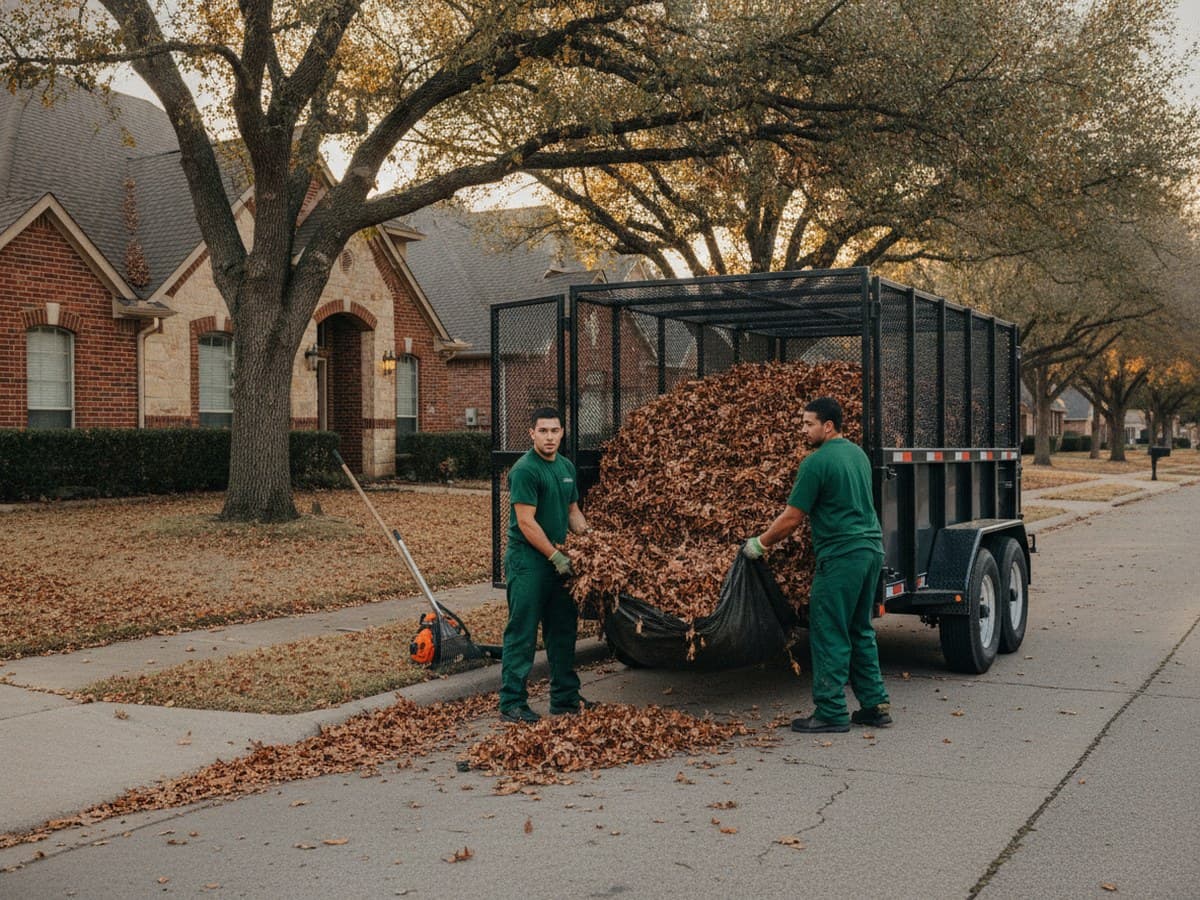
What to charge for fall leaf cleanup in Collin County
The market in this metro will pay roughly $185 to $260 for a quarter-acre leaf cleanup, and $128 to $429 across all home sizes, averaging $275 (Angi, Dallas, 2026 data). Those are the numbers a McKinney or Plano homeowner is comparing your quote against.
Whether that price is a good day or a bad one comes down to a line most fall quotes never break out: what it costs to get the leaves off the property and through a gate. On a scattered route that line alone can be over $100 a home. On three houses in a row it drops to about $46. Same crew, same leaves, same price to the customer.
This is the operator's side of what leaf cleanup costs in Collin County. That post is the number a homeowner should expect. This one is the number you need to clear before you quote it.
Late August is the right week to work this out. Oak and pecan drop here runs October through December, and by the time the first cold front strips the pecans your pricing is already locked into whatever you told people in September.
Where a Collin County crew can actually dump leaves
Start here, because two obvious-looking options are not open to you.
Curbside is out. McKinney does collect yard waste weekly for composting, but the rules are written for residents doing their own yard. Leaves must go in brown paper bags, the cap is 10 bags or bundles total per collection day, and limbs cut by anyone other than the resident are explicitly not eligible. One average quarter-acre leaf load is around 5 cubic yards, which is roughly 34 thirty-gallon paper bags. You would blow the cap by more than three times on a single house, and you would have paid your crew to bag it.
Resident free drop-off is out. NTMWD gives residents of Allen, Frisco, McKinney, Plano, and Richardson two free drop-offs a month, but it requires a matching driver's license and a city water bill dated within 30 days. McKinney's own page adds the part that settles it for contractors: anyone using a dump trailer of any length, a stake bed, or a box truck pays for disposal.
That leaves three real gates:
| Facility | Priced by | Rate | Minimum |
|---|---|---|---|
| 121 Regional Disposal Facility (landfill), Melissa | weight | $52 / ton | 1 ton |
| NTMWD transfer stations (Custer Road, Plano; Lookout Drive, Richardson) | weight | $75 / ton | 1 ton |
| Texas Pure Products, 9901 Custer Road, Plano | volume | $22 / cubic yard | $66 (3 cy) |
Four operational details that cost real money if you learn them at the gate:
- Card or a commercial account, nothing else. NTMWD stopped taking cash and checks in January 2024. A Commercial Solid Waste account carries a $500 monthly minimum, which most small crews should skip in favor of paying at the gate.
- Tarp or you get turned around on the access road before you reach the scale.
- The landfill has a hard stop. Public hours end at 5 p.m. weekdays, and vehicles exiting after 5:30 are charged $100. Transfer stations and Texas Pure close at 4:30. A crew finishing its last Prosper job at 4:15 is not making a 4:30 gate.
- A $25 pull-off fee applies at the landfill if your load gets rejected, and it is non-refundable.
Haul leaves by weight, limbs by volume
The two pricing bases are not interchangeable, and leaves sit at the extreme end of the spread.
The EPA's standard conversion factors put uncompacted leaves at 200 to 250 pounds per cubic yard - lighter than anything else you haul. Grass clippings run 350 to 450. Large limbs and stumps run about 1,080.
Now run the break-even. At $22 per cubic yard, volume pricing only beats the landfill's $52 per ton once your material is denser than 846 pounds per cubic yard, and only beats a $75-per-ton transfer station above 587. Even fully compacted, leaves top out around 450.
One honest exception: Texas Pure is the cities' composting partner, so that material is recycled rather than buried. If "we compost your green waste" is part of how you sell, the premium is a marketing cost you are choosing on purpose. Just choose it on purpose.
What one dump run really costs
The gate fee is the smallest part of a dump run. Here is the rest, using public figures so you can swap in your own.
Assumptions: two-person crew at the BLS/O*NET median of $18.82 per hour each ($37.64/hour in raw wages, before payroll burden); vehicle at the IRS business rate of $0.76 per mile; an 18-mile round trip and 60 minutes of crew time including the gate queue and unload.
| Line | Cost |
|---|---|
| Crew time, 60 min at $37.64/hr | $37.64 |
| Vehicle, 18 mi at $0.76 | $13.68 |
| Run overhead, before the gate | $51.32 |
| Gate, 1-ton minimum at the landfill | $52.00 |
| Total for a partial load | $103.32 |
That is the number to hold onto: a dump run costs you about $100 whether the trailer is full or a third full.
The one-ton minimum is a routing problem
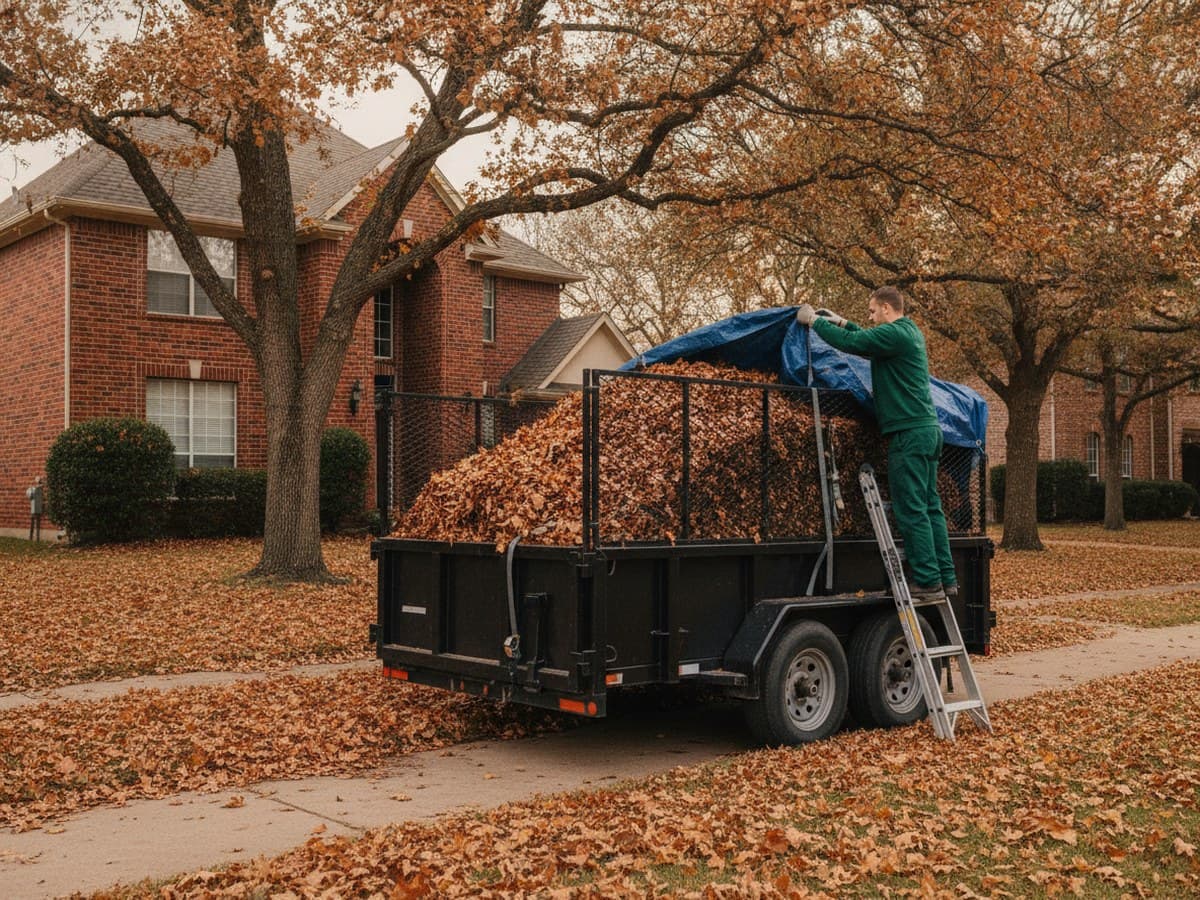
Take a typical Collin quarter-acre in peak drop at 5 cubic yards, and a dump trailer with leaf sides at 15 cubic yards working capacity. Three houses fill it.
| Homes on the load | Leaves | Weight at 225 lb/cy | Gate charge | Plus run overhead | Disposal per home |
|---|---|---|---|---|---|
| 1 | 5 cy | 1,125 lb | $52.00 (minimum) | $103.32 | $103.32 |
| 2 | 10 cy | 2,250 lb | $58.50 | $109.82 | $54.91 |
| 3 | 15 cy | 3,375 lb | $87.75 | $139.07 | $46.36 |
One home's leaves weigh 1,125 pounds. You are charged for 2,000. You already bought the ton - the question is whether you brought one. The other 875 pounds of prepaid capacity is sitting on the lawn two doors down.
Filling that trailer is not an equipment problem or a sales problem. It is a map problem. Three houses on one street fill it before lunch. Three houses in McKinney, Frisco, and Prosper mean you are choosing between a half-empty gate run and hauling the load into tomorrow.
Building the quote: the same job, two maps
Put the four cost buckets together for one quarter-acre house - mobilization, on-property labor, the hop to the next stop, and the disposal share.
On-property labor here is two person-hours (a two-person crew for about an hour). Mobilization is 15 minutes of crew time to unload, stage, tarp, and reload. Inter-job travel uses the same figures as what drive time costs a landscaping company: two minutes and 0.2 miles between neighbors, ten minutes and five miles on a loose route.
| Per home | Dense street | Scattered county |
|---|---|---|
| Mobilization (15 min) | $9.41 | $9.41 |
| On-property labor (2 person-hours) | $37.64 | $37.64 |
| Drive to next stop | $1.41 | $10.07 |
| Disposal share | $46.36 | $103.32 |
| Direct cost | $94.82 | $160.44 |
| At a $220 quote | $125 gross, 57% | $60 gross, 27% |
$220 sits just under the midpoint of Angi's Dallas quarter-acre band, so this is not a premium price. It is the ordinary market price, and the map moved gross margin on it by 30 points.
Two caveats, both of which make the gap wider rather than narrower. These are raw wages, not fully loaded - add your real burden multiplier and the scattered column absorbs more of it, because more of that column is labor. And the disposal share assumes you actually fill the trailer on the dense route; if you do not, you are back at $103.
The P&L version of this is how route density affects landscaping profit margins: labor sits at 50 to 58 percent of revenue at many maintenance shops, and fall is when that ratio gets tested.
Three fall pricing mistakes
Quoting per bag. It ties your revenue to a unit that has nothing to do with your cost structure, and it quietly pays you to use the slowest method on the property. Your cost is crew-hours plus a share of one dump run. Price that.
Charging the same wet as dry. Wet North Texas oak is heavier, slower to move, and slower to load. The Dallas market prices that difference in hourly form - vacuuming runs $45 to $65 an hour versus $20 to $50 for blowing. Either build a wet-weather clause into the quote or give a not-to-exceed number instead of a flat one.
Selling one-offs when the drop lasts eight weeks. Oaks and pecans here fall from October into December, and one visit rarely finishes a canopied lot. Angi's Dallas figures put a one-time sweep at $210 to $880 against a monthly contract at $310 to $930 a year. The contract is better for you too, because visits two and three land on a route you are already driving instead of a fresh mobilization and a fresh dump run.
Where BlockBundle fits
Straight answer first: there is no dedicated leaf-cleanup SKU on the platform today. Lawn and yard care is the live instant-price path, and fall cleanup rides that flow. We are not going to tell you a leaf button exists before it does.
What does exist is the demand side of the map. Homeowners enter an address, we measure the property from parcel data and imagery, and they book individually - no group to organize, no threshold to hit. You register as a provider by drawing the streets you actually cover and setting your rate. When neighboring homes on those streets book, the work shows up already clustered.
We are launching Collin County first - McKinney, Trinity Falls, and the inner-ring DFW towns - specifically so early routes are dense enough to be worth keeping, rather than pins scattered across the metro. We will not quote you a volume or an earnings figure; those have to come from live routes. The product argument in full is how providers book whole-street routes at the price they set.
The arithmetic above stands on its own regardless. Fall disposal is a fixed cost per trip in a business that gets paid per house, and the only lever that reliably moves it is which driveways the leaves came from.
Sources
- Angi - How Much Does Leaf Removal Cost in Dallas, TX? [2026 Data] ($128-$429, average $275; quarter-acre $185-$260; one-time $210-$880; monthly contract $310-$930/yr; vacuuming $45-$65/hr vs blowing $20-$50/hr): https://www.angi.com/articles/how-much-does-leaf-removal-cost/tx/dallas
- North Texas Municipal Water District - Solid Waste Facilities fee schedule (121 RDF landfill $52/ton with one-ton minimum; transfer stations $75/ton with one-ton minimum; $25 pull-off fee; $100 for exiting the landfill after 5:30 p.m.; card-only since Jan 1 2024; Commercial Solid Waste account $500/month minimum; public hours): https://www.ntmwd.com/297/Solid-Waste-Facilities
- Texas Pure Products (City of Plano interlocal green-waste partner, 9901 Custer Road) - commercial tipping fee for tree trimmers, arborists, landscapers, and lawn services: $22 per cubic yard, $66 minimum: https://texaspureproducts.com/160/Yard-Waste-Disposal
- City of McKinney - Residential Trash Services (yard waste limit of 10 bags or bundles; leaves in brown paper bags; limbs cut by anyone other than the resident are not eligible; dump trailers, stake beds, and box trucks must pay for disposal; tarp required; two free resident drop-offs per month with a matching license and 30-day water bill): https://www.mckinneytexas.org/503/Residential-Trash-Services
- U.S. EPA - Standard Volume-to-Weight Conversion Factors (uncompacted leaves 200-250 lb/cubic yard; compacted 300-450; vacuumed 350; grass clippings 350-450; large limbs and stumps ~1,080): https://www.epa.gov/sites/default/files/2016-03/documents/conversions.pdf
- O*NET / BLS - Landscaping and Groundskeeping Workers (37-3011.00), median wage $18.82/hour (2025): https://www.onetonline.org/link/summary/37-3011.00
- IRS - Standard mileage rates (July 1-December 31, 2026 business rate, 76 cents/mile): https://www.irs.gov/tax-professionals/standard-mileage-rates
- Level - 2026 Landscaping Benchmarks (labor 50-58% of revenue at maintenance shops): https://www.levelcfo.com/downloads/level-landscaping-benchmarks-2026.pdf