How much should a lawn care company charge for sprinkler winterization?
Short answer: price a typical residential blowout (up to about 8 zones) at $85 to $120 as an add-on when you are already on that street, and $100 to $145 as a standalone stop. Larger systems usually add $8 to $15 per zone past your included band. Pump-fed systems, multi-controller setups, and backflow removal or insulation sit on separate lines - do not bury them in the base price.
Those bands sit inside what homeowners already see. Angi's 2026 data puts the national average near $93, with most jobs between $56 and $137. Blowout-method work commonly runs $100 to $250. Thumbtack publishes a similar national band around $68 to $239. Posted contractor books in freeze markets often land near $95 to $105 for 1–8 zones, then $4 to $15 per extra zone. Your job is not to undercut that sheet. It is to decide whether this stop is an add-on on a street you already serve, or a scattered drive that has to carry its own compressor tow.
This sits next to what it costs to run a lawn crew per hour and how drive time eats landscaping margin. The same density math that makes leaf and gutter add-ons work applies when the product is air, not bags.
What you are actually selling
Homeowners think they are buying "air in the lines." You are selling:
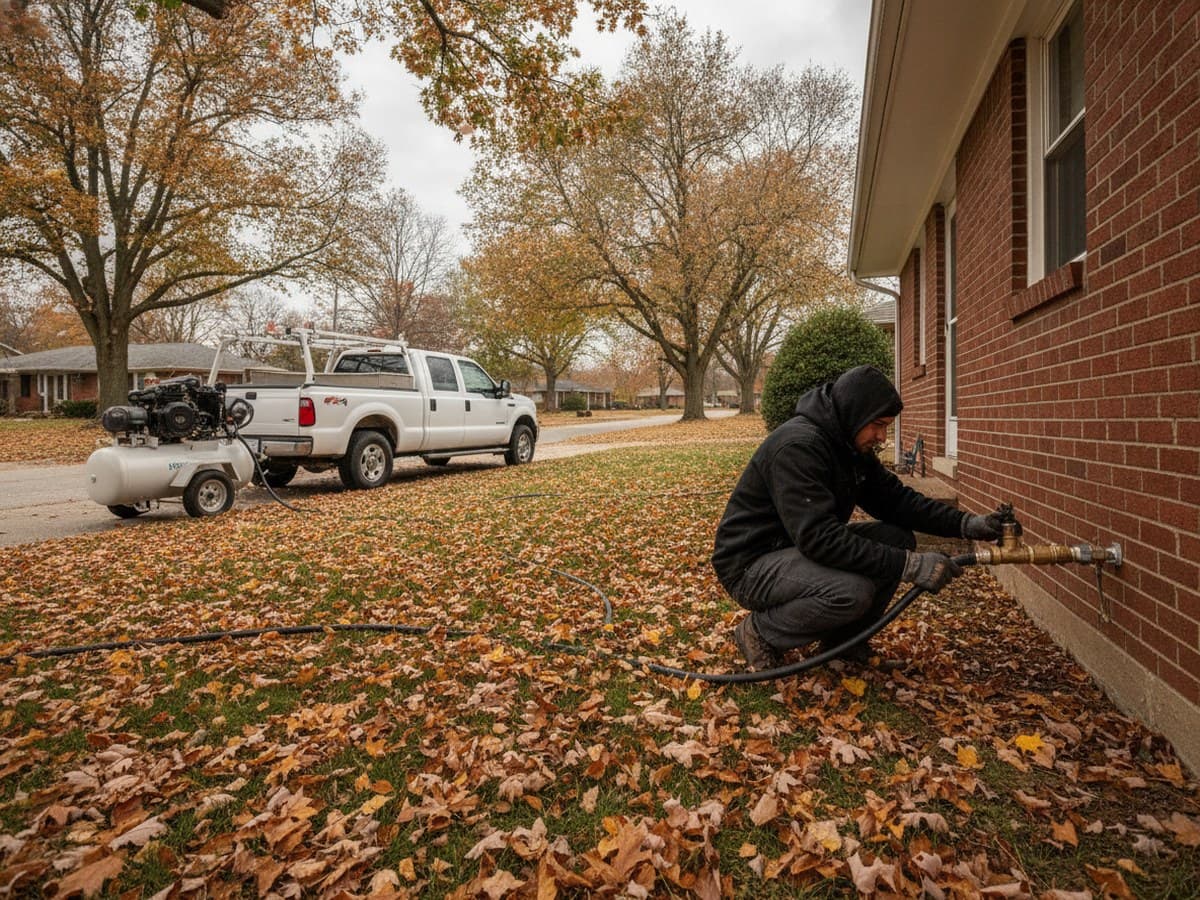
- Compressor capacity and setup. A proper residential blowout needs sustained airflow most garage compressors cannot hold. Towing or staging a professional trailer unit is the fixed cost of the day.
- Zone time. Each zone needs a controlled purge until the heads spit dry mist, not water. More zones means more elapsed minutes, not a free add.
- Backflow and shutdown. Shutting the water, clearing or insulating the backflow, and setting the controller for winter. Exposed backflows freeze before buried laterals do.
- Risk transfer. Incomplete blowouts crack PVC, valves, and heads. Homeowners pay you so they are not the ones guessing compressor PSI.
- The drive and the tow. Getting the compressor to the house, staging, and tearing down. That fixed cost does not care whether the home has 4 zones or 10.
Price the whole stack. If you only quote "per zone minutes," every pump system and every hard-to-reach backflow becomes an argument on the driveway.
A simple price book you can put on the truck
Use a two-column book: standalone (you drove for this job) and add-on (you are already on the street for mowing, leaf cleanup, or gutters). The add-on column is lower because the drive and first park are already paid for - not because the blowout is cheaper to do.
| Job | Standalone | Add-on (already on site / street) |
|---|---|---|
| Up to 4 zones | $95–$120 | $80–$100 |
| 5–8 zones (typical suburban) | $105–$145 | $90–$120 |
| 9–12 zones | $145–$200 | $125–$175 |
| 13+ zones / estate | Quote from $200, or decline | Same |
| Per zone past your included band | +$8–$15 | Same |
| Pump / well-fed system | +$75–$150 | Same |
| Second controller | +$25–$50 | Same |
| Backflow remove / store / reinstall | +$40–$90 | Same |
| Backflow insulation wrap only | +$15–$35 | Same |
| Minimum, any job | $85 | $75 |
Match homeowner bands so you are not racing the bottom. Angi-style 1–4 zones at $60–$100 and 5–6 zones at $100–$130 are the shopping ranges your customers already read. Your add-on column should sit inside those bands. Your standalone column can sit at the top or a notch above when the tow is the product.
Hold price in the peak window (late September through early November in most freeze climates). A 5–10% discount on a fall blowout + spring startup pair billed per visit is enough to lock the calendar without giving the margin away. Spring activation commonly lands around $50 to $150 on its own - price it as a companion line, not a freebie.
Compressor math against a real day cost
A one-tech winterization day with a rented or owned towable compressor is not free labor between mow stops. A working loaded day (tech burden, truck slice, compressor rent or ownership day-rate, fittings) often lands around $375 to $580. Use ~$450 as a planning number.
| Route shape | Stops | Revenue at $100 avg | Contribution after day cost |
|---|---|---|---|
| Scattered (20–30 min between stops) | 6–8 | $600–$800 | Thin; windshield eats the book |
| Tight street / HOA cluster | 10–14 | $1,000–$1,400 | Healthy; compressor stays staged |
A typical 4–8 zone residential blowout runs about 15 to 30 minutes on site once you are staged. The day rate is set by how many times you tear down the compressor, not by how fast you can purge one head. That is the same lesson as how many leaf cleanup jobs a crew finishes in a day: setup sets the ceiling.
If your loaded day cost is higher - hard freeze markets with peak overtime, two-tech crews, or commercial pump work - raise the book. Do not "match the neighbor" quoting $49 citywide. That number usually assumes unpaid labor, a garage compressor that leaves water in the low spots, or a marketing loss-leader that never covers the tow.
Why a dense street changes the number
Winterization rewards clustering harder than most add-ons:
- The compressor stays staged. On a tight block of similar ranches, you roll the hose three doors down instead of packing the trailer between every stop.
- Homes match. Same subdivision, same zone counts, same backflow layout. Your time estimates stop lying.
- One peak window. Everyone books before the first hard freeze. A street you already mow or leaf-clean will say yes in the same two-week band if you offer it in writing.
- Fall pairs with leaf and gutters. The same week homeowners want leaf cleanup, they remember the sprinkler blowout. Selling both on one street fills the day without a new ad campaign - the playbook in how to sell leaf cleanup to lawn customers.
Ten 8-zone add-ons on one cul-de-sac at $100 each is $1,000 of revenue with one compressor park for the morning. Ten standalone stops at $130 with 25 minutes between each of them look better on the invoice and worse on the P&L - you already paid for that pattern in route density and landscaping margins.
Climate note: sell the scope you perform
Not every market needs a full blowout every October.
- Hard-freeze climates (Midwest, Mountain West, Northeast): Buried laterals and above-ground backflows both need a real purge. This is core seasonal revenue.
- Shoulder freeze climates (North Texas / DFW included): Buried lines freeze less often than exposed backflows. Many homeowners still want a professional shutdown, insulation, and controller winter setting - and a cold snap still cracks neglected systems. Price the job you actually perform; do not sell a Colorado-grade fear pitch for a Dallas ranch if the scope is backflow + drain + controller.
- Rare-freeze climates: Winterization may not be a product. Do not force it onto the book.
How to sell it without a second marketing budget
You do not need a new Google Ads campaign to fill a fall blowout book.
- Offer it to every lawn and leaf account you already visit. A text in late September ("sprinkler blowout while we are on your street - $X up to 8 zones") converts warmer than a cold irrigation lead.
- Price the add-on in writing on the leaf or fall quote. Separate line. Separate yes.
- Build the street, not the zip. When one house books a blowout, knock or text the two doors on either side the same afternoon.
- Skip pump systems and commercial pads until you have the adapters, the insurance, and the appetite.
- Mind backflow rules. Some markets require licensed irrigation work for backflow handling. Subcontract or decline when you are not covered.
Cold leads for winterization alone have the same CAC problem as mowing leads - you pay to win a pin that may sit 25 minutes off your cluster. The cheaper customer is the neighbor of someone you already serve. That is the whole pitch in how to get lawn mowing customers from zero and what a new lawn account really costs.
Where BlockBundle fits
The hard part is not connecting a compressor. It is landing several homes on the same street so the add-on column in your price book is the one you actually get to use.
BlockBundle books homeowners on the streets you cover at the rates you set. You draw your service area and publish structured pricing. When neighbors on one block book lawn, leaf, or - as coverage expands - related outdoor work, the stops arrive already clustered. You keep the full add-on margin because the compressor tow was never the product. Homeowners still book one house at a time; they do not have to organize the block for you.
If you already run Collin County or another launch market, register as a provider and put the fall services you can keep tight on the streets you already serve. Density is the margin. The compressor just makes it obvious.
If you already run lawn routes in Collin County, winterization is an add-on on streets you already cover. Homeowners in McKinney can start on the McKinney lawn-care page; Trinity Falls streets should use the Trinity Falls lawn-care page.
As an add-on on a street you already serve, about $90–$120 for a typical 5–8 zone system. As a standalone drive-to job, $105–$145. Match Angi-style homeowner bands around $56–$137 nationally (average near $93) so you are not racing the bottom.
Include a band (often up to 6 or 8 zones) in the base price, then add $8–$15 per zone past that. Estate and 13+ zone systems should be quoted on site or declined until you know the layout.
Yes - modestly. The add-on column exists because mobilization is already paid for, not because the blowout is easier. Keep enough gap that standalone work still covers its own compressor tow.
Full hard-freeze blowouts are less universal in DFW than in the Midwest, but exposed backflows still freeze and homeowners still ask. Sell the scope you actually perform and price that stack honestly.