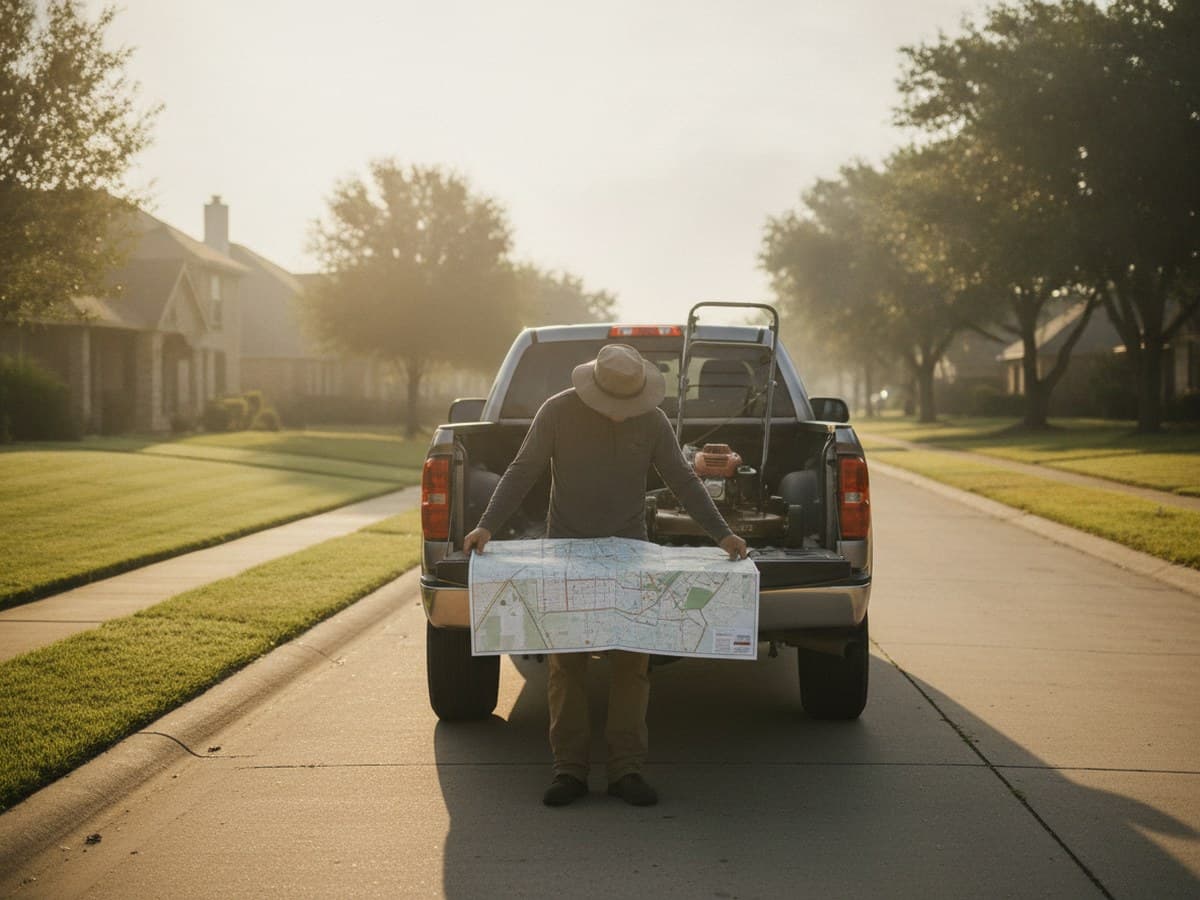
How to get lawn mowing customers when you have none
You already know how to mow. The hard part of starting a lawn care business is not the work - it is finding enough nearby homes that the day is billable.
Most starter advice skips that. It tells you to hang door hangers, post in Facebook groups, buy Angi leads, or cold-call every HOA in the zip. Those tactics can produce some customers. They almost never produce a route.
If you are leaving a crew, running a side hustle with one truck, or starting with zero book of business, the first question is not "how do I get any customer." It is "how do I get customers who sit next to each other."
This post is that cold-start playbook: what kills a one-person day, which channels create scattered pins, and how BlockBundle is built for operators who need clustered work on streets they can actually cover.
The real bottleneck is not demand - it is density
A solo operator can finish a normal residential cut in a tight window once the mower is off the trailer. What eats the day is everything between stops: loading, driving, unloading, and resetting.
Five lawns on the same block is a morning. Five lawns spread across a county is a day with almost no margin left. That is why drive time costs a landscaping company real money even when every stop pays the same quote, and why route density decides profit margins long before your rate card does.
When you have no customers yet, every acquisition channel should be judged on one question:
Does this put the next job next door to the last one - or across town?
If the answer is across town, you are not building a lawn route. You are buying a scrapbook of pins.
Why the usual starter channels scatter your map
Door-knocking and door hangers
Walking a street works when you already own that street. As a cold start it is slow, and the yeses land wherever someone happens to answer. You can spend a Saturday covering two neighborhoods and still end the day with three accounts that do not share a route.
Facebook groups and Nextdoor
Local groups are useful for reputation later. Early on they produce one-off jobs from people who saw your post at different times, in different subdivisions. The map fills in randomly.
Lead marketplaces and paid search
Shared leads and Google Ads can fill a calendar fast - at a price. Public 2025 green-industry benchmarks put lawn care Google Ads leads around $84 each, and a signed account often costs $170-$280 once you account for close rates. We break that math down in lawn care customer acquisition cost.
For a new operator, the bigger problem is location: the lead platform does not care whether the next inquiry is three doors down from your first win or twenty minutes away. You pay for volume. You inherit the scatter.
Referrals from an old crew or friends
Referrals are the cheapest customers you will ever get. They also arrive on the customer's schedule, not yours, and rarely land on the same two streets you are trying to own.
None of these channels are "bad." They are just poor cold-start tools if your constraint is a one-truck day.
What "first customers" should look like on a map
Before you chase more leads, draw the streets you can actually serve from where you park the trailer:
- Pick a tight service footprint. A handful of neighborhoods you can reach without a highway hop, not an entire metro.
- Prefer streets over zips. Zips look big on a flyer. Streets decide whether Tuesday is profitable.
- Say no to the lonely pin. A $60 cut thirty minutes from everything else is not a win when you have empty hours nearby.
- Stack recurring work first. Weekly or biweekly lawns beat one-time cleanups when you are building a route you keep.
That discipline feels slow when you have zero revenue. It is how you avoid becoming the operator who is "busy" and still broke.
How BlockBundle helps you land clustered first customers
BlockBundle is the demand side of a neighborhood. Homeowners enter an address, get a property-specific price, and book without forming a group or waiting on neighbors.
On the provider side, your move is simple:
- Register as a provider.
- Draw the streets you can actually serve - not the whole county.
- Set your $/sqft rate and route cost so the homeowner price is built from your numbers.
- Take work that is already next door to itself on those streets.
You are not buying a shared lead that three other trucks also called. You are covering mapped streets where homeowners can book individually, and the jobs that land are already clustered for routing - the same model we describe in how providers book whole-street routes.
We will not quote you a volume number or promise to fill your week. Launch honesty matters more than hype: BlockBundle is live in Collin County / inner-ring DFW (McKinney and the towns around it) and in the Ohio neighborhoods we actually cover, with open territory still the pitch in places where density is still forming. If your truck is nowhere near those footprints, do not stretch a route to force a fit.
A practical cold-start sequence (first two weeks)
Day 1-2: Draw before you sell. Map the streets within a short drive of where you stage equipment. If a street is a pain to reach with a trailer, leave it out.
Day 3: Set price like a route, not a panic quote. Use a per-square-foot rate you can live with at density, plus a route cost that covers the dead miles you still expect early on. Undercutting everyone in the zip to "get your first five" teaches homeowners a price you cannot keep when the route fills.
Day 4 onward: Put every inbound job on the map. Whether it came from BlockBundle, a neighbor text, or a Facebook reply, plot it. If it sits outside your drawn streets and you already have open capacity inside them, pass.
Keep the compounding channels warm, but secondary. Ask every happy stop for a next-door intro. Post in local groups after you have a street you are trying to thicken - not as your only plan. Use paid leads only if you can gate them to your footprint; otherwise you are renting scatter.
When you want the deeper economics later - what a paid lead really costs, what windshield time is worth, how density moves margin - those posts are already written. This one is only about getting the first clustered customers without lighting money on fire.
What not to do while you are starting
- Do not recruit neighbors for the homeowner. Homeowners book one address at a time. You do not need to organize a street club to get work.
- Do not expand the map to chase every yes. Growth that widens the footprint before it thickens it recreates the scatter problem.
- Do not confuse a full calendar with a good route. Ten scattered cuts can pay less than six on two blocks once you count fuel, trailer time, and wear.
- Do not wait for "the neighborhood to fill" before you draw coverage. Open territory is usable. Fake density promises are not.
Bottom line
Getting lawn mowing customers from zero is a routing problem disguised as a marketing problem.
Door-knocking, social posts, and lead marketplaces can put names on a list. They rarely put those names next to each other. BlockBundle is built for the second outcome: homeowners already booking on streets you choose to cover, at prices you set, so your first customers can become a route instead of a scavenger hunt.
Draw the streets you can serve. Set your rate. Take the clustered work.