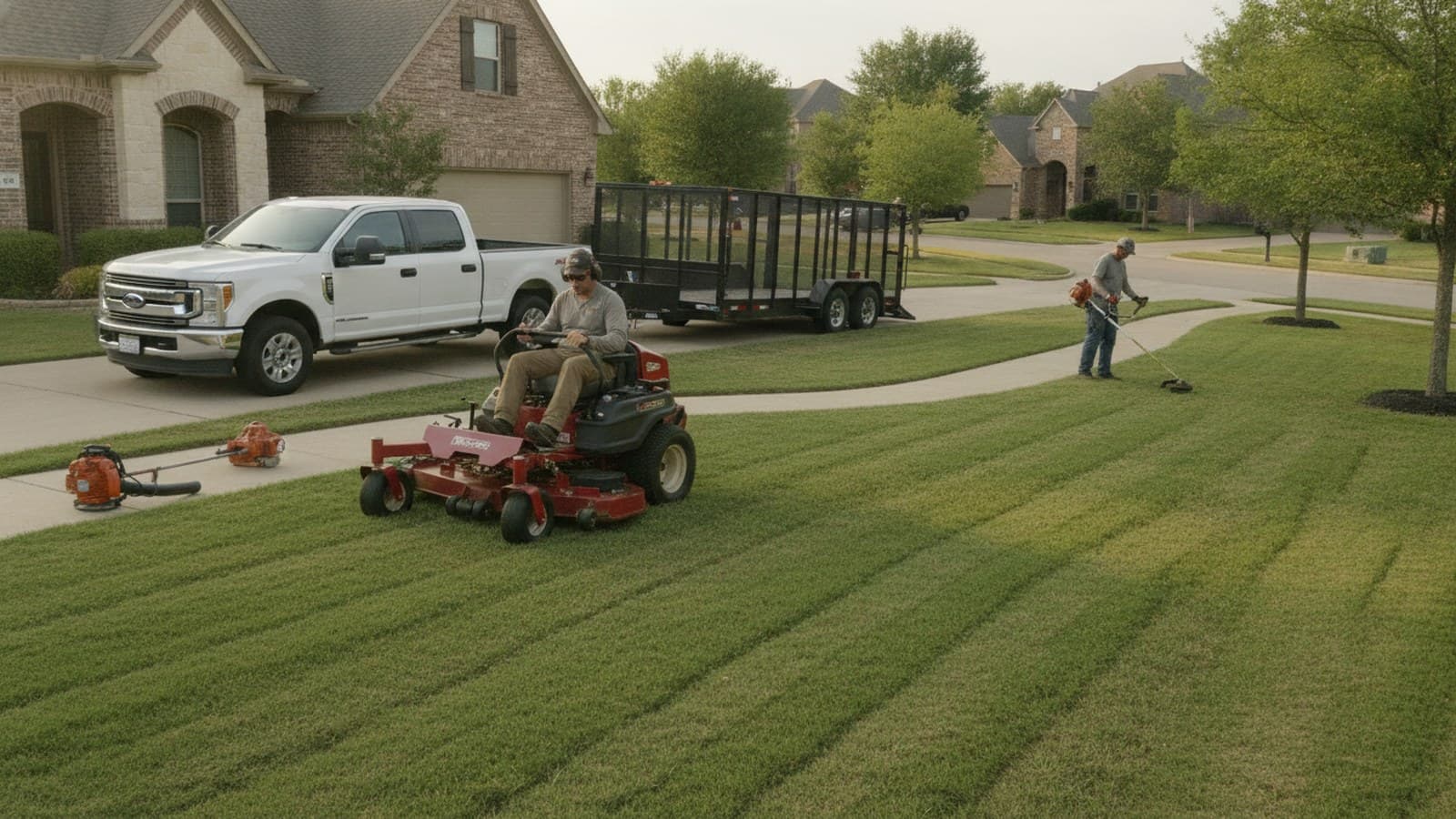
What does it actually cost to run a lawn crew per hour?
Short answer: a two-person mowing crew costs roughly $90-100 an hour to put on the road once you add up loaded labor, equipment, the truck, and overhead. But that is not the number that decides whether you make money.
The number that matters is your cost per billable hour - what each hour of actual mowing costs after you spread all that overhead across a day that is only part billable. And that number is almost always much higher than owners think, because drive time, loading, and dump runs are burning the same money without earning any.
Here is the full stack, worked out, and why tightening your route lowers your true cost floor faster than any price increase.
The four buckets in an hourly crew cost
Every hour your crew is on the clock, four buckets are draining at once.
1. Loaded labor (the big one)
The wage is only the start. The U.S. Bureau of Labor Statistics puts the median wage for landscaping and groundskeeping workers at about $18.82/hour as of May 2025. But you never pay only the wage. Payroll taxes, workers' comp, unemployment insurance, and paid time off make up your labor burden, and in lawn and landscaping that burden typically adds 20-35% or more on top of base pay. A worker you hired at $20/hour actually costs you $24-$27/hour before they touch a mower.
For a two-person crew at roughly $25/hour loaded each, that is ~$50/hour in labor alone.
2. Equipment
A commercial zero-turn is not cheap to run. Once you fold in fuel, maintenance, and depreciation, operators peg a commercial mower at around $7.75-$8.00 an hour. Depreciation by itself is real money: a $15,000 zero-turn run 3,000 hours over its life is $5.00/hour in wear, before a drop of gas. Add trimmers, edgers, and blowers - their own fuel, line, and replacement - and equipment lands near $10/hour for a working crew.
3. The truck and trailer
The rig that moves the crew is a rolling expense: fuel, tires, maintenance, insurance, and depreciation. Operators commonly report truck-and-equipment depreciation alone in the $6-$7/hour range, and a thirsty box truck can burn ~$100 a week in fuel. Bundle in commercial auto insurance and you are realistically at ~$10/hour for the vehicle.
4. Overhead
Everything that keeps the doors open but never rides in the truck: office, admin time, general-liability insurance, software, phone, and marketing. A common way to allocate it is total overhead divided by labor hours worked - and worked examples land around $22/hour of labor. That is the bucket owners most often forget, which is exactly why so many "profitable-looking" crews aren't.
Add it up for a two-person crew:
| Bucket | Cost / crew-hour |
|---|---|
| Loaded labor (2 workers) | ~$50 |
| Equipment (mower + handhelds) | ~$10 |
| Truck + trailer | ~$10 |
| Overhead allocation | ~$22 |
| Total | ~$92/hour |
Round it: about $90-100 to run a two-person crew for one hour. Your local numbers will move - wages in California or Massachusetts run $20-24/hour before burden, and a solo operator's stack is lower - but the shape holds.
Why the sticker cost is the wrong number
Here is the trap. That ~$92/hour is what the crew costs every hour it is on the clock - including the hours it earns nothing.
A crew rarely bills all eight hours. Loading, driving between stops, lunch, and dump runs eat a big share of the day, and drive time alone commonly runs 30-50% of the workday. So the money keeps draining while the mowers sit on the trailer.
Watch what that does to your real cost floor. Take the same $92/hour crew over an 8-hour day - $736 of cost, every day, no matter what.
Scattered route - only 5 of 8 hours are actually billable:
- $736 ÷ 5 billable hours = ~$147 cost per billable hour
Tight route - 6.5 of 8 hours are billable:
- $736 ÷ 6.5 billable hours = ~$113 cost per billable hour
Same crew. Same truck. Same wages. Same $736 spent. But converting 1.5 hours of windshield time into mowing time dropped your true cost per billable hour by ~23% - and every dollar of that drop is margin, because you never raised a price.
That is the whole game for a mowing business. Your billable rate is capped by what the market will pay. Your cost per billable hour is set almost entirely by how tightly your route is packed. We ran the job-count version of this in how many lawns a crew can mow in a day and the pure drive-time math in what it costs a landscaping company to drive between jobs - same lesson from two angles.
Three levers that lower your cost per billable hour
- Sequence by street, not by signup date. Group every day's stops geographically and cut the account that sits 20 minutes off your cluster. It is quietly your least profitable job even at full price - it drags your billable-hour ratio down for every other stop that day.
- Add homes on blocks you already serve. A new customer on a street you already mow is nearly free to serve - the drive is already paid for. That is the density that turns route density into margin, and it is the cheapest customer you will ever add. It also beats buying leads: see what customer acquisition really costs in lawn care.
- Protect billable hours. Fewer, bigger dump runs. Load out the night before. Every non-billable minute you remove spreads that fixed $736 across more mowing.
Where BlockBundle fits
The hardest lever to pull alone is the second one - getting several paying homes on the same street. Door-knocking one block for weeks to land two neighbors is exactly the kind of acquisition cost that eats the density you are trying to build.
BlockBundle flips that. You draw the streets you already cover and set your own per-square-foot rate plus a route cost. Homeowners on those streets book their own homes, and when neighbors on the same block sign up, the work arrives already clustered - several properties, one trip, one park, one unload. You are not discounting to win the street; you are lowering the cost of serving it and keeping the difference. The homeowner-side explanation is in what home-service bundling is.
We launch in Collin County first - McKinney, Trinity Falls, and the inner-ring DFW towns around them - so the first clustered routes sit on streets a crew can keep genuinely tight.
A fully-loaded two-person mowing crew runs roughly $90-100 an hour once you add loaded labor ($50), equipment ($10), truck and trailer ($10), and overhead ($22). A solo operator's stack is lower, and high-wage regions push it higher.
Because the crew costs money every hour it is on the clock, but only bills a fraction of those hours. When 3 of 8 hours go to driving, loading, and dumping, your total daily cost spreads across fewer billable hours - so each mowing hour costs far more than the sticker number.
Tighten the route. Sequence stops by street, drop far-flung accounts, and add homes on blocks you already serve. Converting drive time into billable time can cut your true cost per billable hour 20% or more with no change to wages or prices.
Usually not first. A bigger crew cuts mow time per lawn but not the drive between houses, and it adds labor cost every hour. Tightening the route lifts output and lowers cost per billable hour without new payroll.
Sources
- U.S. Bureau of Labor Statistics - Occupational Employment and Wage Statistics, Landscaping and Groundskeeping Workers (median wage ~$18.82/hr, ~$39,150/yr, May 2025): https://www.bls.gov/oes/current/oes373011.htm
- Service Autopilot - The Real Cost of Labor for Lawn & Landscaping Businesses in 2026 (labor burden adds 20-35%+; a $20/hr worker costs $24-27/hr loaded): https://www.serviceautopilot.com/lawn-care/the-real-cost-of-labor-for-lawn-landscaping-businesses-in-2026/
- SynkedUp - Landscaping Cost per Hour: 2026 Rates + How to Find Yours (overhead allocated per labor hour worked, ~$22/hr worked example; billable man-hour rates): https://synkedup.com/landscaping-cost-per-hour/
- GUS - Zero Turn Mower Running Costs: The Real Numbers (~$7.75-8.00/hr all-in; $15,000 mower over 3,000 hrs = $5.00/hr depreciation): https://gusapp.io/blog/zero-turn-mower-running-costs
- Turf Magazine - Equipment Cost Per Hour, Landscape Maintenance (truck and equipment depreciation ~$6-7/hr): https://turfmagazine.com/equipment-cost-per-hour