How much does sprinkler winterization cost in 2026?
Most homeowners pay about $56 to $137 to professionally winterize a sprinkler system in 2026, with a national average near $93, according to Angi's 2026 cost data (based on thousands of verified projects). Thumbtack publishes a wider national band around $68 to $239. LawnStarter lands most jobs between $59 and $144.
That is the shopping range you will see when you request quotes. What you actually pay depends on zone count, whether the job is a full compressor blowout, and whether the tech is already on your street for lawn or leaf work - or driving across town just for your house.
This guide is the homeowner side of the same economics we cover for crews in how much a lawn care company should charge for sprinkler winterization.
What you are paying for
Homeowners often think of winterization as "air in the lines." The invoice covers more than that:
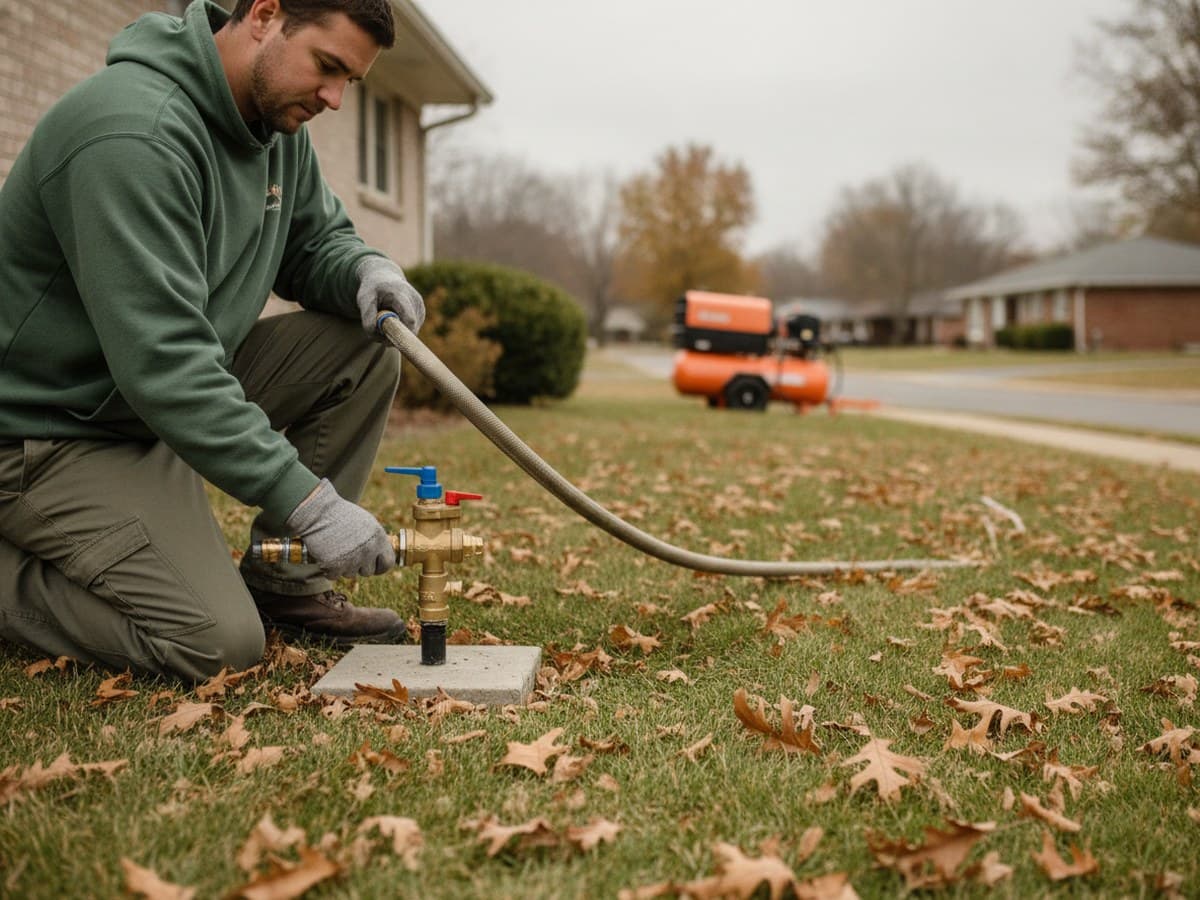
- Compressor and setup. A proper residential blowout needs sustained airflow most garage compressors cannot hold. Staging a professional unit is the fixed cost of the visit.
- Zone time. Each zone is purged until the heads spit dry mist, not water. More zones means more minutes on site.
- Backflow and controller work. Shutting the water, insulating or storing the backflow, and setting the timer for winter. Exposed backflows freeze before buried laterals do.
- The drive. Getting the compressor to your house, staging, and tearing down. That fixed cost does not care whether you have 4 zones or 10.
If a quote only says "per zone" with no mention of mobilization, ask what happens when the tech has to tow the compressor for a single stop.
Cost by system size
Zone count is the number most quotes hinge on. Angi-style bands for 2026 look like this:
| Zones | Typical home | Average cost (2026) |
|---|---|---|
| 1–4 | Small system, one main turf area | $60–$100 |
| 5–6 | Standard suburban yard | $100–$130 |
| 9–12 | Large yard or multiple beds | $150–$250 |
| 13+ | Estate / complex layout | $250+ |
Many books include a base band (often up to 6 or 8 zones), then add roughly $10 to $20 per extra zone. Pump-fed or well systems, second controllers, and backflow remove-and-store work sit on separate lines - expect adders, not a surprise lump on the receipt.
Cost by winterization method
Not every "winterization" visit is the same product:
| Method | Typical cost | What it is |
|---|---|---|
| Manual drain | $75–$150 | Shutoffs and drain valves; water can remain in low spots |
| Automatic drain | $90–$175 | Valves empty when pressure drops; still may need a blowout |
| Blowout (compressor) | $100–$250 | Air forces remaining water out zone by zone |
Blowouts cost more and are the method most freeze-climate pros recommend when you want the lowest chance of cracked PVC, valves, and heads. DIY compressor rental often runs about $30 to $60 per day, but consumer units frequently lack the CFM a full system needs - and over-pressuring heads is an easy way to turn a $90 service into a repair bill.
Climate reality: do you need a full blowout?
Skip the fear pitch if your climate does not match it.
- Hard-freeze climates (Midwest, Mountain West, Northeast): Buried laterals and above-ground backflows both need a real purge before the first hard freeze. Book before peak panic week if you can.
- Shoulder freeze climates (North Texas / DFW included): Buried lines freeze less often than exposed backflows. Many homeowners still want a professional shutdown, insulation, and controller winter setting - a cold snap still cracks neglected systems. Ask the tech what scope they recommend for your layout, not a Colorado sales script pasted onto a Dallas ranch.
- Rare-freeze climates: Full winterization may not be worth buying every year. Follow local irrigation pros, not national averages alone.
Spring activation commonly runs about $50 to $230 on its own. Many companies discount a fall blowout + spring startup pair when you book both in the same conversation.
Why a dense street changes your quote
Winterization has the same structure as gutter cleaning and leaf cleanup: a large fixed cost (tow, stage, tear down) plus minutes on your specific system.
When a crew is already leaf-cleaning or mowing your block, your stop can sit in their add-on column instead of their standalone drive column. That is why a neighbor who books the same week often gets a better number than a scattered one-off across the zip code - not because the blowout got easier, but because the compressor was already paid for.
You do not have to organize a co-op. Book your own house. If two doors down are lining up leaf cleanup the same week, mention it. Dense streets are cheaper to serve, and honest books reflect that. The same bundling logic that applies to a Saturday mow applies when the product is air, not grass.
DIY vs hiring a pro
DIY can make sense if you have a simple system, the right adapters, and a compressor that can hold the flow your manufacturer specifies (often discussed in the 20–50+ CFM range depending on the system - check your manual, do not guess from a blog).
Hire a pro when:
- You have more than a handful of zones, a pump, or a hard-to-reach backflow
- You do not own (or want to rent) a compressor that can actually clear the lines
- A freeze is forecast and you need the job done correctly the first time
- Local rules treat backflow work as licensed irrigation work
The cash cost of DIY is the rental and your Saturday. The risk cost is a cracked lateral or split backflow - usually many times the price of a professional visit.
How to get a fair quote this fall
- Count your zones (or photograph the controller) before you call. Quotes without a zone count are not comparable.
- Ask for method and scope in writing: blowout vs drain-only, backflow insulation vs removal, controller winter setting, and any per-zone adder.
- Book before the first hard freeze, not the morning after. Peak panic weeks fill calendars and raise urgency pricing.
- Ask if leaf or lawn work is already on your street. An add-on stop should sit below a standalone drive-out - same pattern as bundling gutter cleaning with leaf cleanup.
- Compare two written quotes, not two verbal "around a hundred" guesses.
Where BlockBundle fits
Sprinkler winterization is not a live instant-book category on BlockBundle today. Lawn mowing and leaf cleanup are. The density lesson still applies: streets that already share a fall outdoor crew are the streets where winterization add-ons price better, because the provider is not towing a compressor for one address.
If you want that density on your block this season, start with the live path - a measured lawn price or a leaf quote for your address - and tell neighbors who are booking the same week. You book individually. The route gets denser. That is the whole model.
If you already run lawn routes in Collin County, winterization is an add-on on streets you already cover. Homeowners in McKinney can start on the McKinney lawn-care page; Trinity Falls streets should use the Trinity Falls lawn-care page.
Most homeowners pay about $56–$137 in 2026, with a national average near $93 (Angi). A standard 5–6 zone suburban system often lands around $100–$130. Larger systems and full compressor blowouts run higher.
Blowouts commonly run about $100–$250. Manual or automatic drain visits are often cheaper ($75–$175) but may leave water in low spots. Ask which method is in the quote.
Full hard-freeze blowouts are less universal in DFW than in the Midwest, but exposed backflows still freeze and cold snaps still crack neglected systems. Ask a local irrigation pro what scope fits your layout.
Yes, when the same crew is already on your street. Mobilization is a big slice of the bill. An add-on stop while a tech is leaf-cleaning or mowing nearby is usually cheaper than a standalone drive across town.
Spring startup commonly runs about $50–$230. Many companies discount a fall winterization + spring activation pair when you book both together.
Sources (for 2026 cost bands and method guidance):
- Angi - How Much Does It Cost to Winterize a Sprinkler System? [2026 Data] (avg ~$93; typical $56–$137; zone and method tables; spring activation ~$50–$230): https://www.angi.com/articles/how-much-cost-winterize-sprinkler-system.htm
- Thumbtack - 2026 Sprinkler Winterization Cost (~$68–$239 national band): https://www.thumbtack.com/p/sprinkler-winterization-cost
- LawnStarter - How Much Does it Cost to Winterize a Sprinkler System in 2026? (~$59–$144; blowout ~$85–$215; DIY compressor rental ~$30–$60/day): https://www.lawnstarter.com/blog/cost/winterize-sprinkler-system-price/
- BlockBundle - How much should a lawn care company charge for sprinkler winterization, What is home service bundling