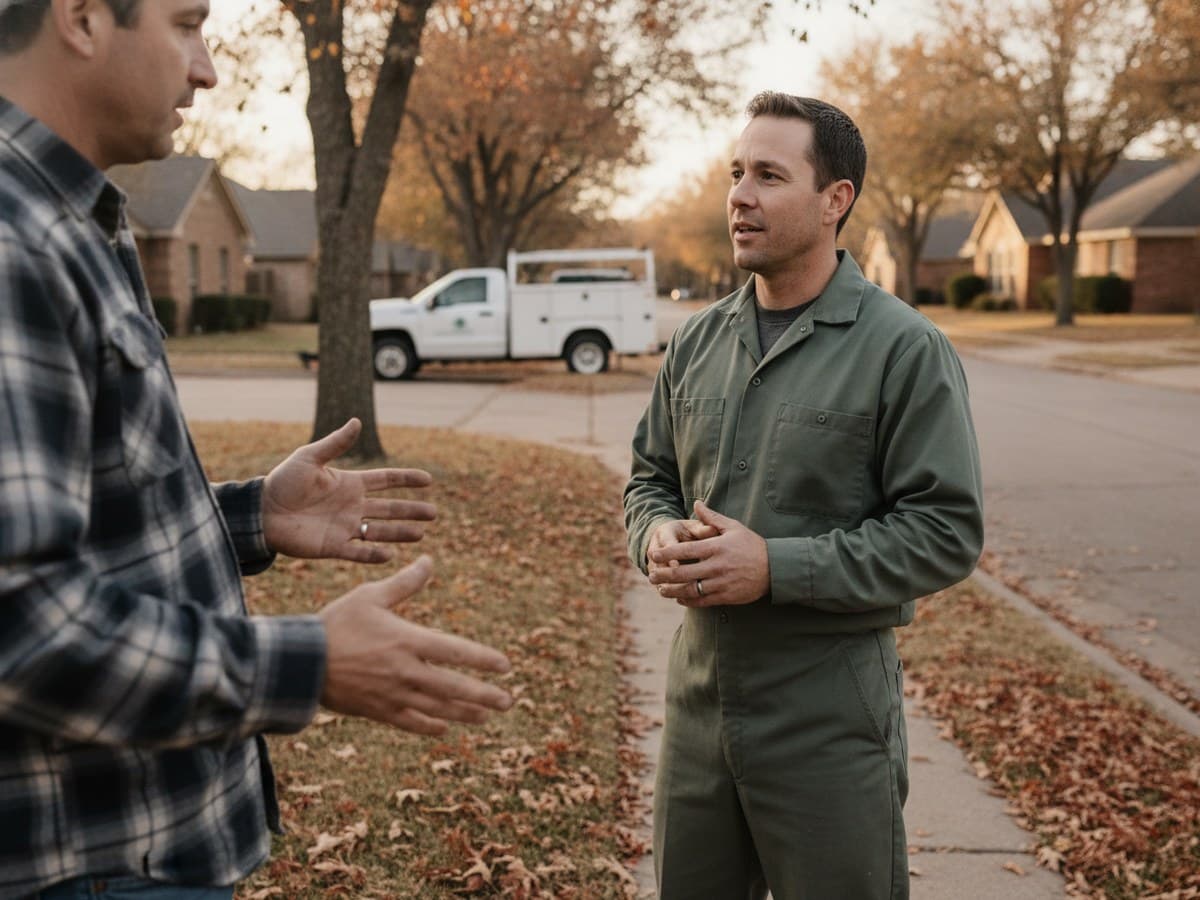
How lawn care companies should keep customers through the off-season
Short answer: treat November through February as a retention and route-locking season, not a quiet season. Sell the winter work your existing mow streets already need, then lock next year's mowing with a clear early-bird or prepay offer before competitors wake up in March. The goal is not busywork. It is keeping the density you already paid to build.
This follows when lawn companies should stop mowing for the season. Homeowners reading the other side of that decision land on when to stop mowing your lawn. If you have not already sold leaf cleanup on the same book, start with how to sell leaf cleanup to lawn customers.
Why "see you in spring" is expensive
Every account that goes quiet after the last cut becomes a spring reacquisition problem:
- New residential lawn accounts often cost tens to low hundreds of dollars in ads, door hangers, drive time, and quote labor before the first paid visit - see lawn care customer acquisition cost.
- A quiet winter is when neighbors try a cheaper truck, a HOA tip, or DIY "just until spring."
- In March you are not only selling mowing. You are re-earning trust on streets you already knew.
Operators treat winter prepay campaigns as a high-leverage cash event for a reason: cash arrives when you need working capital, churn drops because the season is paid, and the route is full before green-up. Typical residential prepay discounts land around 5% to 10%, often stepped down across November–February so early committers get the best deal (Landscape Management on prepaid renewals).
That discount is not a coupon war. It is a trade: you buy cash and a locked route; they buy a known crew and a clearer spring start.
The off-season menu that belongs on streets you already serve
Do not invent a brand-new winter product line from cold Facebook leads. Build a short menu that reuses trust, trucks, and trailer staging on blocks you already mow.
| Offer | Who it fits | Why it keeps density |
|---|---|---|
| Leaf package (2–3 visits) | Oak / pecan streets still dropping | Same trailer fill math as leaf sales to mow customers |
| Gutter clean + leaf same day | Homes with clogged runs after drop | One mobilization; see bundling gutters with leaves |
| Sprinkler blowout | Customers with irrigation | Sell before the hard freeze window; how to sell sprinkler winterization |
| Winter weed / dormant visit | Bermuda yards with henbit, rescuegrass, Poa | Spot control while turf is quiet; keep a reason to roll the street |
| Spring prepay / early-bird mow plan | Every active mow account | Locks March–October density before competitors knock |
In North Texas, winter annuals such as henbit, rescuegrass, and annual bluegrass are a real reason to stay visible. Texas A&M AgriLife's bermudagrass calendar calls for fall preemergent timing when a lawn has a history of winter annual grasses (often mid-August to mid-September), plus winter broadleaf control while plants are small (AgriLife bermudagrass calendar). Stay inside the label and your insurance. The marketing point is simpler: dormant turf still needs a plan, and that plan sells best to people who already know your truck.
Holiday lighting or snow can fill gaps in some markets, but only with real equipment, insurance, and demand. Retention on streets you already mow is not optional.
Run the retention calendar like a campaign, not a hope
A single "we'll call you in March" text is not a campaign. Use a short sequence while the relationship is still warm.
- At the last mow or final leaf visit: hand or text a one-page winter menu + spring renewal. Name the streets you will keep serving so the homeowner hears density, not a pitch deck.
- Early November: first prepay or early-bird offer (often ~10% off the seasonal mow package, with a hard deadline).
- Early December: second touch with a smaller discount (often ~7%).
- January: final touch (~5%) plus a clear "route is filling" note for the weekday you already run that block.
- February: confirm start week, access notes, and any add-ons (first fertilizer, edging restart) so March is execution, not renegotiation.
Write refund and cancellation terms into the agreement before you take money. Prepaid revenue is working capital, not free spend - park it so January payroll does not eat March's mows.
Price renewals against churn, not against your ego
A 5–10% prepay discount looks expensive until you compare it to replacing the account:
- Take last year's off-season churn on comparable residential accounts (no return by May).
- Multiply by contribution margin per season for that account type.
- Keep the prepay discount at or below that expected lost-margin hit.
Example: 15 of 100 similar accounts churned, each leaving ~$800 of contribution - $12,000 of risk. A 7% early-bird on a $1,200 season package costs $84 per locked account. Locking 40 accounts for $3,360 beats rebuying those pins in March with ads and windshield time, especially when drive time and route density are what pay the crew.
Do not discount below the point where the route still covers mobilization. Density saves travel; it does not invent free work.
Thicken the street while you renew it
Every renewal ask is also a neighbor ask. When one house prepays for spring mowing, text the two doors that already got leaf or winterization quotes the same week. Offer the same start window. The win condition is not "100 random renewals." It is three to six houses on the same weekday route before green-up - the same density flywheel that makes clustered mowing and leaf days profitable. Winter is when that map hardens or resets to scatter.
Where BlockBundle fits
Your off-season playbook still depends on landing several homes on the same street without a neighborhood group chat. BlockBundle lets homeowners book one address at a time while work arrives on the streets you cover. You draw your service area and set structured pricing. When neighbors renew or book fall/winter add-ons together, you keep the margin because the product was the route, not a single driveway.
If you run Collin County or another launch market, register as a provider, keep winter add-ons on streets you can hold tight, and let spring density arrive as clustered bookings instead of a March cold-start scramble.
Begin at the last mow or final leaf visit, then run a November–January prepay or early-bird sequence while the relationship is still warm.
Common residential programs use about 5% to 10%, often stepped down across November–February. Cap the discount against your own churn-and-margin math, not a race to the bottom.
Prioritize work on streets you already serve: leaf packages, gutters, sprinkler winterization, and appropriate dormant-season weed visits. Add holiday lighting or snow only if equipment, insurance, and demand are real.
Quiet winters turn paid density into spring CAC. Competitors, DIY, and forgotten relationships show up before your first green-up text.
Yes for many North Texas lawns. Winter annuals germinate in fall and grow through winter. Extension calendars treat identification and timely control as part of bermudagrass management, not optional spring cleanup.
Sources (for 2026 off-season planning):
- Landscape Management - Motivating customers to prepay (5–10% stepped prepay letters; cash-flow and retention benefits): https://www.landscapemanagement.net/motivating-customers-to-prepay/
- Texas A&M AgriLife Extension - Bermudagrass Home Lawn Management Calendar (winter annual weeds; fall preemergent timing; dormant-season irrigation note): https://agrilifeextension.tamu.edu/library/landscaping/bermudagrass-home-lawn-management-calendar/
- AgriLife / turf tips - Winter weed control timing for annual winter weeds in Texas districts: https://agrilifeextension.tamu.edu/wp-content/uploads/2026/03/wintweedcont.pdf
- BlockBundle - When lawn companies should stop mowing, Sell leaf cleanup to lawn customers, Sell sprinkler winterization, Lawn care CAC, Route density and margins