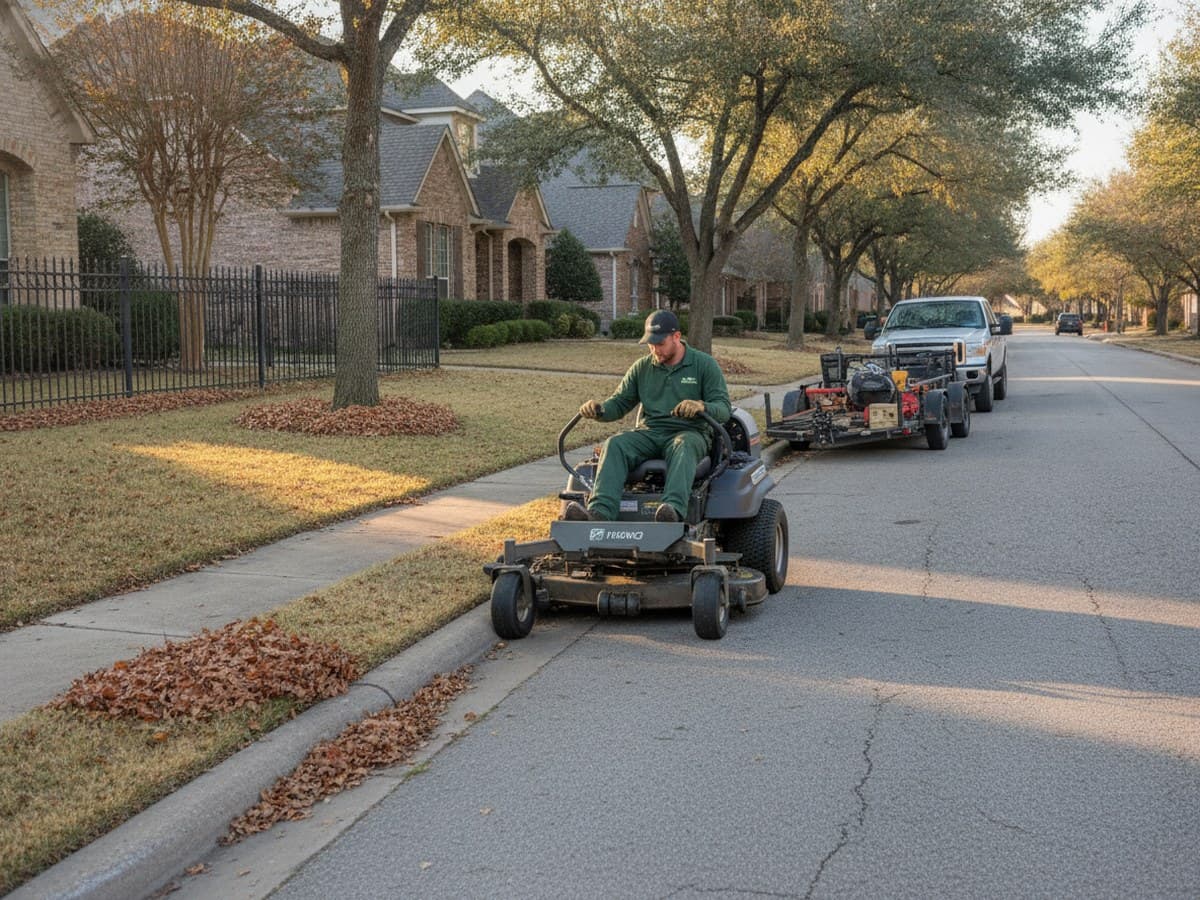
When should a lawn company stop mowing for the season?
Short answer: stop when the grass stops growing, not when your calendar hits a favorite Friday. For warm-season turf (Bermuda, St. Augustine, Zoysia, Buffalo), that means continuing recommended mowing until dormancy, then parking the deck until spring green-up - unless the account is overseeded with rye. In North Texas / DFW, most Bermuda routes slow hard in late October and are largely dormant by mid-to-late November, around the area's average first freeze near November 22 (NWS Fort Worth DFW freeze record). Treat that as a planning anchor, not a hard kill switch.
This is the operator companion to weekly vs. biweekly lawn mowing. Homeowners shopping the same question will get the grass-side framing; you need the route-side framing: when to drop frequency, how to price the last visits, and how to keep the truck on streets you already own while leaf and winterization add-ons fill the gap.
Watch the turf, not a single calendar date
Warm-season grass does not punch a time clock. Extension guidance is consistent on the stop rule:
- Texas A&M AgriLife (bermudagrass calendar): keep normal mowing practices until the grass goes dormant and no longer needs cutting. Overseeded lawns stay on a winter mow schedule instead (AgriLife bermudagrass calendar).
- Collin County Master Gardeners: keep the one-third rule and hold height at the upper end of the recommended range until the lawn signals dormancy (CCMGA fall turf note).
- Soil temperature cue for Bermuda color loss: when soil near 4 inches drops under about 55°F, chlorophyll production struggles and green color fades; freezing air finishes leaf tissue browning over following days (Pennington bermudagrass fall color note).
Practical crew translation:
| Signal on the property | What to do on the route |
|---|---|
| Still pushing weekly growth after rain | Keep weekly; do not jump to "winter rate" early |
| Growth slows to a push every 10-14 days | Move the account to biweekly (same logic as weekly vs biweekly) |
| Uniform straw / tan, no measurable growth | Last tidy visit, then pause mowing until spring |
| Rye overseed stays green | Keep mowing; that is a different product |
Do not invent a company-wide "last mow week of October" rule for DFW Bermuda. The NWS DFW freeze history shows first freezes from late October into early January across the record. An average of November 22 is useful for staffing; a single pinned date will leave some lawns too tall and others cut after they already stopped growing.
North Texas / DFW: a usable season window
Local operators and extension-adjacent writeups converge on a workable DFW pattern:
- Early-mid October: growth slows. Frequency drops from weekly toward every 10-14 days on many Bermuda routes.
- Late October - mid November: color shifts yellow-tan; shaded and low spots brown first. Plan last regular visits street by street.
- Around the average first freeze (~Nov 22): most non-overseeded Bermuda is dormant or nearly there. Deep dormancy runs roughly December through February in a typical year.
- Warm snaps after dormancy: optional cleanup passes only if growth actually resumes; do not charge a full summer mow for a cosmetic pass on straw.
That window also lines up with when to schedule leaf cleanup in North Texas and the back half of sprinkler winterization timing. Your densest October-November blocks should already be booked for leaves and freeze prep - not for chasing one last cold mow across town.
Final-cut height and what "last mow" should include
Industry guidance mostly agrees on raising cut height toward the top of the species range as growth slows, not scalping into dormancy:
- Bermuda home lawns commonly sit near 1-2 inches; hold toward the upper end heading into winter (AgriLife, STMA warm-season fall calendar).
- St. Augustine usually wants a taller band (often about 2.5-3 inches in North Texas recommendations).
- Never remove more than one-third of the blade on any visit - including the last one.
Some local crews intentionally cut a touch shorter on a bagging "final" pass to pull leaf litter and thatch before dormancy. That is a leaf-management choice, not a universal turf rule. If you do it, say so in the scope ("final fall cut + bag"), charge for bagging time, and stay inside the one-third rule. Do not scalp dormant crowns - dormant tissue tears instead of cuts cleanly.
A clean last-mow SOP for the file:
- Confirm growth is still present (or call it a leaf/edge tidy, not a mow).
- Raise deck to the upper recommended height for that grass.
- Edge hardscape once; do not invent summer-detailing hours on a dying growth curve.
- Blow hard surfaces; bag only if the contract pays for it.
- Note the stop date in the account so spring restart is not a surprise invoice fight.
How to price the wind-down without torching winter cash flow
Fall is when scattered routes get expensive. Growth slows, drive time does not. Use the same drive-time cost and route-density margin math you use in peak season:
- Keep dense streets on the truck. A biweekly last month on a full cul-de-sac still beats a weekly pin across two zip codes.
- Convert thinning mow revenue into add-ons on the same map. Leaf cleanup, gutter cleaning, and sprinkler winterization live on the same October-December calendar. See selling leaf cleanup to lawn customers and selling sprinkler winterization to lawn customers.
- Publish a pause policy. "We pause mowing when your lawn is dormant; spring restart is automatic unless you cancel" beats ghosting accounts in December and re-selling them in March (CAC reality check).
- Do not discount the last three visits "because it's slow." Slow growth is exactly when windshield time dominates unit cost. Hold price or raise the minimum stop fee; fill the day with clustered add-ons instead.
Example day design for a Collin County crew in early November:
| Block | Work | Why it pays |
|---|---|---|
| 08:00-10:30 | 6 biweekly last-mows on one street | One stage-in, short hops |
| 10:30-13:00 | Leaf cleanup on 3 of those same homes | Compressor/blower already on the block |
| 13:30-16:00 | Winterization quotes / booked blowouts two streets over | Same trailer; no new cold lead |
That is serving a whole street applied to the season wind-down.
Cool-season and overseeded accounts (do not use the Bermuda stop rule)
If you run fescue, bluegrass, or rye overseed routes, dormancy timing and mow frequency are different. Overseeded warm-season lawns often need winter cuts while the rye is active; AgriLife treats that as a separate winter product, not a paused Bermuda account. Label those properties in your schedule software now, or a green rye lawn will get wrongly paused in November and you will own the callback.
National crews that also run Midwest cool-season books should keep those routes going until growth truly stops for that species - often much earlier frost calendars than DFW. Do not paste a Collin County pause date onto an Ohio bluegrass route.
Where BlockBundle fits
BlockBundle's job for providers is not "one more lead in December." It is dense fall stops on streets you can finish in one stage-in: last mows, leaf cleanup, and related outdoor work booked as neighboring homes, not as a scavenger hunt.
If your November calendar is full of single pins, the season wind-down will feel like a margin cliff even when list price looks fine. Prefer clustered homeowner demand on maps you already know. Collin County homeowners who book McKinney lawn care on a shared route or land on the Trinity Falls lawn care page are the demand side of those dense fall streets, and the price bands they see are in McKinney lawn mowing cost ranges. Register as a provider, set coverage and structured pricing, and take the routes where several nearby homes already want service in the same window.
Stop when warm-season turf is dormant and no longer growing - not on a single company-wide calendar date. In DFW, that usually lands from late October through mid-to-late November, around the average first freeze near November 22.
Raise toward the upper end of the recommended height for that grass and keep the one-third rule. Bagging a slightly cleaner final pass for leaves is optional and should be scoped and priced separately - do not scalp dormant crowns.
Move them to biweekly while growth still appears every 10-14 days, then pause at dormancy. Keep dense streets; do not chase weekly frequency across town when the grass is barely moving.
No. Rye or other cool-season overseed usually needs winter mowing. Tag those accounts separately so they are not paused with Bermuda routes.
Sell leaf cleanup, gutter cleaning, and sprinkler winterization on streets you already mow. Clustered add-ons beat cold December leads on windshield cost.
Sources (for 2026 season guidance):
- Texas A&M AgriLife Extension - Bermudagrass Home Lawn Management Calendar (mow until dormant; overseed exception): https://agrilifeextension.tamu.edu/library/landscaping/bermudagrass-home-lawn-management-calendar/
- Collin County Master Gardeners Association - Turf Talk: Preparing Your Lawn for Fall (one-third rule; upper height range until dormancy): https://ccmgatx.org/resources/articles/article-repository/2024/september/turf-talk-preparing-your-lawn-for-fall/
- National Weather Service Fort Worth - DFW earliest/latest freezes (average first freeze Nov 22): https://www.weather.gov/fwd/d32dates
- Pennington - Fall Color Retention in Bermudagrass (~55°F soil color cue): https://www.pennington.com/all-products/grass-seed/resources/fall-color-retention-in-bermudagrass
- STMA - Fall Athletic Field Maintenance Calendar for Warm-Season Turf (raise height; 1/3 rule): http://www.stma.org/sites/stma/files/STMA_Bulletins/Fall_Warm_Maint_Calendar_Final.pdf
- BlockBundle - Weekly vs biweekly lawn mowing, Sell leaf cleanup to lawn customers, Sell sprinkler winterization to lawn customers, Landscaping route density and profit margins, McKinney lawn care, Trinity Falls lawn care, McKinney lawn mowing cost