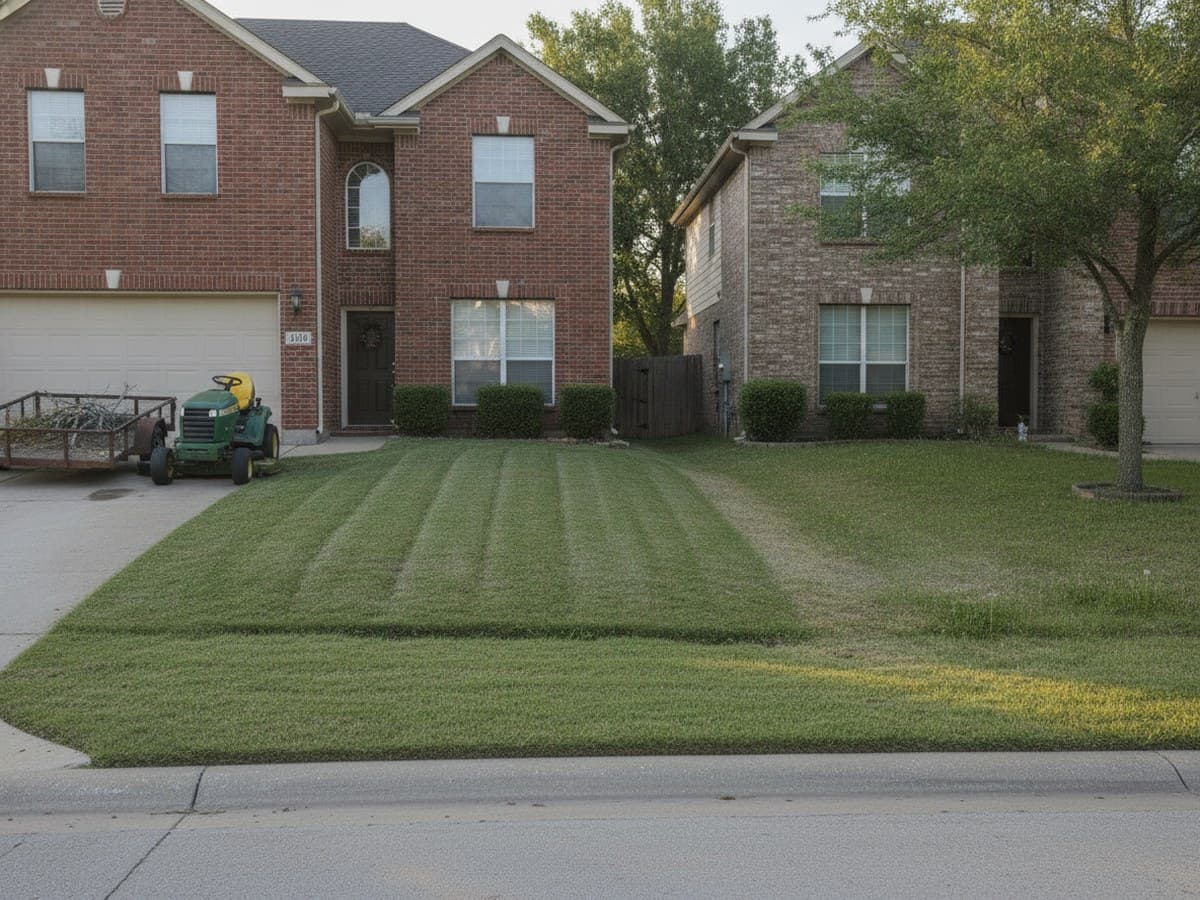
Weekly vs. biweekly lawn mowing: which is better?
Short answer: weekly is better for the grass during the growing season. Biweekly is cheaper for the season because you buy half as many visits, not because each visit is a bargain.
That is the whole trade. The per-visit price barely moves. LawnStarter's 2026 customer data puts a typical weekly mow at $53.55 and a typical biweekly mow at $54.31 - about $1 more per visit to wait two weeks. Over a 26-week North Texas mowing season, weekly is 26 × $53.55 ≈ $1,392. Biweekly is 13 × $54.31 ≈ $706. You are not saving on the cut. You are buying half as many of them.
Whether that is a good deal depends on what is growing in your yard, how fast it is growing this month, and whether a crew already has a route on your street. Here is how to decide.
The rule that actually decides frequency
Forget the calendar for a minute. Extension turf programs use one rule: never remove more than one-third of the leaf blade in a single mow.
Texas A&M AgriLife's example is blunt. If you keep Bermuda at 1 inch, you need to cut it again as soon as it hits 1.5 inches. If you keep St. Augustine at 3 inches, you mow when it reaches about 4 to 4.5 inches. Frequency is a growth-rate question, not a preference.
That is why "every other week" fails in June and works in November. The same lawn, same crew, same height setting. The grass just grows at a different speed.
Warm-season grasses in North Texas - Bermuda and St. Augustine, the two you actually see in McKinney, Plano, Frisco, Allen, and Prosper - grow fastest in the heat. AgriLife tells homeowners to mow common Bermuda weekly during the growing season, and AggieTurf lists St. Augustine as a weekly rotary-mow at 2.5 to 3.5 inches. In peak summer, Bermuda can need a cut every 3 to 5 days if you hold it low. UF/IFAS puts St. Augustine on a 5- to 14-day window depending on growth.
Cool-season lawns (tall fescue, Kentucky bluegrass) invert the calendar. They need weekly cuts in spring and fall, then slow down in summer heat. If you are not in a warm-season market, use the one-third rule and ignore the Texas months below.
What weekly actually buys you
A weekly visit is a small, predictable job: a light cut, an edge, a blow-off. The crew does not fight a hayfield. You do not get a "long grass" surcharge. The lawn stays dense enough to shade the soil and crowd out weeds.
That last part is the health argument, not curb appeal. Scalping - taking too much leaf at once - is what happens when you skip a week in a growth spurt and then ask the crew to "catch it up." AgriLife's warm-season mowing guide is explicit: infrequent mowing is what produces scalping, and scalping is injury. If the lawn did get away from you, drop the height over two or three visits instead of one.
Weekly also matches how HOA streets in Collin County actually get judged. A missed week on a Stonebridge Ranch or Trinity Falls front yard is public. That is not a BlockBundle pitch. It is why so many of those streets already sit on a Thursday route.
What biweekly actually buys you
Biweekly is the most common schedule LawnStarter reports - about 75% of their mowing customers. It is a rational budget choice when growth has slowed, when you have a taller St. Augustine that can absorb a few extra days, or when you are between peak weeks.
The catch is rain. Two dry weeks in October can look fine. Two wet weeks in May can put the lawn over 9 inches, which is where many companies add a long-grass fee. LawnStarter's own write-up is clear: weekly is $1 to $4 cheaper per visit, and biweekly is where those overgrowth fees show up.
Treat monthly as a dormant-season or "I just need the weeds knocked down" option, not a growing-season plan. The per-visit price is similar (about $56 in that same LawnStarter set) and the lawn is usually a cleanup job by the time the truck arrives.
A North Texas calendar, not a national one
Use this as a starting point for Bermuda and St. Augustine in Collin County. Adjust for rainfall, irrigation, and fertilizer. More nitrogen means more mowing, which is also AgriLife's point: do not fertilize a lawn you plan to mow less often.
| Window | Typical growth | Sensible schedule |
|---|---|---|
| Late spring through early fall | Fast. Heat plus irrigation. | Weekly. Bermuda may want two cuts some weeks if you hold it short. |
| Mid-to-late fall (now into November) | Slowing as nights cool. | Weekly until growth visibly drops, then biweekly. Mid-September is usually still weekly here. |
| Winter dormant brown | Almost none. | Skip, or one cleanup cut if seedheads or weeds get ahead of you. |
If you have been paying for weekly all summer and the lawn is barely moving, dropping to biweekly is the right call. Doing it in June to "save money" is how you buy a scalp, a weed flush, and a more expensive catch-up visit.
For what a McKinney visit actually costs, see lawn mowing cost in McKinney. If you want to sanity-check a bid against turf size, use what lawn care costs per square foot in North Texas.
Why the per-visit price barely changes
A biweekly stop is a longer job: taller grass, more clippings, more trimmer work, more chance the mower leaves ridges. The crew prices that extra time. That is why the national averages sit within a dollar of each other.
The other half of the bill does not care about your calendar at all: drive and setup. Getting the trailer to your street, unloading, and packing up again is a fixed cost. We break that stack down for operators in what it costs to run a lawn crew per hour and what drive time costs a landscaping company. From the homeowner side, it is why a small yard still hits a visit minimum.
This is also where a dense street changes the math. If four neighbors are already on a weekly Thursday route, adding your house as a fifth weekly stop is a driveway roll, not a new trip. The crew would rather have you weekly on that street than biweekly as a one-off across town. That is how home-service bundling works: you book your own home; nearby homes on the same service make the route cheaper to run.
You do not have to recruit the block. Enter an address, get a measured lawn price, and book. As more of the street joins, the shared trip cost can fall. Run your own numbers in the lawn-care savings calculator.
How to choose this month
- Look at last week's growth, not last year's invoice. If the lawn grew more than a third of its height in seven days, weekly is the answer.
- Match the grass. Bermuda wants weekly in the heat. Taller St. Augustine can stretch toward 10-14 days when it slows. Cool-season turf wants weekly in fall, not in July.
- Do not use biweekly as a discount code. The visit is not cheaper in any meaningful way. You are buying fewer visits, with more risk of a long-grass fee.
- Prefer the schedule the street already runs. A crew that is already on your cul-de-sac every Thursday will price that weekly stop more sanely than a scattered every-other-week hop.
If you are in Collin County, start from your city page and get a property-specific price: McKinney, Trinity Falls, Plano, Frisco, Allen, or Prosper.
Sources:
- LawnStarter - Weekly vs. Biweekly Mowing (Apr 28, 2026; weekly avg $53.55 / 444k jobs; biweekly avg $54.31 / 1.59M jobs; ~75% of customers on biweekly; $1-$4 per-visit gap; long-grass fee above 9 inches): https://www.lawnstarter.com/blog/lawnstarter/weekly-vs-biweekly-mowing/
- LawnStarter - How Much Does Lawn Mowing Cost in 2026 ($43-$70 typical visit): https://www.lawnstarter.com/blog/cost/lawn-mowing-price/
- Texas A&M AgriLife - Bermudagrass Home Lawn Management Calendar (1-2 inch home-lawn height; weekly in the growing season; one-third rule): https://agrilifeextension.tamu.edu/library/landscaping/bermudagrass-home-lawn-management-calendar/
- Texas A&M AgriLife / AggieTurf - Mowing Recommendations for Warm-Season Turfgrasses (one-third rule; summer mowing sometimes twice per week to avoid scalping): https://mytexas.ag.tamu.edu/publications/mowing-recommendations-for-warm-season-turfgrasses/
- AggieTurf - St. Augustinegrass (mow weekly at 2.5-3.5 inches): https://aggieturf.tamu.edu/texas-turfgrasses/st-augustinegrass/
- UF/IFAS Gardening Solutions - Mowing Your Florida Lawn (Bermuda 3-5 days; St. Augustine 5-14 days; one-third rule): https://gardeningsolutions.ifas.ufl.edu/lawns/maintenance-and-care/mowing-your-florida-lawn/