When should you winterize your sprinkler system?
Short answer: finish winterization 1 to 2 weeks before your area's first hard freeze - overnight lows around 28°F for several hours, not the first light frost at 32°F. Use the forecast, not a single calendar date. In hard-freeze climates that usually means finishing in October. In North Texas / DFW, the median first 28°F night lands near December 12, so a practical book-by window is late November into early December - earlier if a cold snap shows up in the 10-day outlook.
What the visit costs is in how much sprinkler winterization costs. This post is only about when.
The 28°F rule (and why 32°F is not enough)
Irrigation damage is a temperature problem, not a "first day of fall" problem.
- Light freeze (~32°F): Ice on grass and windshields. Buried laterals usually survive a brief dip. This is your cue to book, not always the night the brass cracks.
- Hard freeze (~28°F for several hours): Standing water in shallow lines and above-ground parts can freeze hard enough to split fittings. The Farmers' Almanac hard-freeze guide and most irrigation pros treat this as the real deadline.
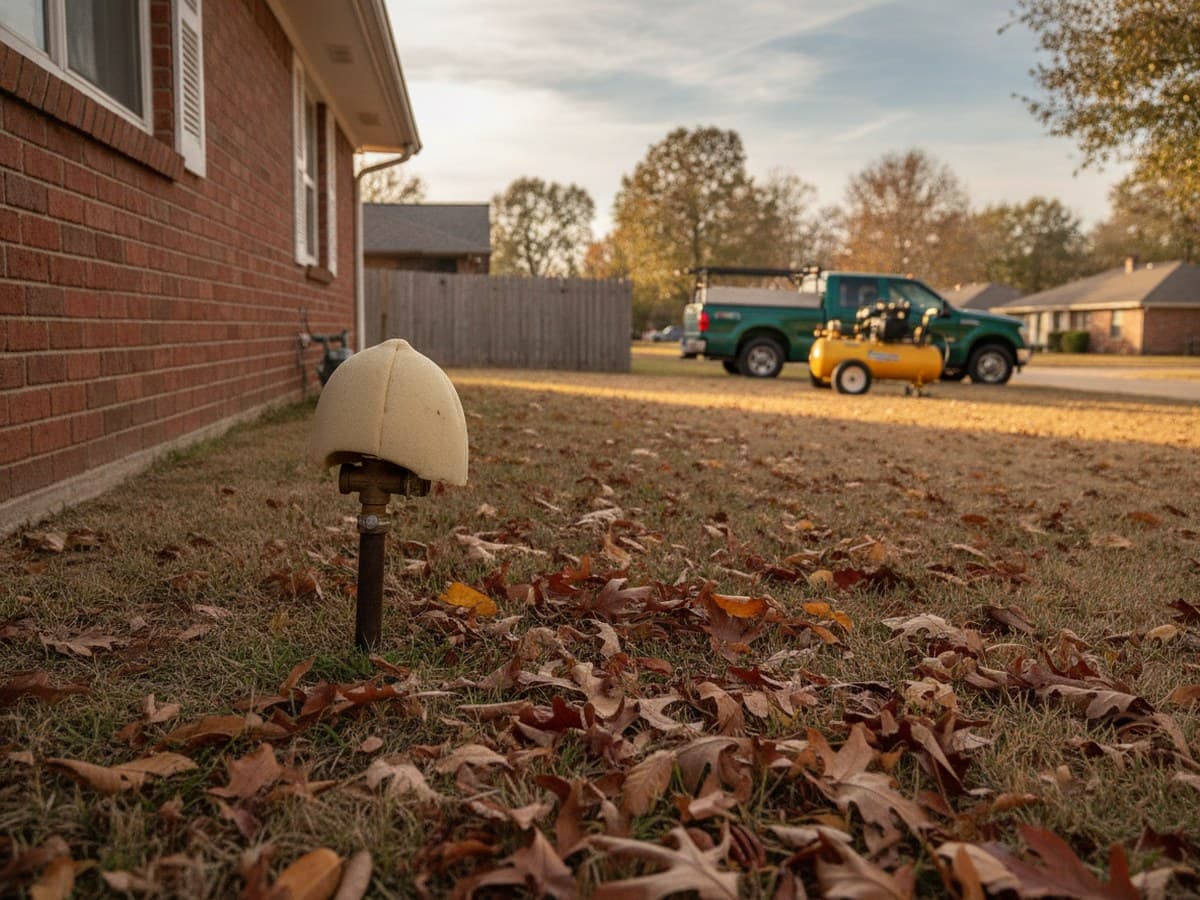
- What fails first: The exposed backflow preventer. It sits above grade, holds water, and is expensive to replace - often hundreds to well over a thousand dollars once ice splits the body. Buried mains freeze slower; the brass on the side of the house does not wait for them.
A useful national rule of thumb (see TurfRain's timing guide and similar industry writeups): when overnight lows live in the mid-30s and a 28°F night is in the forecast, that is go-time. Finish before that night, not the morning after.
Timing by climate, not vibes
| Climate | Typical first hard freeze | Practical winterize window | Method most yards need |
|---|---|---|---|
| Cold (Midwest, Mountain West, Northeast) | Late Sep – mid Oct | Finish 1–2 weeks before that window | Full compressor blowout |
| Transition (Upper South, Ozarks, OK) | Mid Oct – early Nov | Book in October; watch early snaps | Blowout or thorough drain |
| Mild / shoulder freeze (North Texas, much of GA/Carolinas low country) | Late Nov – mid Dec, or only on cold snaps | Book before the forecasted 28°F night; DFW median near Dec 12 | Insulate + shutoff at minimum; many still want a pro blowout for peace of mind |
| Rare-freeze coast / deep South | May not hit 28°F every year | Standby: drain/insulate 24–48 hours before a warned hard freeze | Partial drain + insulation; full blowout optional |
Do not paste a Colorado October deadline onto a McKinney ranch house. Do not wait until January in Minneapolis either.
North Texas / DFW: the local numbers
For Dallas (NOAA normals via FrostList's Dallas winterize page, station Dallas Love Field):
| Threshold | Early (about 1-in-10) | Median | Late (about 9-in-10) |
|---|---|---|---|
| 32°F light freeze | ~Nov 10 | ~Nov 29 | ~Dec 18 |
| 28°F hard freeze | ~Nov 21 | ~Dec 12 | ~Jan 8 |
Practical takeaway for Collin County and DFW suburbs:
- Median hard freeze is mid-December - most years you still have November to shop quotes.
- Early years bite in late November - the early 28°F date near Nov 21 is why "I'll do it after Thanksgiving" fails some seasons.
- Watch the 10-day forecast starting mid-November, and earlier if Arctic air is in the medium-range models.
- An early October snap can already have happened in some North Texas microclimates in a weird year. If you already saw lows near the mid-20s, treat exposed backflows as urgent even if buried lines looked fine.
Plano and Frisco freeze a little differently than Love Field. Use your closest NWS forecast, not a statewide "Texas winterizes in December" meme.
What to do in which week
2–4 weeks before the expected hard freeze
- Count your zones (photograph the controller).
- Get two written quotes that name method (blowout vs drain), backflow handling, and zone band.
- Ask whether a leaf or lawn crew is already on your street that week - an add-on stop usually prices better than a standalone drive. Same density logic as bundling gutter cleaning with leaf cleanup.
The week you book
- Clear the backflow area (mulch, rose canes, dog toys).
- Leave a gate code or latch note.
- Confirm the tech will set the controller to rain/off for winter.
24–48 hours before a forecasted 28°F night (if you are still not winterized)
- Shut the irrigation supply.
- Insulate or wrap the backflow.
- Disconnect hoses from outdoor faucets (a hose left on is a classic freeze-burst move).
- Call for an emergency blowout if you have a complex system - do not invent air pressure on a garage pancake compressor you have never tested on irrigation.
Checklist: what "winterized" actually means
- Irrigation water supply shut off.
- Controller off or in rain/off mode.
- Lines drained or blown out zone by zone until heads mist dry.
- Backflow drained, insulated, and left in a freeze-safe valve position (pros often leave ball valves half-open so trapped water has room to expand - follow your device manual).
- Hose bibs drained and capped after hoses come off.
Safe blowout pressure is usually discussed in the 40–60 PSI range for many residential systems, with manufacturer limits commonly cited near ≤50 PSI for polyethylene and ≤80 PSI for PVC (Colorado State University Extension). Volume (CFM) clears water; excess pressure cracks seals. If that sentence already makes you nervous, hire it out.
DIY vs hiring on the calendar
DIY timing only works if you already own the right adapter and a compressor that can move enough air. Peak freeze week is the wrong Saturday to discover your pancake unit cannot clear zone 6.
Hire when:
- A hard freeze is inside the 7-day forecast and you have never blown the system out
- You have a pump, well, or more than a handful of zones
- Your backflow sits awkwardly and you do not want to force air the wrong direction through it
Cost bands and quote questions live in the 2026 sprinkler winterization cost guide. Providers reading this for route planning should use how much to charge for sprinkler winterization and how to sell winterization to existing lawn customers.
Why booking with neighbors changes the week you get
Winterization has a fat fixed cost: tow the compressor, stage, tear down. Minutes on your zones are the variable. When several homes on one street book the same window, the tech can keep the compressor on that block instead of chasing single pins across the zip code. That is home service bundling applied to air, not grass.
You do not need a co-op spreadsheet. Book your own house. Text two doors down that you are locking a date before the first 28°F night. Dense streets get served first in peak freeze week for a reason.
Where BlockBundle fits
Sprinkler winterization is not a live instant-book category on BlockBundle today. Lawn mowing and leaf cleanup are. The timing lesson still maps: streets that already share a fall outdoor crew are the streets where a winterization add-on is easiest to schedule before the hard freeze - because the provider is already on your map.
If you want that density this season, start with a measured lawn price - book McKinney lawn care on a shared route or use the Trinity Falls lawn care page - or a leaf quote for your address, and tell neighbors who are booking the same week. You book individually. The route gets denser. That is the whole model.
Aim to finish 1–2 weeks before overnight lows near 28°F for several hours (a hard freeze). A light 32°F frost is usually your cue to book, not the night buried lines freeze solid. Exposed backflows can fail first.
Dallas's median first 28°F freeze is around December 12 (NOAA normals), with early years near November 21. A practical book-by window is late November into early December, or sooner if a hard freeze shows up in the 10-day forecast.
No. Frost at ~32°F and a hard freeze at ~28°F are different. In many regions the hard freeze follows the first frost by about one to three weeks - that gap is your scheduling window.
Sometimes, in a mild year. Not safely as a rule. Early hard freezes can arrive in late November in DFW. Watch the forecast; do not bank on the median date alone.
After your area's last spring freeze risk has passed. For Dallas normals that averages around early March. Turning on too early risks refreezing a charged line.
Sources (for 2026 timing guidance):
- Farmers' Almanac - When to Winterize Sprinklers and Outdoor Faucets / first hard freeze (28°F) framing: https://www.farmersalmanac.com/when-to-winterize-sprinklers-outdoor-faucets-by-state
- FrostList - When to Winterize Sprinklers in Dallas, TX (NOAA 1991–2020 normals; median 28°F ~Dec 12; early ~Nov 21; local deadline framing ~Dec 2): https://frostlist.net/winterize-sprinklers/texas/dallas/
- TurfRain - When to Winterize Your Sprinkler System (mid-30s nights + hard-freeze forecast cue): https://blogs.turfrain.com/when-to-winterize-your-sprinkler-system-and-the-exact-temperatures-to-watch
- Colorado State University Extension - Preparing Your Sprinkler System for Winter (blowout method, pressure guidance): https://extension.colostate.edu/resource/home-sprinkler-systems-preparing-your-sprinkler-system-for-winter/
- City of Englewood, CO - Winterize Your Sprinklers (hard freeze below 28°F framing): https://www.englewoodco.gov/government/city-departments/utilities/customers/save-water/winterize-your-sprinklers
- BlockBundle - Sprinkler winterization cost, How much to charge for sprinkler winterization, Sell winterization to lawn customers