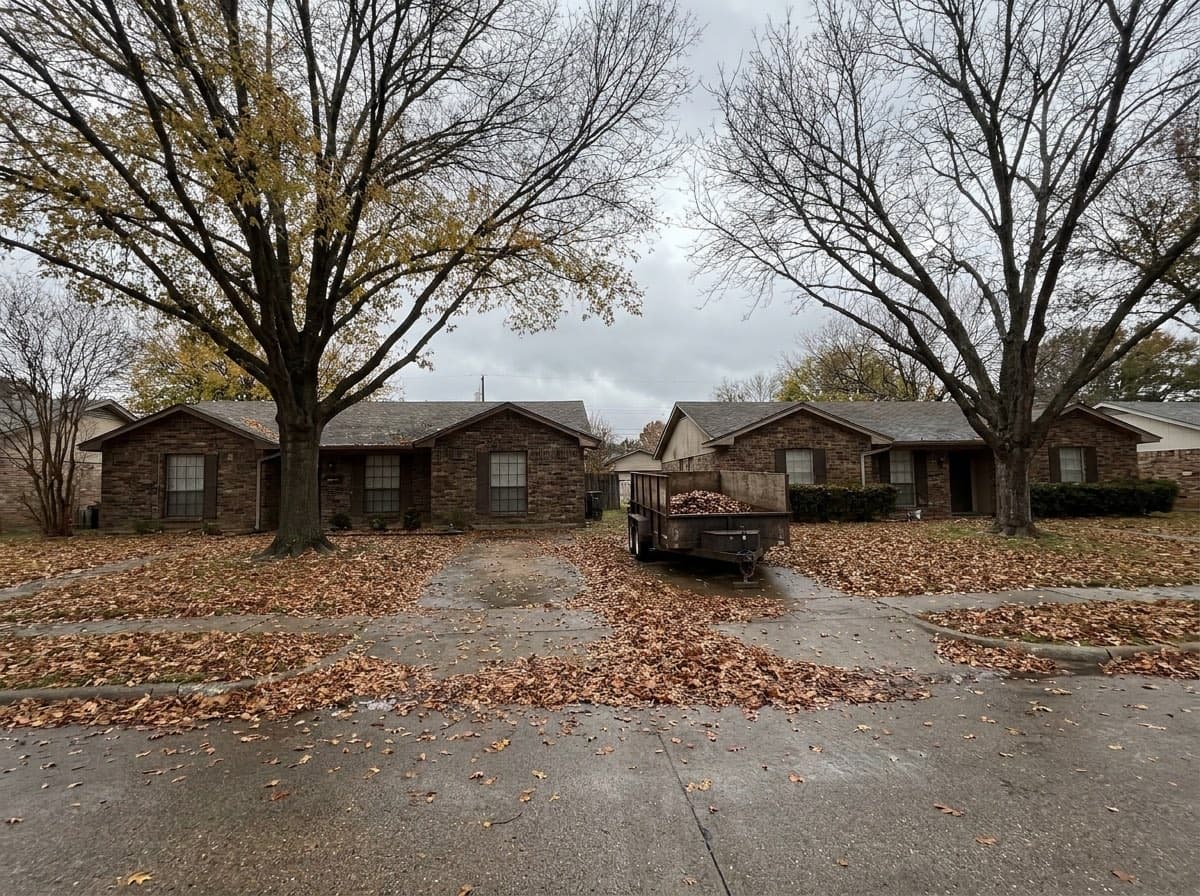
When should you schedule fall leaf cleanup in North Texas?
Short answer: book in late September or early October, and put the first haul on the pecan drop in late October through mid-November. Do not pay for a final cleanup while the canopy is still green. Do not wait until every oak is bare either. On a North Texas lot those are different months.
Pecans do the heavy fall dump. Shumard red oaks often hold brown leaves into winter. Live oaks shed in late winter, not in the fall. One Saturday in November can finish the pecans and still leave the oaks for a second visit.
What that visit costs is in leaf cleanup cost in Collin County. This post is only about when.
The calendar is the tree, not the month
A McKinney or Prosper yard might have a pecan in the back, a Shumard red oak in the parkway, and a live oak the builder planted out front. They do not drop together. If you schedule off a single "fall cleanup" weekend, you will either pay twice or leave a mat on the grass for two months.
| Tree | When the leaves come down | What to do |
|---|---|---|
| Pecan | A trickle can start in late summer. The big drop is late October into mid-November. | First haul. This is the visit that matters. |
| Shumard red oak | Some trees drop with the first cool spell. Many turn brown and hold leaves into February or March. | Plan a second pass. A November final will not finish them. |
| Live oak | Not a fall drop. Old leaves shed as new growth comes in, typically late January and February. | Fold into the late-winter visit. A November crew will not see this litter. |
| Post oak | The common native oak. Fall color is a dull yellow-brown. Drought can start an early drop in late summer. | Treat a July or August leaf fall as stress, not as your cleanup date. |
The pecan window is Neil Sperry, from a McKinney yard under pecans: a light drop can start in late July, and the massive drop is late October into mid-November. Texas A&M's native pecan guide lines up with that. A few nuts fall in October. Most fall in November and December, and you cannot really shake a tree that still has leaves. Leaf drop and nut drop travel together.
Use the freeze date as a checkpoint, not a start gun. The National Weather Service puts the average first freeze at Dallas/Fort Worth on November 22 (station record from 1898 through the winter of 2023-2024). The earliest freeze on that record is October 22, 1898. Hold the crew for the first half of November unless a front strips the pecans early.
The oak exceptions are why a November invoice is often not the last one. Sperry notes that some Shumard red oaks form their abscission layer slowly, turn brown, and hold leaves until February or March. Texas A&M's plant clinic says live oaks drop old leaves as new growth emerges, typically late January and February. That yellowing is normal. It is not, by itself, oak wilt, and it is not an October job. Post oak is the common native, with a dull yellow-brown fall color (Howard Garrett). A dry-year note from the same plant clinic: stressed post oaks can shed in late summer. If that happens in July or August, look for new buds. Early drop is a tree-health question. The cleanup calendar still starts with the pecans.
Why one "final" visit wastes the money
Two failure modes show up every year.
Too early. A full haul in September, while the pecans are still green, buys a clean lawn for a week. The volume is still in the tree. You pay again in November.
Too late, and only once. Waiting until the red oaks are bare leaves the pecan mat on Bermuda or St. Augustine from November into February. Sperry's rule for the heaviest weeks: large leaves, especially red oak, are too much to mulch back into the lawn. Take that mass off. A mower mulch is fine most of the year. It is not fine when the canopy hits the turf at once.
For a treed Collin County lot, the plan that matches the trees:
- Book in late September or early October, while November days are still open.
- First visit in early to mid-November, after the big pecan drop and around the average first freeze. Blow, haul, and get the mat off the turf.
- Second visit in January or February if red oaks held their leaves, or if live oaks are starting their shed. Skip it when the yard is mostly pecan and the November haul actually finished the job.
That is two visits in a heavy year. It is not a monthly contract, and it is not one Thanksgiving photo. One-off versus seasonal price bands are in the Collin County cost guide.
The city bag limit is why haul-away exists
If you are in McKinney, the city already picks up leaves. It will not absorb a pecan week.
McKinney's published yard-waste rules:
- Leaves and grass go in brown paper bags. Plastic bags are not collected.
- Set them out on your regular trash day. A separate truck takes yard waste. You do not schedule it.
- Limit of 10 bags or 10 bundles, or a mix that does not pass 10 items total.
- Set them out no earlier than 6 p.m. the evening before collection.
- Limbs cut by anyone other than the resident are not eligible for the brush pickup.
Ten paper bags covers a light week on a new build. It does not cover a mature pecan, or a parkway of red oaks, after a front. The overflow is the hired job: blow, load, and haul. Wet leaves make that overflow slower, which is also why a scattered crew finishes fewer yards. The operator math is in how many leaf cleanup jobs a crew can finish.
Plano, Frisco, Allen, and Prosper do not copy McKinney's 10-item cap. Check your own hauler before you assume the curb will take a peak week.
Gutters are the same debris, one ladder later
A November pecan drop and a January red-oak drop both end up in the downspouts. If a crew is already on the street for leaves, gutter cleaning is the same pile plus one ladder setup. Two random Tuesdays means two drive-outs for one season of leaves.
What changes when the street wants the same window
You do not organize the block. You book your own address.
Leaf cleanup in Collin County is a quoted visit, not an instant mow price. A fair number depends on what is on the ground: wet oak, pecan volume, beds, and whether the crew hauls it off. Enter the address, add photos of the cover, and local crews price the job by hand.
The reason to want that quote in the same week as your neighbors is route math. A trailer parked once can take several of those over-the-limit piles before the dump run. Five separate Tuesday calls are five arrivals. A street that wants the pecan window is closer to one. That is the same bundling logic as a Saturday mow, on a two-week season instead of a weekly one.
BlockBundle takes leaf quote requests nationwide, including McKinney and Trinity Falls.
Book in late September or early October. Put the first haul on the pecan drop, late October through mid-November, near the Dallas/Fort Worth average first freeze of November 22. Add a January or February visit if red oaks held their leaves or live oaks are shedding.
No. Texas A&M's plant clinic says live oaks drop old leaves as new growth emerges, typically in late January and February. A fall cleanup will not catch that litter.
On a pecan-only yard, often yes, if you wait for the late October to mid-November drop. If you also have Shumard red oaks that hold brown leaves, or live oaks, plan a second visit in late winter. A September haul is almost always too early to be the only one.
Yes, up to the cap. McKinney collects yard waste every trash day in brown paper bags, with a limit of 10 bags or bundles. A heavy pecan week on a treed lot exceeds that, which is when a haul-away crew is the actual product.
Sources
- Neil Sperry's Gardens, November 24, 2020 (pecan drop from late July with the massive drop in late October into mid-November; some Shumard red oaks hold brown leaves until February and March): https://neilsperry.com/2020/11/question-of-the-week-number-three-november-24-2020/
- Neil Sperry's Gardens, November 17, 2022 (during the few weeks of prime drop, large leaves such as red oak are too much to mulch back into the lawn): https://neilsperry.com/2022/11/qa-ask-neil-november-17-2022/
- Texas A&M AgriLife, Texas Fruit and Nut Production: Native Pecans (a few nuts in October; most fall November to December; harvest waits until the tree loses its leaves): https://txmg.org/blanco/files/2024/12/native-pecans.pdf
- Texas A&M Plant Disease Diagnostic Lab, live oak leaf drop (normal shed as new leaves emerge, typically late January and February): https://plantclinic.tamu.edu/factsheets/live-oak/
- Texas A&M Plant Disease Diagnostic Lab, September 4, 2015 (stressed post oaks can drop leaves in late summer; check for new buds before assuming the tree is dying): https://plantclinic.tamu.edu/2015/09/04/why-are-the-leaves-falling/
- Howard Garrett, The Dirt Doctor, post oak (fall color yellow to brown; most common native oak in North Texas): https://dirtdoctor.com/library/oak-post/
- National Weather Service Fort Worth/Dallas, DFW freeze summary (average first freeze November 22; earliest October 22, 1898; record through winter 2023-2024): https://www.weather.gov/fwd/d32info
- City of McKinney, yard waste (brown paper bags, 10-item limit, weekly on trash day, no scheduling): https://www.mckinneytexas.org/yardwaste
- City of McKinney, residential trash FAQ (set-out no earlier than 6 p.m. the day before): https://www.mckinneytexas.org/FAQ.aspx?QID=904