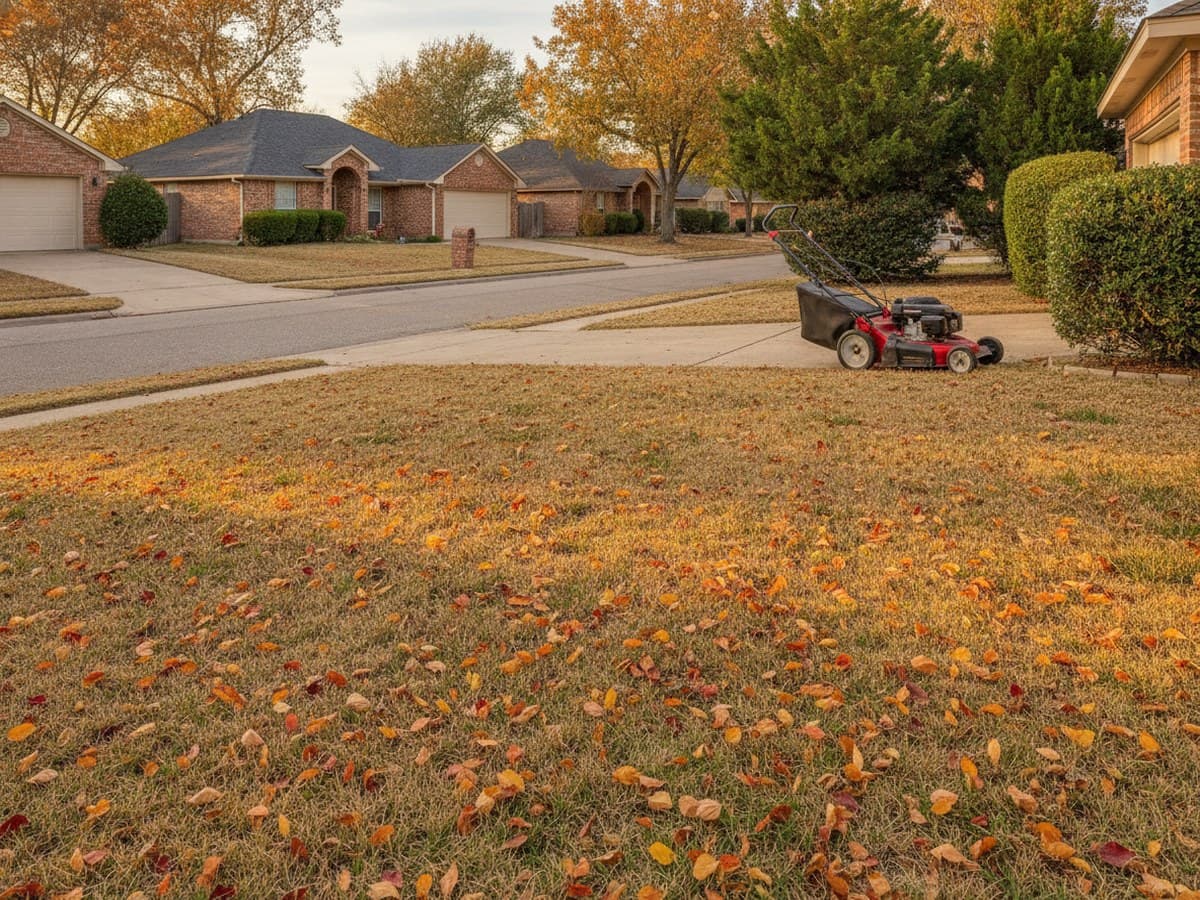
When should you stop mowing your lawn for the season?
Short answer: stop when the grass stops growing, not when the calendar hits Halloween or Thanksgiving. Warm-season lawns (Bermuda, St. Augustine, Zoysia, Buffalo) pause once they go dormant and turn straw or tan. Cool-season lawns (Kentucky bluegrass, tall fescue, rye) usually keep growing until daytime highs sit near 50°F for days in a row. In North Texas / DFW Bermuda yards, that wind-down is typically late October into mid-to-late November, near the area's average first freeze around November 22 (NWS Fort Worth DFW freeze record).
This is the homeowner companion to when lawn companies should stop mowing for the season. If you are still deciding weekly vs biweekly while growth slows, start with weekly vs. biweekly lawn mowing.
The only rule that matters: watch growth, not a fixed date
Extension guidance is consistent across regions:
- Iowa State University Extension (cool-season): keep mowing until foliage stops growing. Bluegrass leaf growth drops hard when daytime highs stay below about 50°F; in central Iowa that often lands early to mid-November (ISU Yard and Garden).
- Texas A&M AgriLife (Bermuda calendar): keep normal mowing until the lawn is dormant, then mow in winter only if you need to cut winter weeds before they flower (AgriLife bermudagrass calendar).
- AggieTurf / Texas Lawn Companion: as temperatures cool, raise height slightly within the recommended range; once dormant, mow mainly for weed seedhead control and bag those clippings (Texas Lawn Companion fall note).
A simple field test: mow as usual, wait 10 to 14 days. If the lawn barely moved, season is effectively over. If it put on another inch or two, you are not done yet - even after a light frost.
| What you see | What to do |
|---|---|
| Still pushing a weekly inch-plus after rain | Keep weekly (or the schedule that matches weekly vs biweekly) |
| Growth slows to every 10-14 days | Drop to biweekly |
| Uniform straw / tan, no measurable growth | One tidy last cut if needed, then park the mower |
| Green rye overseed on Bermuda | Keep mowing - that is a winter product, not a paused lawn |
| Winter weeds flowering on dormant turf | Spot-mow and bag seedheads, or treat weeds - do not resume a full summer schedule |
Do not invent a household "last mow Friday" rule. A warm October can add two more cuts. An early cold snap can shut Bermuda down weeks earlier than last year.
Warm-season vs cool-season: different stop signals
Warm-season (most of North Texas and the South)
Bermuda, St. Augustine, Zoysia, and Buffalo thrive in heat. As nights cool, growth slows, then color fades as the plant stores energy in roots and crowns. A useful Bermuda color cue: when soil near 4 inches drops under about 55°F, green color often fades; freezing air browns leaf tissue over the following days (Pennington bermudagrass fall color note).
In DFW, a usable homeowner window looks like this:
- Early-mid October: growth slows. Many yards leave weekly and move toward every 10-14 days.
- Late October - mid November: color shifts yellow-tan; shade and low spots brown first.
- Around the average first freeze (~Nov 22): most non-overseeded Bermuda is dormant or nearly there.
- Warm snaps after dormancy: optional cleanup only if growth actually resumes - do not pay for a full summer cut on straw.
That same calendar lines up with when to schedule leaf cleanup in North Texas and when to winterize your sprinkler system. Fall is one outdoor season, not three separate projects.
Cool-season (Midwest, Northeast, mountain foothills, and fescue pockets)
Keep cutting while the lawn is still putting on leaf. ISU's 50°F daytime high cue is a practical national rule of thumb for bluegrass-type turf. Light frost does not automatically end the season - cool-season grass can stay green and grow after a frosty morning. Put the mower away when growth has essentially stopped, not when the first pumpkin shows up on the porch.
Final cut height: raise it, do not scalp it
Old advice to "cut it short for winter" usually means stress, not insulation. Leaves are the plant's solar panels. Extension and turf programs converge on:
- Stay inside the recommended height band for your grass.
- Prefer the upper end of that band heading into dormancy for warm-season lawns (Collin County Master Gardeners fall turf note, K-State fall mowing guidance).
- Never remove more than one-third of the blade in one visit - including the last one.
Typical home-lawn bands (confirm for your cultivar):
| Grass | Typical home height band |
|---|---|
| Bermudagrass | about 1-2 inches |
| St. Augustine | about 2.5-3.5 inches |
| Zoysia | about 1-2 inches |
| Tall fescue | about 2.5-3.5 inches |
| Kentucky bluegrass | about 2-3 inches |
If the lawn got away from you, bring it down over two or three cuts, not one scalp. A bagging pass to pull leaf litter on the last visit is fine if you want a cleaner look - just call it leaf cleanup work and stay inside the one-third rule.
What to do after the last mow
Parking the mower is not the end of fall yard work. On most North Texas streets, the same window covers:
- Leaf cleanup before mats smother turf and clog drains - see DIY vs hiring for leaf cleanup and leaf cleanup cost in Collin County.
- Gutter cleaning while the ladder is out - often smarter as one trip with leaves (bundle gutter cleaning with leaf cleanup).
- Sprinkler winterization timed to the 28°F hard-freeze rule, not the first light frost (when to winterize sprinklers).
If a crew already knows your street for summer mowing, those add-ons are usually cheaper and cleaner when several neighbors book the same week. That is the density idea behind home-service bundling: you book your own house; nearby homes on the same route cut shared travel and setup cost.
How this changes what you pay
Stopping for the season means fewer visits, not a cheaper per-visit rate. A biweekly stop on tall, slow grass can take as long as a weekly summer cut, and the crew still pays to get the trailer to your driveway. National visit averages for weekly and biweekly mowing sit close to each other for that reason - see the math in weekly vs biweekly.
What does change the bill is whether your stop is a one-off across town or one more house on a street the crew already works. For Collin County pricing context, see lawn mowing cost in McKinney and lawn care cost per square foot in North Texas.
Practical move for late fall: keep the last one or two cuts on the same schedule as your neighbors if a crew is already on the block, then pause together when growth stops. Do not pay for weekly frequency after the lawn has stopped moving.
Where BlockBundle fits
You do not need to organize the cul-de-sac yourself. Enter your address for a measured lawn price, book the last mows or fall add-ons you still need, and watch the shared trip cost improve as more homes on your street join the same route.
If you are in Collin County, start from your city page: McKinney, Trinity Falls, Plano, Frisco, Allen, or Prosper.
Stop when the grass stops growing. Warm-season lawns pause at dormancy (often late Oct-Nov in DFW). Cool-season lawns usually stop when daytime highs stay near 50°F for several days.
No. Stay in the recommended height range, prefer the upper end for warm-season turf heading into dormancy, and never remove more than one-third of the blade in one cut.
Not automatically. Light frost can brown tips while cool-season grass keeps growing. Warm-season dormancy is a growth and color change, not a single frosty morning.
Keep mowing while the rye is actively growing. That lawn is on a winter schedule, not a dormant Bermuda pause.
Often yes: leaf cleanup, gutters, and sprinkler winterization land in the same fall window. Bundling nearby homes on one visit usually beats three separate trips.
Sources (for 2026 season guidance):
- Iowa State University Extension - When can I stop mowing the lawn in the fall? (cool-season; ~50°F daytime high cue): https://yardandgarden.extension.iastate.edu/faq/when-can-i-stop-mowing-lawn-fall
- Texas A&M AgriLife Extension - Bermudagrass Home Lawn Management Calendar (mow until dormant; winter weed mowing exception): https://agrilifeextension.tamu.edu/library/landscaping/bermudagrass-home-lawn-management-calendar/
- AggieTurf - Texas Lawn Companion Fall 2018 (raise height into dormancy; dormant mowing for weed seedheads): https://aggieturf.tamu.edu/wp-content/uploads/sites/24/TLCFall18_3.pdf
- National Weather Service Fort Worth - DFW earliest/latest freezes (average first freeze Nov 22): https://www.weather.gov/fwd/d32dates
- Pennington - Fall Color Retention in Bermudagrass (~55°F soil color cue): https://www.pennington.com/all-products/grass-seed/resources/fall-color-retention-in-bermudagrass
- Collin County Master Gardeners Association - Turf Talk: Preparing Your Lawn for Fall (one-third rule; upper height range): https://ccmgatx.org/resources/articles/article-repository/2024/september/turf-talk-preparing-your-lawn-for-fall/
- Kansas State University Extension - Fall mowing height guidance (species bands; avoid scalping for winter): https://www.extension.k-state.edu/news-and-publications/news/stories/2024/10/horticulture-fall-lawn-mowing.html
- BlockBundle - Weekly vs biweekly lawn mowing, When lawn companies should stop mowing, When to schedule leaf cleanup in North Texas, When to winterize sprinklers