DIY leaf cleanup vs hiring a crew: what it really costs
Hire when the canopy is heavy, the leaves are wet, or your weekend is worth more than the quote. DIY wins on small lots with light drop, free curbside pickup, or a mulching mower that can keep up. If the open question is whether those leaves should stay on the grass at all, use mulch or haul. For a normal suburban yard in 2026, a pro leaf visit usually lands around $150 to $400, while a serious DIY pass still costs equipment, disposal, and 4 to 12+ hours of work - often more than one Saturday.
This is the homeowner decision guide next to leaf cleanup cost in Collin County and when to schedule leaf cleanup in North Texas. The pricing math those posts use is the same stack you are shopping against when you decide whether to grab a rake.
What a hired leaf visit actually buys
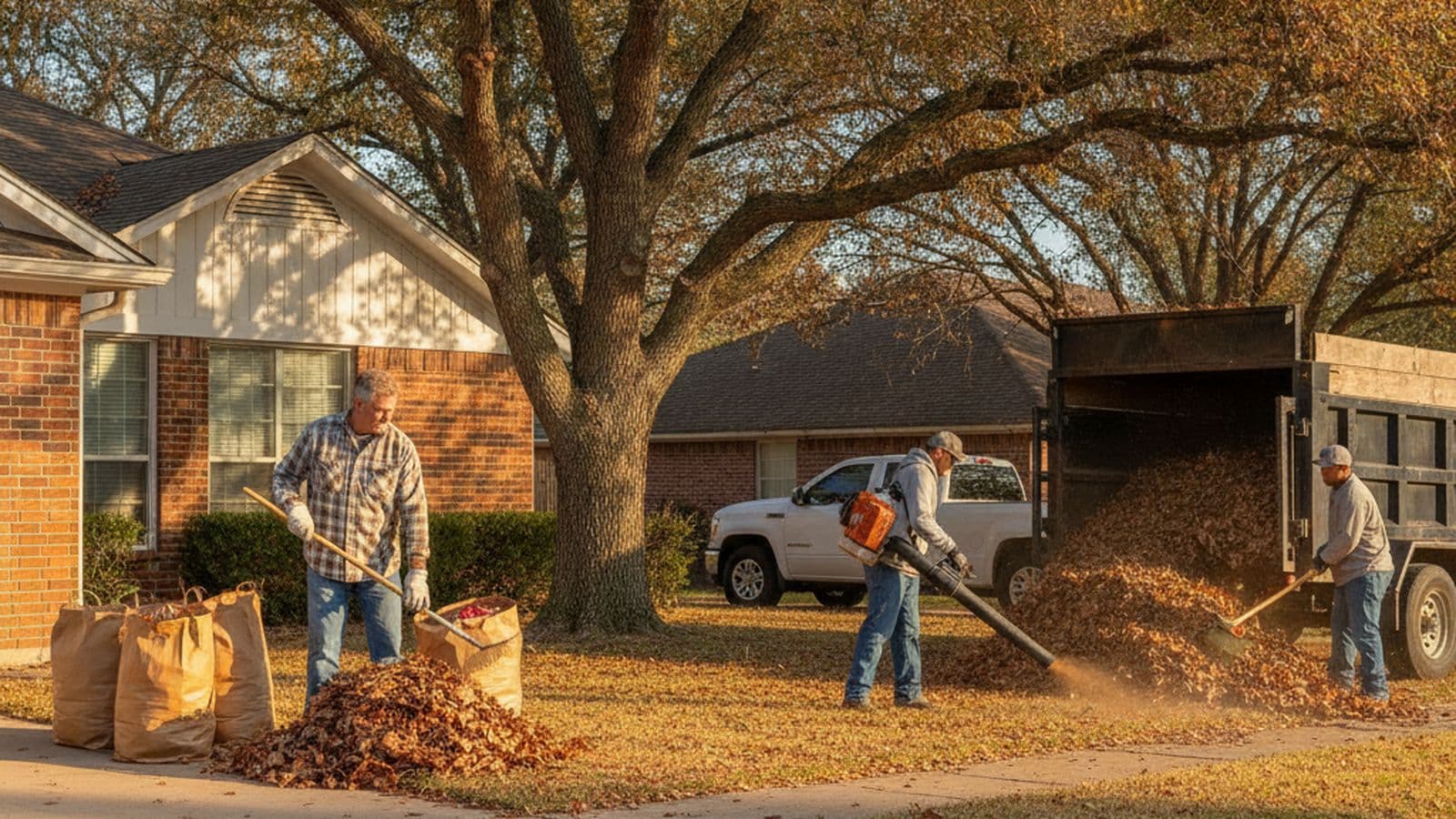
You are not paying for raking alone. A typical crew visit includes blow/rake, bag or load, haul-away (or curb bags), and a dump run sized to the wet weight on your lot.
Published 2026 bands:
- LawnStarter: about $160 to $290 for a standard quarter-acre, typical near $170, common $80 minimum
- Angi (national): roughly $191 to $592, average near $379
- Thumbtack: about $131 to $374, typical near $222
- Dallas-metro / Collin County working band: often $150 to $400; heavier oak-and-pecan lots run higher
Hourly quotes (when used) often sit near $15 to $50 blowing, $25 to $50 raking, $37 to $65 vacuuming, plus $5 to $10 per bag if disposal is a la carte. Crews usually finish a normal yard in 1 to 4 hours.
What DIY really costs (not just the rake)
DIY is cheap on cash and expensive on time.
| Cost stack | Typical DIY outlay | Notes |
|---|---|---|
| Rake | ~$20–$90 | Fine for light yards; slow on heavy pecan |
| Leaf blower | ~$80–$420 | Gas backpack units sit higher |
| Leaf vacuum / mulcher | ~$150–$800 | Useful if you will reuse mulch |
| Bags, tarps, gloves | ~$20–$60 per season | Paper lawn bags add up fast |
| Dump / transfer fee | ~$30–$100+ per load | Or $5–$15/bag if paid curbside |
| Your time | 4–12+ hours | Whole weekend on thick canopy |
After you already own tools, the marginal cash cost of one pass can look like $20 to $80. That is still not free labor. Value your Saturday at even $25/hour and an eight-hour DIY day is a $200 opportunity cost - already inside the same band as a mid-range pro visit - before you count the second pass when pecans keep falling.
Physical strain is part of the bill too. Wet oak and pecan leaves after a North Texas front are heavy. Back and shoulder weekends are a real failure mode for DIY "savings."
The third option: mulch in place
You do not always have to bag.
Extension guidance (UConn IPM, Virginia Cooperative Extension, and similar turf programs) supports mulch-mowing leaves into the lawn when you can chop them finely and keep grass blades visible - roughly no more than about 20% of the surface covered after each pass. Finely chopped leaves can return organic matter and modest nutrients without building thatch the way people fear.
Mulch-in-place fails when:
- The layer is thick, wet, or matted
- You only hit the yard once after a heavy dump
- The lawn is thin, shaded, or already disease-stressed
- You cannot keep up weekly through the drop window
On Collin County pecan and red-oak lots, mulching often works for the light weeks and fails on the heavy dump. Many homeowners do both: mulch early October, then hire one haul-away after the late-October / mid-November pecan peak. Timing for that peak is in when to schedule leaf cleanup in North Texas.
Decision framework: rake, mulch, or hire
Use this as a working rule, not a sermon.
DIY (rake/blow + curb or compost) when most of these are true:
- Small lot or light canopy (few mature trees)
- You already own a blower or enjoy the workout
- Your city still takes leaf bags or you have a free dump option
- You can revisit every 1–2 weeks through the drop
Mulch-mow when most of these are true:
- Leaves are dry enough to chop fine
- You can keep grass visible after each pass
- The lawn is healthy Bermuda or similar warm-season turf
- You are willing to mow more often, not once
Hire a crew when most of these are true:
- Mature oak/pecan canopy or a yard that buries the grass in one weekend
- Wet leaves, steep pitch, or limited physical capacity
- You need haul-away and do not want a trailer of bags on the curb for a week
- Neighbors on your street want the same fall window (dense routes price better)
| Yard type | DIY cash | DIY time | Hire band | Better default |
|---|---|---|---|---|
| Light canopy, small lot | $20–$60 | 2–4 hrs | $150–$250 | DIY or mulch |
| Typical suburban 1/4 acre | $40–$100 + tools | 6–10 hrs | $160–$290 | Hire or seasonal |
| Heavy oak/pecan | $80–$150 + dump | 10–20 hrs | $275–$550+ | Hire (1–2 visits) |
How neighbors change the math
A scattered single-house leaf job pays for one drive-out and one half-empty dump run. When several homes on the same street book the same week, the crew stages the trailer once and fills it before the transfer station trip. That is the same home-service bundling logic that cuts windshield time for mowing - applied to fall debris.
You still book your house. The savings show up as more realistic quotes when the street fills in, not as a coupon code. If you are in Collin County, book McKinney lawn care on a shared route or start on the Trinity Falls lawn care page - the same dense streets that price mowing honestly are the ones where a leaf visit stays inside McKinney lawn mowing cost ranges instead of a scattered dump-run tax. If gutters are due in the same window, ask for a same-day add-on while the ladder and trailer are already there - see should you bundle gutter cleaning with leaf cleanup.
A practical playbook for this fall
- Walk the yard after the first real drop. Grass still visible → mulch-mow. Lawn disappears → price a hire.
- Get one written quote with haul-away spelled out. Curb bags vs truck, one visit vs a 2–3 visit seasonal window.
- Time the heavy pass for your trees. In North Texas, pecans often peak late October into mid-November.
- Ask two neighbors. Three yeses on one cul-de-sac usually beat three cold leads across the county.
Leaf cleanup quotes are live nationwide: enter your address, add a few photos of the cover, and local crews price the visit by hand.
On cash, yes - if you already own tools and disposal is free. Once you count a blower ($80–$420), bags, dump fees, and 4–12+ hours of work, many suburban yards land in the same economic band as a $150–$400 pro visit.
Yes when you chop them finely and keep grass blades visible (roughly under about 20% surface cover after each pass). Thick, wet, or matted layers should be removed or they smother turf and encourage disease.
Light lots may need one. Heavy pecan or oak canopies often need two or three passes through the drop window, or a seasonal package priced below stacking one-offs.
Hire when the canopy is heavy, leaves are wet, you need haul-away, or your weekend is worth more than the quote. DIY still wins on small, light yards with free curbside pickup.
Sources (for cost and turf guidance):
- LawnStarter - How Much Does Leaf Removal Cost in 2026 ($160–$290 per 1/4 acre; ~$170 typical; blower ~$80–$420): https://www.lawnstarter.com/blog/cost/leaf-removal-price/
- Angi / HomeAdvisor - leaf removal national bands ($191–$592; bag disposal often $5–$10): https://www.angi.com/articles/how-much-does-leaf-removal-cost.htm
- Thumbtack - leaf cleanup national averages (~$131–$374, typical near $222)
- UConn Extension IPM - Leaf Disposal & Mulch Mowing (finely chop; keep roughly ≤20% surface cover): https://ipm.cahnr.uconn.edu/leaf_disposal_mulch_mowing/
- Virginia Cooperative Extension - lawn leaf management / mulch-mowing guidance (SPES-729)
- BlockBundle - Leaf cleanup cost in Collin County, When to schedule leaf cleanup in North Texas