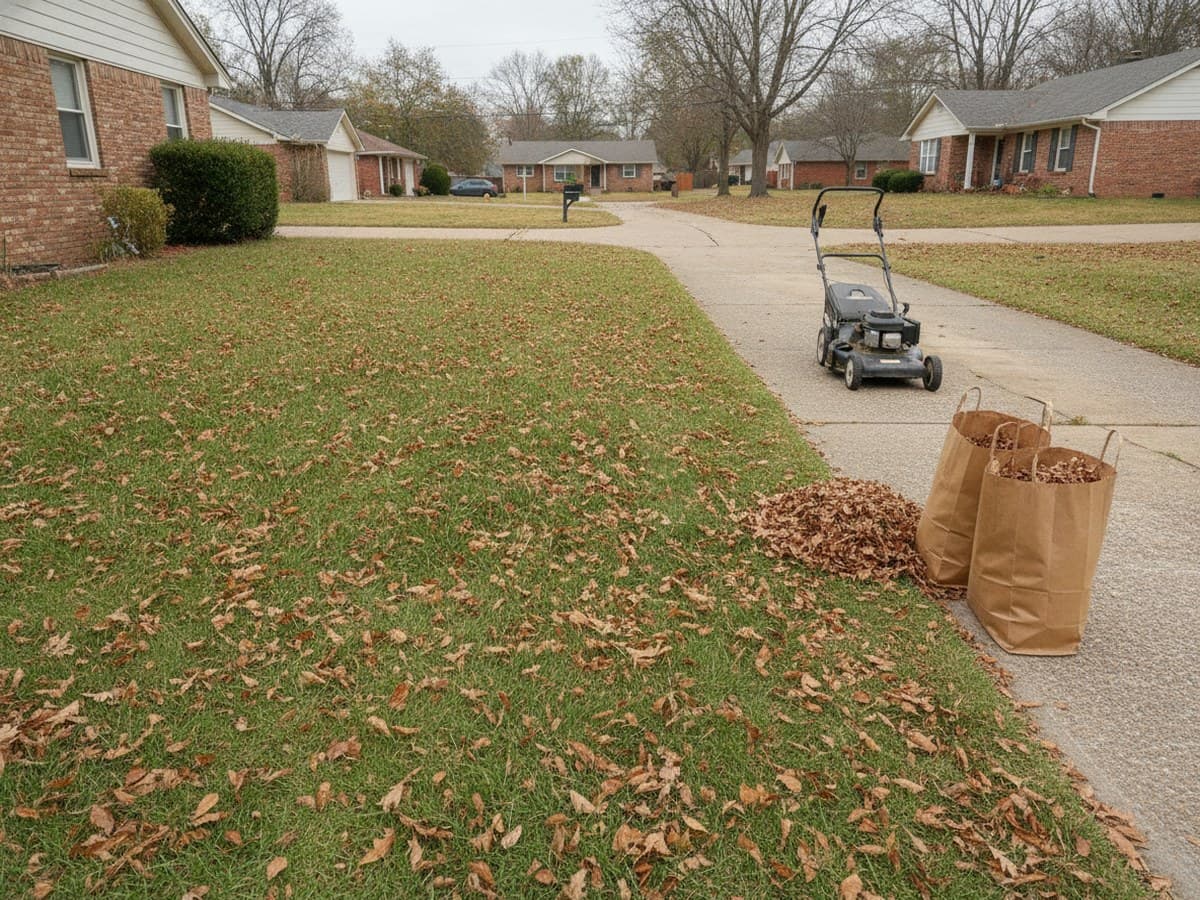
Should you mulch fall leaves or have them hauled away?
Short answer: mulch dry leaves into the lawn while grass still shows through after the pass. Haul the rest. A light, chopped layer feeds the soil and saves a Saturday. A thick mat, especially wet whole leaves left through winter, shades the turf and sets up snow mold.
DIY leaf cleanup vs hiring prices your time against a crew. This post answers a different question: which leaves should stay on the grass at all.
The cutoff you can see from the sidewalk
Two extension rules line up, and both are visual.
UConn Extension says no more than about 20% of the lawn should still be covered by leaves after each mulching pass (citing Trappe, 2018). Colorado State University Extension puts the same idea in plain sight: if you can see grass after you mulch, the layer is not too thick.
If a dry pass still hides the lawn, stop adding leaves and remove the excess. Purdue's turf program is blunt about why. Heavy layers that shade the grass can smother and kill it. Chopped oak and maple leaves that filter down into the canopy do not.
| What you see after a dry pass | What to do |
|---|---|
| Grass blades obvious, only a light chopped dusting | Leave it. Mulch the next dry drop the same way. |
| More than a light cover, lawn half-hidden or worse | Haul or compost the excess. Do not stack another pass on top. |
| Wet, matted whole leaves | Wait for a dry day if the layer is thin. If it is already a mat, haul it. Wet leaves will not chop cleanly. |
| Anything that would sit all winter deeper than a thin shredded cover | Haul down to a light shredded layer before snow. |
What mulching does, and what it does not
Purdue's published turf guidance (the page is dated 2010 and is still the program's leaf note) reports that mulched oak and maple leaves did not increase thatch or disease, did not change soil pH, and did not show a measurable effect on nutrient availability in their trials. The same note says the practice usually improves soil structure, does not increase weed pressure, and that some Michigan research suggests fewer dandelions.
UConn Extension answers a different question: how much nutrient is in the leaves. Citing Ferree (2016), they estimate that mulching a 2-inch layer over the course of the fall adds about 150 lb of nitrogen, 20 lb of phosphorus, and 65 lb of potassium per acre. That is about 3.44 lb N, 0.46 lb P, and 1.49 lb K per 1,000 sq ft. They also cite work showing mulched leaves raise organic matter at the surface without directly building thatch (Horton, 2014). On a mature lawn that is not trying to recover from heavy wear, UConn says that annual chopping can be a reason to reduce fall fertilizer.
Do not mash those into "mulch replaces fertilizer" or "mulch is worthless." Purdue measured whether the soil test moved. UConn estimated what is in the leaves. Keep a fertilizer plan a soil test already justified.
Colorado State, summarizing Michigan State turf work, goes further on weeds: three years of mulching leaves into the lawn can nearly eliminate dandelions and crabgrass. Treat that as CSU's summary of the Michigan work, not as a promise for a shaded, thin lawn in year one.
How to mulch a pass that does not smother the grass
UConn's fact sheet is the practical checklist:
- Mow when the grass and the leaves are dry. Wet leaves clump, strain the mower, and stay in sheets.
- Use a mulching mower when you have one. UConn says those machines can finely chop up to about 6 inches of leaves in a pass. A regular rotary mower still works if you raise the deck and make several crisscross passes.
- Mow often enough that chopped pieces settle into the canopy instead of coating the blades. Keep removing no more than one-third of the grass blade on each cut.
- After the pass, leaves should cover no more than about 20% of the surface.
- Wear a dust mask. Dry chopping throws fine dust.
- Maple and ash leaves are harder to mulch than oak, per UConn's citation of Trappe (2018). Budget an extra pass on those trees. Do not assume oak is the difficult one.
If the last growth of the season is already slowing, pair this with when to stop mowing for the season. A mulch pass only works while you are still mowing. Once the lawn has stopped growing, you cannot mow your way out of a late dump.
When hauling is the right job
Haul when the visual test fails, and haul before winter locks a mat in place.
Wisconsin Horticulture (October 2026) describes a three-year University of Wisconsin-Madison trial that is not through final analysis. The preliminary read: a 2-inch cover of shredded leaves left all winter looked reasonable, and a 4-inch depth was highly likely to cause winter damage. Shredded beats whole. UConn adds the disease half of that warning. A thick layer left through late fall and winter can encourage snow mold and can slow spring green-up by shading the soil. An early spring cleanup of whatever is still sitting on the grass helps the lawn start.
Also move leaves that are not a turf question:
- Off sidewalks, driveways, and storm drains, where whole leaves turn into slick mats and clogged inlets.
- Out of turf and into a bed only if you want them there. CSU says a quiet pile of whole leaves off the lawn, left until at least mid-April or mid-May, gives bumblebees a winter shelter. The same page says not to leave that litter on the grass.
- Into a compost pile if you have more than the lawn can take. CSU says oak and cottonwood are high in tannins and should be chopped and kept as a minority of the pile, and that whole leaves compost better than finely chopped ones because chopped leaves pack tight and lose air.
City bag rules and HOA deadlines vary. Check the local set-out date before you assume the curb is a plan.
Gutters are a separate surface with the same calendar. If the haul week is also the week the troughs fill, do both in the same window. The timing and the bundle case are in when to clean gutters before winter and bundling gutter cleaning with leaf cleanup.
What a haul costs versus another mow
A mulch pass is mower time and fuel. A haul is labor, a truck, and a dump. On a normal suburban lot, a hired leaf visit often lands in the same band we already broke down in DIY leaf cleanup vs hiring: commonly on the order of a few hundred dollars, with heavy oak and pecan lots higher. Local working numbers for Collin County are in leaf cleanup cost in Collin County. Ohio city pages are a different cut, in leaf cleanup cost in Ohio.
The expensive version is one truck hopping between scattered houses. The cheaper version is the week the whole street fails the 20% test together: same canopy, same storm, one dump run. A per-home haul comes down only when the crew loads once and moves driveway to driveway.
Yes, when the leaves are dry and the chopped layer stays thin enough to see grass. Purdue reports no thatch, disease, or pH penalty from mulched oak and maple. A heavy unshredded mat can smother the turf.
Mulch while a dry pass leaves grass showing and covers no more than about 20% of the lawn. Bag, compost, or haul once the lawn stays hidden or the leaves are a wet mat.
A thin shredded layer can be reasonable. Wisconsin's preliminary trial points to about 2 inches of shredded leaves as a winter maximum and flags 4 inches as likely to damage turf. Whole leaves left in a thick mat are the snow-mold problem.
Not automatically. UConn estimates a real nutrient load in a 2-inch layer and says mature lawns may reduce fertilizer over time. Purdue's trials did not find a measurable nutrient-availability change. Keep any plan that a soil test already justified.
When a dry mulch pass still hides the grass, the leaves are too wet to chop, or a deep layer would sit under snow. A crew is also the right call when the volume is more than one weekend and the street is dropping leaves the same week.
Sources
- UConn Extension, Victoria Wallace and Alyssa Siegel-Miles, "Leaf Disposal & Mulch Mowing" (ADA PDF, 2025 path): 20% cover after each pass, up to about 6 inches with a mulching mower, nutrient estimate for a 2-inch seasonal layer citing Ferree 2016, thatch citation to Horton 2014, maple/ash vs oak citing Trappe 2018, snow-mold warning. https://ipm-cahnr.media.uconn.edu/wp-content/uploads/sites/3216/2025/10/UConn-Extension-Leaf-Disposal-and-Mulch-Mowing_ADA-2025.pdf
- Purdue Turf, Aaron Patton, "What should I do with all these falling leaves?" (October 18, 2010): no thatch or disease increase, no pH change, no measurable nutrient-availability effect in their trials, smothering risk from heavy shade, dry leaves mulch more easily. https://turf.purdue.edu/what-should-i-do-with-all-these-falling-leaves/
- Colorado State University Extension, Alison O'Connor, "How to Mow, Compost, and Mulch Leaves" (November 2024): see-grass test, Michigan State weed summary, oak and cottonwood in compost, pollinator leaf litter off the lawn. https://extension.colostate.edu/resource/mow-compost-and-mulch-leaves/
- Wisconsin Horticulture, "Winter Leaf Coverage on Lawns" (posted October 12, 2026): preliminary UW-Madison result, 2-inch shredded winter cover vs 4-inch damage risk. https://hort.extension.wisc.edu/winter-leaf-coverage-on-lawns/
- BlockBundle: DIY leaf cleanup vs hiring, leaf cleanup cost in Collin County, when to stop mowing, gutters before winter, bundle gutters with leaf cleanup