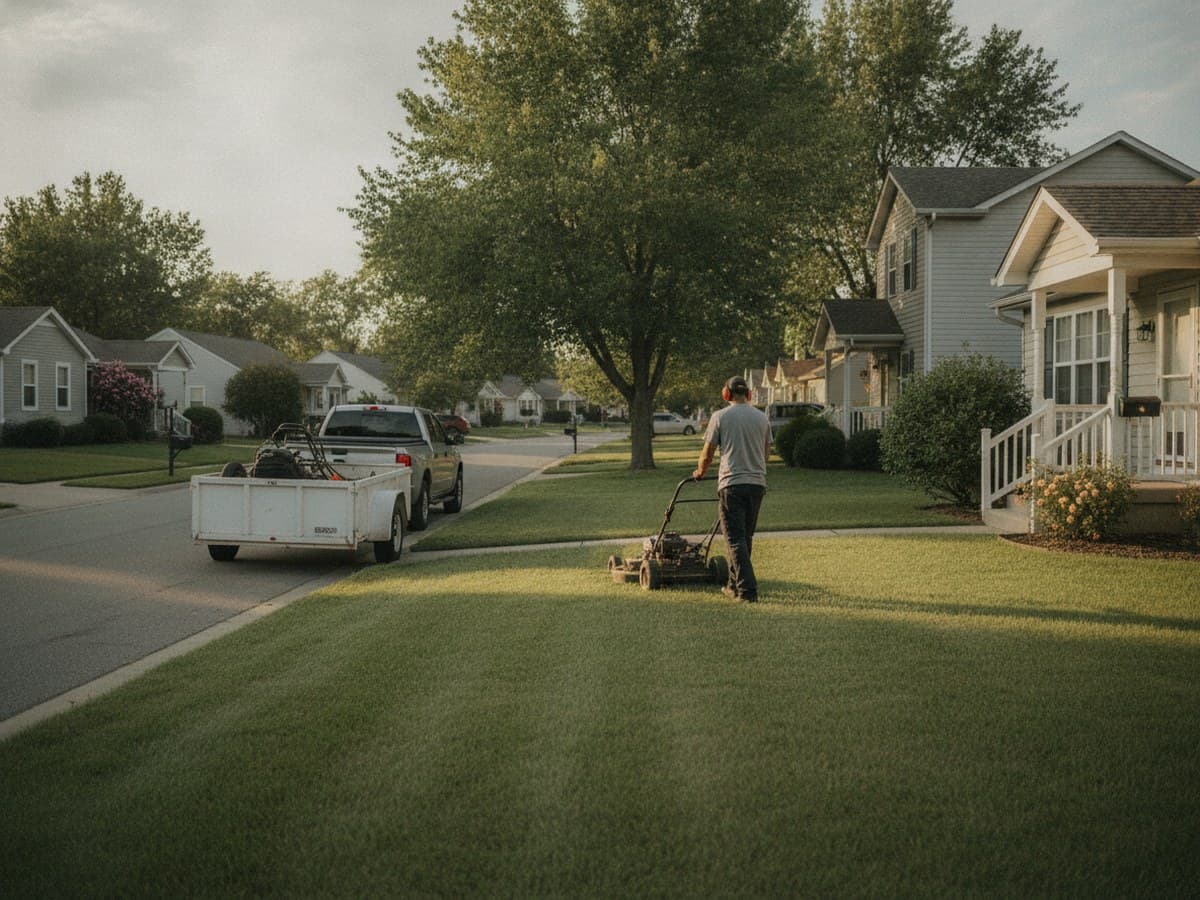
Lawn care for Airbnb properties starts on the street, not the listing
Short answer: treat a residential street with short-term rentals as one annual route. Mow it through the growing season, sell leaf cleanup on that same list in the fall, and sell snow only where you already plow. A Friday "need this yard done before check-in" pin across town is a one-off. The street you already drive is the product.
People searching "lawn care for Airbnb properties" are often hosts trying to book a crew. If that is you, use lawn service for Airbnb hosts. This page is for the crew. BlockBundle is not an Airbnb app, there is no iCal sync, and there is no partnership badge.
Why a rental street is an annual route
A short-term rental still sits on a normal residential lot. The grass does not care that the guest changes on Saturday. What changes is who notices an overgrown yard: the host is often in another city, and the listing photo is the curb.
That is useful for a lawn company only when several of those lots sit on streets you already cover. One listing is a lead. Several residential stops on the same block are a route. You do not need a count of hosts in the zip code to see the difference. You need the next job to be the next driveway.
The year on that street has three stops, not three businesses:
| Season | The job | Who already owns the relationship |
|---|---|---|
| Growing season | Weekly or biweekly mow, edge, and blow | The crew that shows up on a named weekday |
| Fall | Leaf cleanup on the same lots, often two or three visits | The same crew, if you asked before the oaks dropped |
| Winter, snow markets only | Driveway clearing on streets you already plow | The same crew, if you sold a season contract before the first storm |
Leaf cleanup on a mow book is the playbook in how to sell leaf cleanup to lawn customers. Snow on that same book is how to sell snow removal to lawn customers. Do not invent a winter plow in a mild market. In North Texas, the annual route is mow, then leaves. Snow belongs where snow actually funds the truck.
Weekly versus biweekly is a route-design choice, not a host special. Weekly vs biweekly lawn mowing covers the cut interval. A rental does not automatically need a different interval than the owner-occupied house next door. Guest-ready curb appeal sometimes pushes a street toward weekly in peak growth. Price that as a visit frequency, not as a different company.
Price the cluster, not the scattered host job
The expensive version of "lawn care for Airbnb properties" is a late text for a single yard twenty-five minutes off your map. You load, you drive, you cut one lot, you drive back. That is the same math as drive time cost and route density. A paid lead that sits alone also recreates the scatter problem in lawn care customer acquisition cost.
Price two different products:
- On-route stop. The truck is already on the street. Travel for that stop is shared with the neighbors. Quote the lot the way you quote any residential lawn on that block. The rental does not earn a mystery "Airbnb rate," and it does not earn a fake discount.
- Off-route one-off. A single listing across town. Quote it high enough to pay the windshield, or decline it. Do not let a Friday check-in panic rewrite your route.
If you already have one yes on the block, the next ask is the two doors beside it, whether those doors are owner-occupied or another listing. Owner-occupied neighbors fund the same loop. A rental street is not a reason to ignore the houses that are not rentals.
You are not promising yourself a full street. You are refusing to price a lone pin as if the neighbors were already on the trailer.
How to work streets you already drive
If you are starting from zero, read how to get lawn mowing customers first. The cold-start rule does not change because a house has a lockbox: the first customers still have to sit next to each other.
On streets you already serve, use this order.
-
Mark the block, not the platform. Look at the street you mow this week. Guest-ready fronts, a lockbox, or a driveway that turns over often are signals, not a database. You do not need to scrape a booking site. You need to know which of your current stops sit among other residential yards that look maintained for guests.
-
Sell the same weekday to every house on that street. "We are on your block every Tuesday" is the offer. Say it to the rental and to the owner next door. A host who lives elsewhere still books one street address. They do not recruit the neighbors, and you should not wait for them to.
-
Ask the adjacent doors the same day you get a yes. One warm stop pays for the conversation at the next two houses. That is how a rental lead becomes a street instead of a pin.
-
Put fall leaves on that list before the drop. Use the leaf ask in selling leaf cleanup to lawn customers. Same map, same contacts, a second season of stops. Do not wait for a host to discover leaf haul the week of a holiday weekend.
-
Add snow only if you already plow that market. Use the season-contract ask in selling snow removal to lawn customers. If you do not own a plow or a blower route, do not bolt snow onto a rental pitch. Mild-winter books stay on mow, leaves, and the off-season retention in keeping lawn customers through winter.
-
Keep access outdoor. Mowing, leaves, and driveway clearing do not need a house key. Gate codes and side-yard access do. Write those down per address the first visit so a remote host is not the bottleneck on Tuesday.
What this is not
Do not build the company on commercial property-management contracts or government accounts. A person who owns or co-hosts one or a few residential listings can sit on a normal lawn route. A portfolio of scattered commercial sites is a different business, with different travel, bidding, and insurance. This post is the residential street.
Do not claim an Airbnb partnership, a calendar sync, or a tool that reads reservations. None of that is required to mow the lot, and BlockBundle does not offer it. Hosts book the listing address the same way a homeowner books a house.
Do not promise a filled route, a host count, or an earnings number. Density is a choice you make when you price and when you ask the next door. A platform cannot invent neighbors who have not booked.
Gutter cleaning is a separate trade on many crews. If you already sell it, time it with the leaf visit and read bundling gutter cleaning with leaf cleanup. It is not a quote button on BlockBundle, and it is not the third leg of this route. The third leg, where it exists, is snow you already know how to plow.
Where BlockBundle fits
The hard part is still landing several homes on the same street without a group chat. BlockBundle is built so a host or a homeowner books one address at a time while the work can show up clustered. You draw the streets you cover and set your rate. You are not handed a commercial contract, and you are not handed a guaranteed block.
Launch coverage for lawn and leaf booking is Collin County and the inner-ring Dallas-Fort Worth suburbs. Snow booking is only for addresses in snow states. If your rental streets are outside that, the route advice above still stands. Registration is how your coverage and pricing become reusable the next time a house on that street asks for a price.
The lot is still a residential lawn. What changes is that the person paying may live somewhere else and care about the curb because guests see it. Cut interval, access notes, and payment before the truck rolls matter more than a special "Airbnb" scope.
Only if the price covers the drive. A single listing off your map is windshield time. Prefer stops on streets you already mow, then ask the neighboring doors.
No. You need the street address, access notes, and a schedule. BlockBundle is not an Airbnb app and does not sync reservations.
Sell leaf cleanup to the same addresses you mow, before the drop. Sell snow only in markets where you already plow, as a seasonal contract on that same list. Skip snow where you do not have the equipment.
No. Neighbors book on their own. A filled block is what happens when several of those bookings land on streets you cover, not a promise that they will.
Related on BlockBundle: