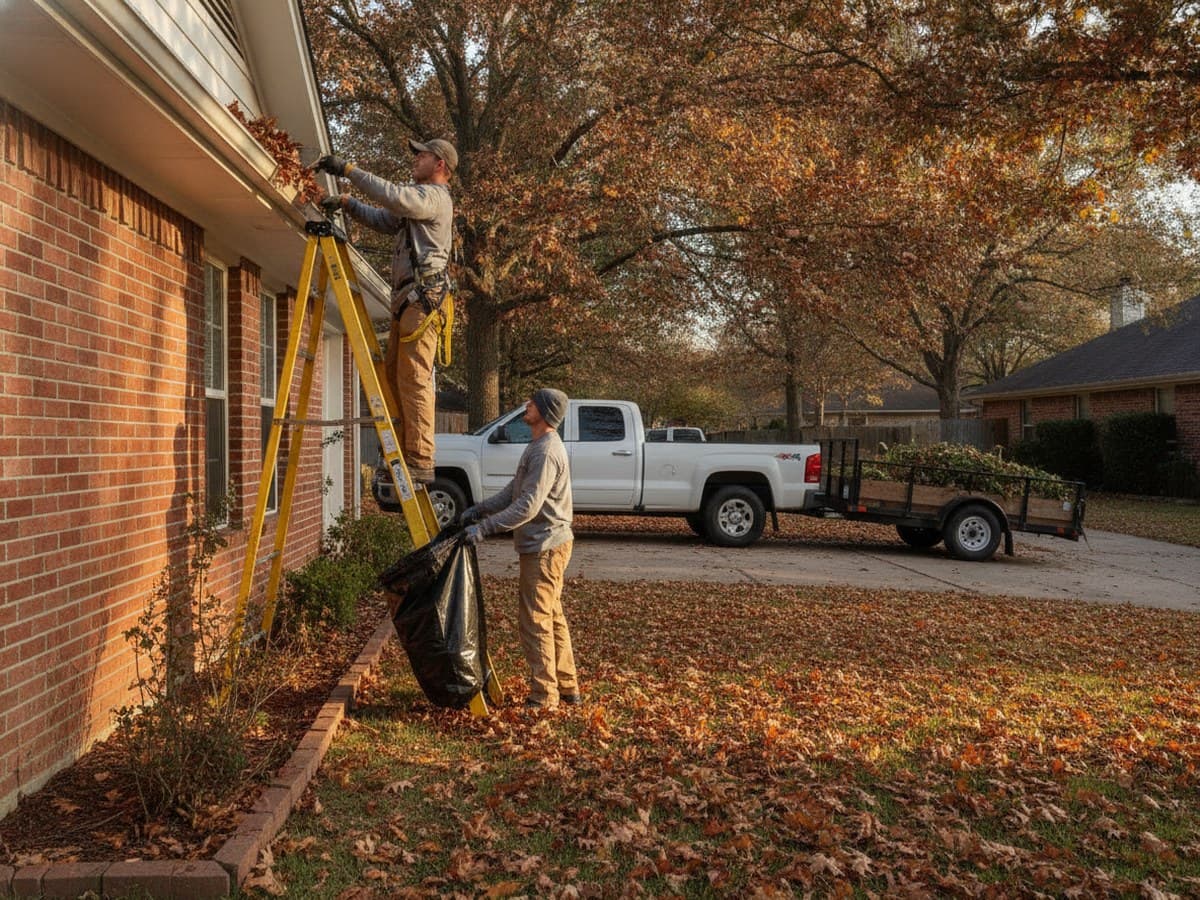
How much should a lawn care company charge for gutter cleaning?
Short answer: price a one-story residential clean at about $125 to $175 as an add-on when you are already on that street, and $150 to $210 as a standalone stop. Two-story work usually lands at $185 to $260 as an add-on, or $210 to $325 when you drove there just for gutters. Per linear foot, that is roughly $0.95 to $2.25, matching what homeowners already see in the market.
Those bands sit inside the published homeowner ranges. Angi's 2026 data puts the national average near $168 per visit, with most jobs between $119 and $234. One-story work commonly runs $145 to $250; two-story $180 to $360. Your job is not to undercut that sheet. It is to decide whether this stop is an add-on on a street you already serve, or a scattered drive that has to carry its own windshield time.
This is the provider pricing companion to the homeowner post on gutter cleaning cost. The route-economics cousins are what it costs to run a lawn crew per hour and how drive time eats landscaping margin.
What you are actually selling
Homeowners think they are buying "leaves out of the gutter." You are selling:
- Ladder time and fall risk. Height, pitch, and repositioning dominate the clock more than scooping.
- Linear feet. Most homes carry about 125 to 200 feet of gutter. A ranch and a two-story colonial with the same footprint are not the same job.
- Downspouts. A flush is usually in the base. A clogged elbow that needs a snake or disassembly is a separate line - commonly $25 to $50 each, sometimes higher.
- Debris haul. Bags to the curb or a trailer load. Light pine needles are easy. A full fall oak drop after three skipped seasons is not.
- The drive and the setup. Getting the truck there, staging ladders, and tearing down. That fixed cost does not care whether the home has 120 or 180 feet of gutter.
Price the whole stack. If you only quote "scoop time," every tall house and every clogged downspout becomes an argument on the driveway.
A simple price book you can put on the truck
Use a two-column book: standalone (you drove for this job) and add-on (you are already on the street for mowing or leaf cleanup). The add-on column is lower because the drive and first park are already paid for - not because the work is cheaper to do.
| Job | Standalone | Add-on (already on site) |
|---|---|---|
| One-story, up to ~2,000 sq ft home, up to 6 downspouts | $150–$175 | $125–$140 |
| One-story, larger footprint / longer eaves | $175–$210 | $140–$165 |
| Two-story, typical suburban | $210–$260 | $185–$215 |
| Two-story, larger or heavy debris | $250–$325 | $215–$260 |
| Three-story, or eaves over ~24 ft | Quote on site from $300, or decline | Same |
| Clogged downspout beyond a flush | +$25–$50 each | Same |
| Gutter guards (remove/replace) | +35–50% | Same |
| Roof valley / roof blow-off | +$50–$150 | Same |
| Detached garage or shed | +$50–$75 | Same |
| Minimum, any job | $125 | $100 |
Per-foot check: $0.95–$1.25/LF one-story, $1.00–$1.85/LF two-story, up to $2.25/LF on taller or awkward work - the same bands Angi publishes for homeowners. If your LF quote lands way under those bands on a two-story with guards, you are probably eating setup and risk.
Hold price in peak season (October–November and March–April). A 5–10% discount on a twice-yearly plan (spring + fall, billed per visit) is enough to lock the calendar without giving the margin away.
Ladder math against a real crew cost
A two-person lawn crew costs roughly $90–$100 per clock hour once you load labor, equipment, truck, and overhead - the stack we broke down in lawn crew cost per hour. Use ~$95/hour as the working number.
Typical elapsed times for a two-person crew on an average suburban home:
| Job | Elapsed on site | Crew cost at $95/hr | Target price | Contribution after labor-ish cost |
|---|---|---|---|---|
| One-story add-on | ~60–75 min | ~$95–$120 | $125–$140 | Thin but positive if the drive is free |
| One-story standalone | ~60–75 min + 20–30 min drive | ~$125–$165 | $150–$175 | Needs the full standalone price |
| Two-story add-on | ~90–110 min | ~$140–$175 | $185–$215 | Healthy when you skipped the hop |
| Two-story standalone | ~90–110 min + drive | ~$170–$220 | $210–$260 | Drive is why the floor moves up |
The lesson is blunt. An add-on one-story at $130 can beat a standalone one-story at $160 on contribution, because the second job never paid for a second mobilization. That is the same density math as leaf cleanup: hauling and setup set the ceiling more than the scoop itself. See how many leaf cleanup jobs a crew finishes in a day.
If your loaded crew cost is higher - high-wage markets, three-person crews, or a rented boom - raise the book. Do not "match the neighbor" who is quoting $89 for two-story work. That number usually assumes unpaid labor or ignores the next hospital bill.
Why a dense street changes the number
Gutter cleaning rewards clustering harder than most people expect:
- Ladders stay staged. On a tight block of similar one-stories, you walk the ladder three doors down instead of packing the trailer between every stop.
- Homes match. Same subdivision, same eave height, same gutter profile. Your time estimates stop lying.
- One debris run. Bag once, haul once. Five scattered houses means five mini-hauls or a trailer that fills at the wrong end of town.
- Fall pairs with leaf season. The same week homeowners want leaf cleanup, their gutters are packing. Selling both on one street fills the day without a new marketing campaign.
Five one-story add-ons on one cul-de-sac at $135 each is $675 of revenue with one park and one debris run. Five standalone stops at $165 with 20 minutes between each of them look better on the invoice and worse on the P&L - you already paid for that pattern in route density and landscaping margins.
How to sell it without a second marketing budget
You do not need a new Google Ads campaign to fill a fall gutter book.
- Offer it to every lawn and leaf account you already visit. A text in late September ("gutters while we are on your street for leaves - $X for one-story") converts warmer than a cold lead.
- Price the add-on in writing on the leaf quote. Separate line. Separate yes. Homeowners who already trust you for the yard will take the ladder work from the same crew.
- Build the street, not the zip. When one house books gutters, knock or text the two doors on either side the same afternoon. The second and third stops are where the day rate jumps.
- Skip three-stories and sketchy pitches until you have the insurance, the gear, and the appetite. Declining a bad job is a pricing decision.
Cold leads for gutters alone have the same CAC problem as mowing leads - you pay to win a pin that may sit 25 minutes off your cluster. The cheaper customer is the neighbor of someone you already serve. That is the whole pitch in how to get lawn mowing customers from zero and what a new lawn account really costs.
Where BlockBundle fits
The hard part is not scooping a gutter. It is landing several homes on the same street so the add-on column in your price book is the one you actually get to use.
BlockBundle books homeowners on the streets you cover at the rates you set. You draw your service area and publish structured pricing. When neighbors on one block book lawn, leaf, or - as coverage expands - related outdoor work, the stops arrive already clustered. You keep the full add-on margin because the drive was never the product. Homeowners still book one house at a time; they do not have to organize the block for you.
If you already run Collin County or another launch market, register as a provider and put gutter cleaning on the streets you can keep tight this fall. The homeowner-facing price story they will see is in gutter cleaning cost.
As an add-on on a street you already serve, about $125–$140 for a typical one-story with up to six downspouts. As a standalone drive-to job, $150–$175. Larger footprints or heavy debris push higher. Match the work to Angi-style homeowner bands of roughly $145–$250 so you are not racing the bottom.
Plan on $185–$215 as an add-on and $210–$260 standalone for a typical two-story suburban home, with larger or debris-heavy jobs at $250–$325+. Height is ladder time and risk, not a small bump on the one-story price.
Yes - modestly. The add-on column exists because mobilization is already paid for, not because the scoop is easier. Keep enough gap that standalone work still covers its own drive, and do not discount peak-season slots just to fill the truck.
Use both. Quote a job price from a per-foot book ($0.95–$2.25/LF by height) so odd footprints stay honest, then present a clean job total to the homeowner. Add separate lines for clogged downspouts, guards, and roof blow-offs.