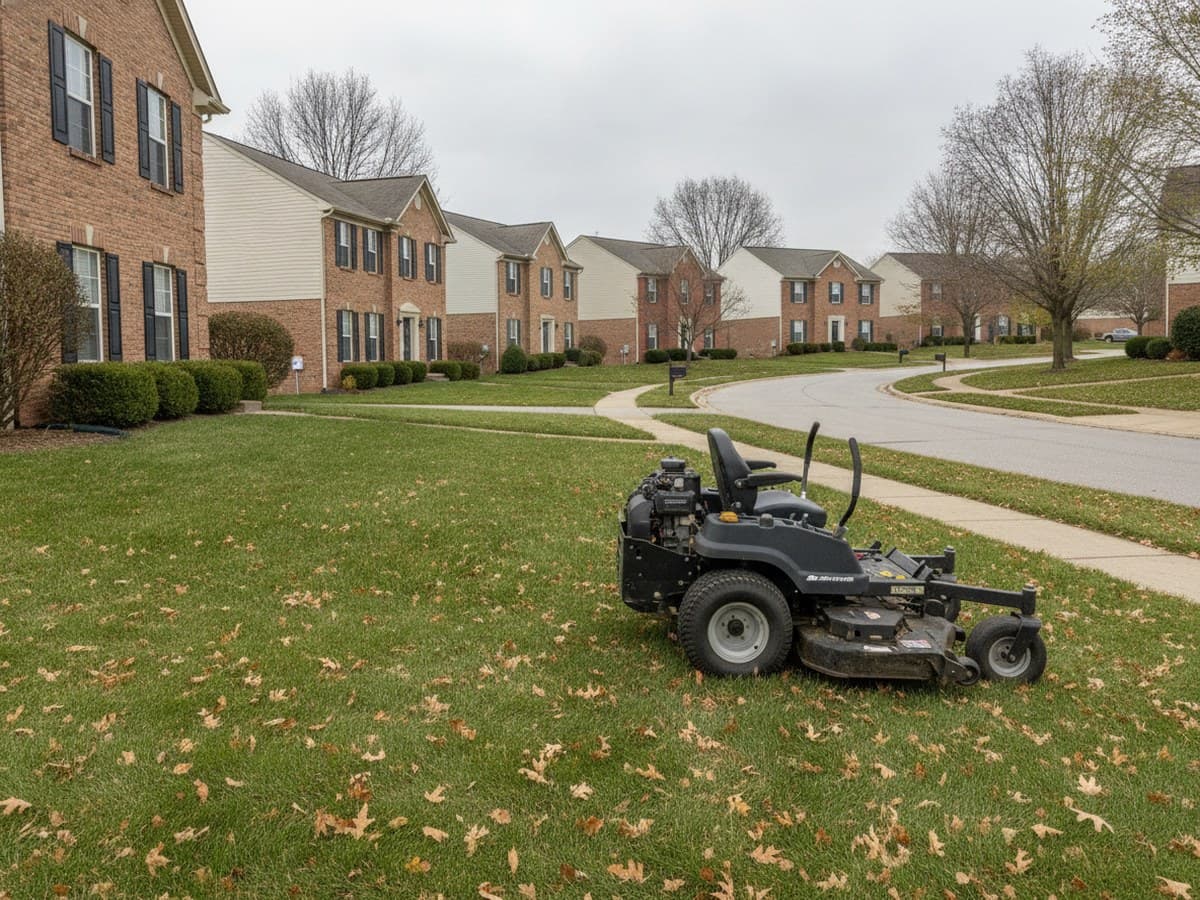
How much does lawn mowing cost in Ohio?
LawnStarter's Ohio facts page, which that page dates November 11, 2026, puts the overall average mowing price at $53.32 a visit.
Their national pricing guide, updated November 4, 2026, says most homeowners pay $44 to $71 a visit, with an average around $57. The Ohio average sits inside that band. It is still an average across lawns that are not the same size, on routes that are not the same length.
The size table on the same Ohio page is the part worth keeping:
| Lawn size | Weekly | Biweekly | Monthly |
|---|---|---|---|
| 1/8 acre | $27.73 | $30.39 | $32.53 |
| 1/4 acre | $37.86 | $44.26 | $44.79 |
| 1/3 acre | $48.52 | $52.79 | $57.59 |
| 1/2 acre | $62.92 | $70.92 | $76.79 |
| 1 acre | $95.98 | $102.92 | $113.05 |
A quarter-acre weekly cut at $37.86 and an acre at $95.98 are different jobs. A single "about $53" hides the column that tracks the work.
City tickets hide the size of the yard
The same page splits the state into cities. Read the ticket next to the yard.
| City | Average mowing price | Average yard | Price per 1,000 sq ft |
|---|---|---|---|
| Akron | $53.88 | 5,129 sq ft | $10.50 |
| Columbus | $51.90 | 5,455 sq ft | $9.51 |
| Cleveland | $54.74 | 6,829 sq ft | $8.02 |
| Hilliard | $47.47 | 6,089 sq ft | $7.80 |
| Dayton | $47.27 | 6,429 sq ft | $7.35 |
| Fairborn | $62.61 | 9,420 sq ft | $6.65 |
| Dublin | $50.57 | 8,300 sq ft | $6.09 |
| Hamilton | $50.36 | 8,499 sq ft | $5.93 |
| Cincinnati | $50.21 | 8,590 sq ft | $5.85 |
| Toledo | $59.01 | 11,517 sq ft | $5.12 |
Price per 1,000 square feet is their published city price divided by their published average yard, rounded to the nearest cent. It is a check on the ticket. It is not a rate a crew has to honor.
Toledo's $59.01 looks high next to Dayton's $47.27. Per 1,000 square feet, Toledo is the cheapest row, because the average yard in this dataset is 11,517 sq ft. Akron's ticket is near the state average, and the turf is the expensive row: $10.50 per 1,000 sq ft on 5,129 sq ft.
Do not blend this table with LawnStarter's separate city landing pages. Checked the same day, those pages publish different average mowing prices for the same cities: Cleveland $58.03, Cincinnati $52.37, Toledo $68.35. Same company, different cut of the data. Use $53.32 as one snapshot.
What that visit does not automatically include
The Ohio facts page does not say the average includes edging, blowing, or bagging. It does say how often other services show up in the same dataset:
- Fertilization on 9.2% of lawns
- Leaf removal on 8.5%
- Core aeration on 8.2%
- A general cleanup on 7.8%
A mow price is the cut. Fertilizer, aeration, and a leaf haul are separate visits in this dataset, and they should be separate lines on a quote.
Bagging is its own decision. Ohio State's lawn-mowing fact sheet (dated December 27, 2023; original authors John R. Street and William E. Pound; revised by Tyler Q. Carr, David S. Gardner, and Edward J. Nangle) cites Law, Bigelow, and Patton (2016): collecting clippings can remove nearly three-quarters of the nitrogen applied to the lawn. Leaving chopped clippings returns that nitrogen, and the fact sheet says clippings do not build thatch. Collect them when weeds are seeding or a disease is active. That is the fact sheet's caveat. It is a weak reason to pay for a haul every week.
How often an Ohio lawn actually needs a cut
The lawns behind these prices are cool-season turf: Kentucky bluegrass, perennial ryegrass, fine fescue, and tall fescue. The same Ohio State fact sheet lists lawn heights of 2.0 to 4.0 inches for Kentucky bluegrass, perennial ryegrass, and fine fescues, and 2.5 to 4.0 inches for tall fescue.
Frequency follows the one-third rule. Kept at 3 inches, the lawn should be cut before it passes 4.5 inches. In active spring and fall growth, Ohio State says that can mean more than one mow in a week. In a summer drought, cool-season grass can go dormant, and the fact sheet says to limit traffic, including the mower, while it is not growing.
City habits in the LawnStarter table are not that rule:
- Dayton: 97% weekly
- Cincinnati: 79% weekly
- Columbus: 55.5% weekly
- Cleveland: 52.5% biweekly, and 37% weekly
- Toledo: 48% monthly
A Cleveland biweekly habit can fit a dormant August and miss a fast April. When a biweekly gap scalps the lawn, and when it does not, is covered in weekly vs. biweekly mowing.
A year of mowing is the visit price times the visits the grass actually needs. At the quarter-acre weekly rate of $37.86, twenty visits is $757.20 and thirty is $1,135.80. Those counts are arithmetic, so a "$38" ad cannot hide a four-figure year. They are not a published Ohio season length.
Two costs the state average skips
The minutes behind the mower are only part of the bill.
Turf is smaller than the lot. A quarter-acre parcel with a two-story house, a driveway, and foundation beds has less grass than 10,890 square feet. Lot size bills the roof. The crew's time is the grass.
The trip is a fixed cost on a one-house stop: the drive to the street, the unload, and the pack-up. That cost does not shrink because the lawn is a small Akron yard, which is one reason small lawns show a higher price per 1,000 square feet in the table above. The same unload, spread across several houses on one street, is a different route. The crew-side version of that math is in what drive time costs a landscaping company. Crews setting a ticket off a later read of the same Ohio page can use how much to charge for lawn mowing in Ohio.
Cool-season streets make the trip cost obvious in April and October, when the lawns on one block are growing in the same weeks. One truck that stays on the block spends the hour on grass. One truck that mows a single house and leaves reloads the trip onto that ticket.
What to do with the number in November
Mid-November is the back of the cool-season year. Use the table to budget next spring. Use the one-third rule to decide whether a biweekly plan will still be honest in April.
Leaf cleanup is a separate bill too. The 2026 city pages and the national size table are in leaf cleanup cost in Ohio.
Snow is a separate bill. Driveway plowing is outside the $53.32 mow average. For an Ohio address, start from driveway snow removal cost and when to line up driveway plowing. Snow quotes are open for snow-state addresses, including Ohio, and the form refuses them for Texas. Keep the plow retainer off the mowing average.
BlockBundle does not sell $53.32 as your price. Enter the address and the quote is for the measured lawn. You can book that house without organizing the block. If nearby homes book the same service, the drive and the setup are shared, and the per-visit price can come down. That happens when the nearby homes are on the route. The flow is the one in how BlockBundle works. To run the same density math with your own inputs, use the lawn-care savings calculator.
LawnStarter's Ohio page, dated November 11, 2026, lists an overall average of $53.32 a visit. Weekly prices on that page run from $27.73 on an eighth acre to $95.98 on an acre. Their national guide the same month puts a typical visit at $44 to $71.
In this dataset Toledo's average ticket is $59.01 and Dayton's is $47.27. Toledo's average yard is 11,517 sq ft and Dayton's is 6,429. Per 1,000 sq ft, Toledo is about $5.12 and Dayton is about $7.35.
Follow the one-third rule. Ohio State says a lawn kept at 3 inches should be cut before it reaches 4.5 inches, and active growth can require more than one mow a week. Cleveland's LawnStarter mix is mostly biweekly. Dayton's is almost all weekly. Match the schedule to growth, not to the neighboring city's habit.
No. On the same LawnStarter page, fertilization shows up on 9.2% of lawns and leaf removal on 8.5%. Price those as their own visits. The leaf numbers are in the Ohio leaf cleanup cost guide.
No. That figure is LawnStarter's statewide average. BlockBundle quotes the measured turf at your address. You can book your own house. A lower price from a shared trip shows up only when nearby homes are on the same route.
Sources
- LawnStarter, "Ohio (OH) Lawn Care - Facts And Figures," page date November 11, 2026: overall average $53.32; size table from 1/8 acre to 1 acre; city prices, yard sizes, and weekly/biweekly/monthly mix; fertilization 9.2%, core aeration 8.2%, leaf removal 8.5%, cleanup 7.8%. https://www.lawnstarter.com/oh
- LawnStarter city pages, fetched November 11, 2026, which do not match that state table: Cleveland average mowing price $58.03 (https://www.lawnstarter.com/cleveland-oh-lawn-care), Cincinnati $52.37 (https://www.lawnstarter.com/cincinnati-oh-lawn-care), Toledo $68.35 (https://www.lawnstarter.com/toledo-oh-lawn-care).
- LawnStarter, Maria Isabela Reis, "How Much Does Lawn Mowing Cost in 2026?" updated November 4, 2026: typical visit $44 to $71, average about $57. https://www.lawnstarter.com/blog/cost/lawn-mowing-price/
- Ohio State University Extension, CFAES, "Lawn mowing," fact sheet dated December 27, 2023. Heights by species (Christians, Patton, and Law, 2016). One-third rule and the 3-inch / 4.5-inch example. Clipping nitrogen loss citing Law, Bigelow, and Patton, 2016. Drought-dormancy traffic limit. Authors: Street and Pound; revision by Carr, Gardner, and Nangle. https://cfaes.osu.edu/fact-sheet/lawn-mowing
- BlockBundle: weekly vs. biweekly mowing, drive time cost, driveway snow removal cost, when to line up driveway plowing, how BlockBundle works, lawn-care savings calculator