How much should a lawn care company charge for pressure washing?
Short answer: price a typical two-car concrete driveway at about $150 to $200 as an add-on when you are already on that street, and $180 to $250 as a standalone stop. A one-story soft wash usually lands at $300 to $450 as an add-on, or $350 to $550 when you drove there just for the wash. Per square foot on flatwork, that is roughly $0.15 to $0.30, matching what homeowners already see in the market.
Those bands sit inside published 2026 homeowner ranges. Operator and marketplace guides put driveways near $100 to $300, single-story house washes near $250 to $450, and two-story work near $400 to $900. Flatwork commonly prices at $0.10 to $0.30 per square foot, with oil stains, height, and soft-wash chemistry pushing higher. Your job is not to undercut that sheet. It is to decide whether this stop is an add-on on a street you already serve, or a scattered drive that has to carry its own tow, hookup, and teardown.
This is the provider pricing companion to the homeowner post on pressure washing cost in Collin County. The route-economics cousins are what it costs to run a lawn crew per hour and how drive time eats landscaping margin.
What you are actually selling
Homeowners think they are buying "clean concrete." You are selling:
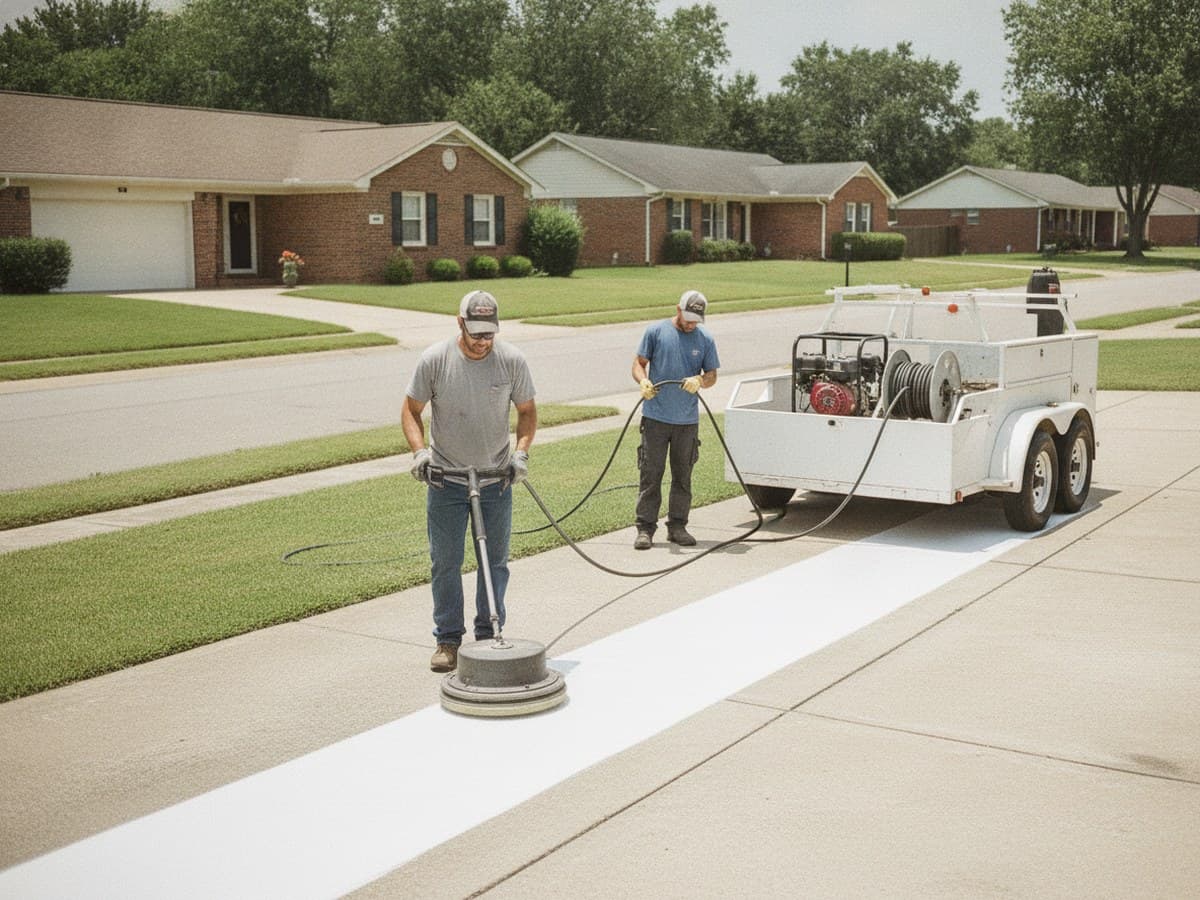
- Mobilization. Tow or load the rig, stage hose and surface cleaner, find water, mix chemistry, then tear it all down. That fixed block barely shrinks when the driveway is small.
- Surface and technique. Driveways take high pressure and a surface cleaner. Vinyl, brick, and stucco want a soft wash - chemistry and low pressure - so you do not drive water behind weep holes or lap siding.
- Square footage of the surface, not the house. An 800 sq ft two-car pad is not a 2,000 sq ft circle drive with a side pad. A "2,500 sq ft home" is not 2,500 sq ft of washable siding.
- Condition. Light pollen film is different from clay splash, algae on a north wall, or oil that needs degreaser and dwell time.
- Risk and access. Second-story work, tight side yards, HOA water rules, and wash-water runoff all cost clock and insurance attention.
Price the stack. If you only quote "minutes behind the wand," every oil stain and every two-story soft wash becomes an argument on the driveway.
A simple price book you can put on the truck
Use a two-column book: standalone (you drove for this job) and add-on (you are already on the street for mowing, leaf cleanup, or gutters). The add-on column is lower because the first park and most of the setup are already paid for - not because the wash is cheaper to do.
| Job | Standalone | Add-on (already on site) |
|---|---|---|
| Two-car driveway (~600–800 sq ft), light soil | $180–$220 | $150–$185 |
| Large / circle drive or heavy clay film | $220–$320 | $190–$275 |
| Driveway + walkways | $250–$375 | $210–$325 |
| Patio or pool deck (concrete) | $150–$275 | $125–$230 |
| Wood fence, 100–150 linear ft | $175–$300 | $150–$260 |
| One-story soft wash (typical suburban) | $350–$475 | $300–$425 |
| Two-story soft wash | $450–$700 | $400–$625 |
| Oil-stain pretreatment | +$25–$75 | Same |
| Minimum, any job | $150 | $125 |
Per-square-foot check on flatwork: $0.15–$0.25/sq ft for clean concrete in good shape, $0.25–$0.40/sq ft when stained, stamped, or awkward. Soft-wash siding commonly lands near $0.20–$0.40/sq ft of washable wall, not living area. If your driveway quote lands under $0.15/sq ft and still clears a $150 floor on a standalone trip, you are probably eating mobilization.
Hold list price in spring pollen season (March–May in DFW and similar oak markets) and after long dry spells when clay and algae return. A 5–10% discount on a twice-yearly plan (spring + late summer, billed per visit) is enough to lock the calendar without giving the margin away.
Setup math against a real crew cost
A two-person lawn crew costs roughly $90–$100 per clock hour once you load labor, equipment, truck, and overhead - the stack we broke down in lawn crew cost per hour. Pressure washing often runs with one skilled operator plus a helper, or a solo tech on flatwork. Use ~$95/hour for a two-person team and ~$55–$70/hour for a loaded solo operator as working numbers, then add chemical and equipment wear.
Typical elapsed times for a two-person crew on an average suburban stop:
| Job | Elapsed on site | Crew cost at $95/hr | Target price | Contribution after labor-ish cost |
|---|---|---|---|---|
| Driveway add-on | ~45–70 min | ~$70–$110 | $150–$185 | Healthy when the tow is free |
| Driveway standalone | ~45–70 min + 25–40 min setup/tear | ~$110–$175 | $180–$250 | Needs the full standalone price |
| One-story soft wash add-on | ~2–3 hr | ~$190–$285 | $300–$425 | Margin lives in chemistry skill, not speed |
| One-story soft wash standalone | ~2–3 hr + full mobilize | ~$230–$340 | $350–$550 | Drive + mix + rinse is why the floor moves up |
The lesson is the same as gutters and leaf cleanup. An add-on driveway at $165 can beat a standalone driveway at $200 on contribution, because the second job never paid for a second tow and hookup. That is why pressure washing is one of the most density-sensitive outdoor jobs: fixed setup is a huge share of the clock. See how route density affects landscaping margins.
If your loaded cost is higher - rented trailer, commercial reclaim gear, or a two-story soft-wash specialty - raise the book. Do not match the Facebook quote of $79 for a full house wash. That number usually assumes unpaid labor, no insurance, or a one-time loss-leader.
Why a dense street changes the number
Pressure washing rewards clustering harder than most lawn add-ons:
- The rig stays staged. On a tight block, you roll the hose three doors down instead of packing the trailer between every stop.
- Homes match. Same subdivision, same concrete mix, same pollen film. Your time estimates stop lying.
- One water and chemical setup. Mix once, rinse once, dispose of wash water on a plan. Five scattered houses means five mini-mobilizations.
- Spring pairs with first heavy mows. The same week homeowners want the yellow oak film gone, you are already on their street for lawn. Selling the wash as a line on the mow visit fills the day without a new ad campaign.
Five driveway add-ons on one cul-de-sac at $170 each is $850 of revenue with one tow and one setup window. Five standalone stops at $210 with 20–30 minutes of pack-up between each of them look better on the invoice and worse on the P&L - you already paid for that pattern in drive time cost.
On Collin County homeowner bands, a driveway often lands $180 to $350 and a whole-home soft wash $375 to $675. Your add-on column should sit inside those bands, not under them. Homeowners comparing quotes will read the same local numbers in pressure washing cost in Collin County.
How to sell it without a second marketing budget
You do not need a new Google Ads campaign to fill a spring wash book.
- Offer it to every lawn account you already visit. A text in late March ("driveway while we are on your street this week - $X") converts warmer than a cold lead.
- Price the add-on in writing on the spring quote. Separate line. Separate yes. Homeowners who already trust you for the yard will take the wash from the same crew.
- Build the street, not the zip. When one house books a driveway, knock or text the two doors on either side the same afternoon. The second and third stops are where the day rate jumps.
- Keep soft wash and flatwork as separate skills. If you are not trained or insured for two-story chemistry work, sell driveways and walkways first. Declining a bad siding job is a pricing decision.
- Mind the water. Confirm local rules on runoff and reclaim before you bid commercial pads or HOA streets that treat wash water as illicit discharge. Put containment on its own line when the job requires it.
Cold leads for pressure washing alone have the same CAC problem as mowing leads - you pay to win a pin that may sit 25 minutes off your cluster. The cheaper customer is the neighbor of someone you already serve. That is the whole pitch in how to get lawn mowing customers from zero and what a new lawn account really costs.
Where BlockBundle fits
The hard part is not running a surface cleaner. It is landing several homes on the same street so the add-on column in your price book is the one you actually get to use.
BlockBundle books homeowners on the streets you cover at the rates you set. You draw your service area and publish structured pricing. When neighbors on one block book lawn - and, as coverage expands, related outdoor work like pressure washing - the stops arrive already clustered. You keep the full add-on margin because the tow was never the product. Homeowners still book one house at a time; they do not have to organize the block for you.
If you already run Collin County or another launch market, register as a provider and put pressure washing on the streets you can keep tight this spring. The homeowner-facing price story they will see is in pressure washing cost in Collin County.
As an add-on on a street you already serve, about $150–$185 for a typical two-car pad with light soil. As a standalone drive-to job, $180–$250. Large circle drives, heavy clay, or oil stains push higher. Match homeowner bands of roughly $100–$300 so you are not racing the bottom.
Plan on $300–$425 as an add-on and $350–$550 standalone for a typical one-story suburban home, with two-story work often at $400–$700+. Price washable wall area and chemistry risk, not the home's living square footage.
Yes - modestly. The add-on column exists because mobilization is already paid for, not because the wash is easier. Keep enough gap that standalone work still covers its own tow, and do not discount peak pollen-season slots just to fill the trailer.
Use both. Quote from a per-square-foot book ($0.15–$0.40/sq ft by surface and condition) so odd footprints stay honest, then present a clean job total to the homeowner. Keep a hard minimum ($125–$150) under every quote.