How much should you charge to salt a driveway?
Short answer: bill salt as its own line, and bill a salt-only callback higher than salt you drop while the plow is already in the driveway.
In Lawn Love's snow removal cost guide, updated November 18, 2026, a single salt application runs $22 to $47 a visit (Lawn Love). That band is a market check, not your price book. At a sane rate, one residential driveway often uses well under a dollar of rock salt. The rest of the $22 to $47 is the stop: the truck, the person on the clock, and showing up when the pavement refroze.
This is the pricing companion to how many driveways one truck can plow in a storm and how to sell snow removal to lawn customers. Homeowners comparing the other side of the invoice land on driveway snow removal cost and when to line up driveway plowing.
What published 2026 prices actually say
Use two public snapshots, and keep them in their lanes.
| Source | What it measures | 2026 figure |
|---|---|---|
| Lawn Love, updated Nov 18, 2026 | Homeowner price for one salt application | $22–$47 a visit |
| Housecall Pro price book, updated Oct 27, 2026 | Median residential job, driveway and walkway, 17,750 jobs | $113 |
| Housecall Pro price book, same update | Median residential job that includes salting, 2,573 jobs | $166 |
Housecall Pro says those medians are different service categories. Do not subtract them and publish $53 as your salt fee.
Their formula is still the right shape: add labor, travel, equipment, materials, and a share of overhead, then divide by (1 − target margin).
The worked example uses 30% (cost ÷ 0.70) and labels that margin as an example, not an industry measurement.
Pick your own, then check it against the $22 to $47 band.
The salt on the driveway is usually under a dollar
Two public application guides set the amount. They do not match each other exactly, so quote the range and measure your own hopper.
The Minnesota Pollution Control Agency, in a December 8, 2025 release, says about 12 ounces (a coffee mug) treats a 20-foot driveway or about 1,000 square feet. Visible leftover salt is waste, not extra safety.
Minnesota LTAP puts sodium chloride at 1 to 4 pounds per 1,000 square feet after the snow is off, crystals about 2 to 3 inches apart, and notes that a 12-ounce mug of salt weighs about a pound. Treat the MPCA mug and the LTAP range as the same neighborhood of dose. Your hopper log after a few storms is the number you quote.
Rock salt (sodium chloride) works between about 32°F and 15°F. Below 15°F, MPCA says most salts stop melting and sand is for traction. LTAP says blends with calcium or magnesium chloride can work down toward 0°F. Read the bag. If the pavement is too cold for the product, do not bill a pass that cannot melt.
Bag math, labeled as an assumption. Swap in your invoice. If a 50-pound bag costs you $15, a pound is $0.30.
- MPCA mug dose, 12 ounces = 0.75 lb → $0.23 of rock salt on about 1,000 square feet.
- LTAP high end, 4 lb on the same area → $1.20.
A crew that dumps a whole bag on one apron is no longer in this math. That is over-application, and it is how a cheap material becomes a real cost. MPCA's point for homeowners is the same point for your margin: leftover salt on dry pavement is product you already paid for.
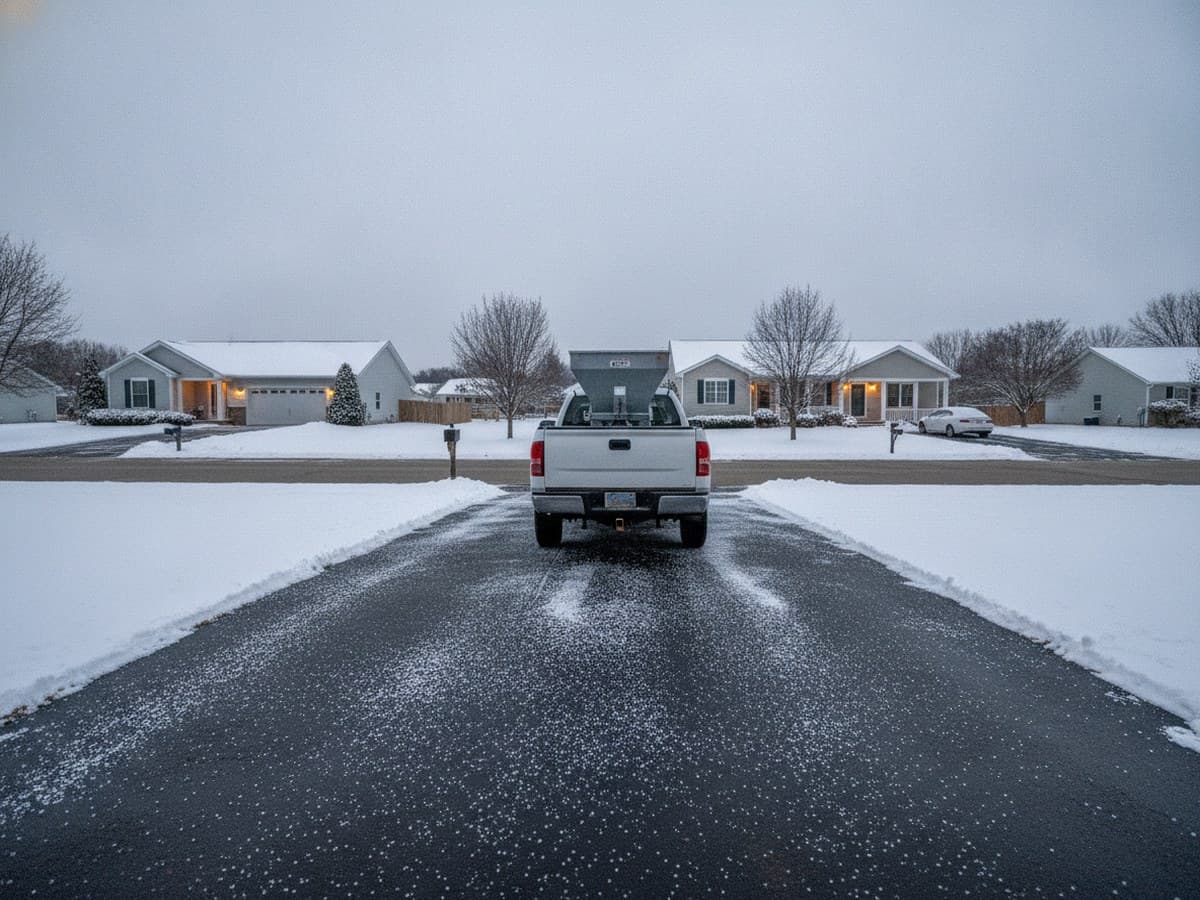
Two prices: on the plow pass, and a separate trip
Price these as different products. The material line barely moves. The clock does.
This planning model uses one operator at the May 2025 BLS median for grounds maintenance workers, $19.27 an hour, and four minutes to spread a residential drive after the snow is off it. Wages only. The truck, fuel, insurance, and the cost of being on call sit on top, the same way drive time cost sits on top of a mowing day. Replace $19.27 with your loaded rate before you quote.
| Stop | Clock | Wage at $19.27/hr | Salt at the $0.23 mug dose |
|---|---|---|---|
| Salt added during a plow you are already on | 4 minutes | $1.28 | $0.23 |
| Salt-only stop, 4-minute hop on the same street | 8 minutes | $2.57 | $0.23 |
| Salt-only stop, 14-minute hop across town | 18 minutes | $5.78 | $0.23 |
The hop times are the same planning split as the driveway-cap model: about four minutes between neighbors, about fourteen when the next driveway is a drive.
Wage plus salt on a tight stop is a few dollars. That is the floor under the price, not the price. The $22 to $47 band exists because the truck, the insurance, and the 5 a.m. response are still unpaid in that table. Housecall Pro's minimum-charge rule applies: the smallest visit has to pay for showing up.
Keep two numbers on the contract. Salt during the plow pass is four extra minutes on a truck that is already in the apron. A salt-only callback is a second mobilization. Walks and steps are slower than a spreader pass down the drive, so they get their own line, the same way the plow-cap post treats shoveling.
Cap the applications or bill each pass. An unlimited salt clause inside a low seasonal plow price is a stack of extra trips at a price you already froze. Housecall Pro's seasonal example shows that shape with extra plow visits: hold the price fixed, add trips, and the margin falls apart.
A street of salt stops versus a scatter
Take eight salt-only driveways, each billed at $25, which sits inside Lawn Love's $22 to $47 band. Revenue is $200 either way. The map is the difference.
| Route | Time for 8 stops | Wages | Salt (8 × $0.23) | Wages + salt |
|---|---|---|---|---|
| Same street, 4-minute hops | 64 minutes | $20.55 | $1.84 | $22.39 |
| Scattered, 14-minute hops | 144 minutes | $46.25 | $1.84 | $48.09 |
Same invoices. The loose route spends about $26 more in wages and burns 80 extra minutes of a storm window. Truck cost is still missing from both columns, and it is larger on the loose route because the miles are longer. That is the same leak as a loose mowing day, with a hopper instead of a mower.
Eight driveways on one street is a route. Eight driveways in eight neighborhoods is eight mobilizations wearing a salt price. Selling snow to the mow book names those streets before the first refreeze.
What to write on the quote
Put five facts in the text you send:
- Trigger. Refreeze, a named temperature, or a customer request. "Salt as needed" with no cap is an unlimited promise.
- Surface. Driveway, walk, and steps are separate time.
- Product and cutoff. Rock salt above the temperature on the bag. Sand, or a colder blend, is its own material price below that.
- Rate. A mug-sized dose per 1,000 square feet.
- Callback price. Higher than salt dropped during the plow pass.
Homeowners need to see that salt is a visit, that a second visit costs more, and that a street already on your list is the one you can treat before work.
Where a bundled snow route changes the salt math
BlockBundle books snow removal one address at a time. The economic unit is still the street. When several homes on the same block book clearing, the salt pass is the tight row in the table: a few minutes between neighbors. You set the price. Clustered stops are what keep a $22 to $47 salt charge on a short hop.
Draw the area you will actually treat and put the rate in your book before the season, the same step as serving a whole street. Neighbors who want the block on one plow list start from how to get a block on one route.
Check your number against Lawn Love's November 2026 band of $22 to $47 for one salt application. Build the price from the stop, not from the pounds. A callback that brings the truck back costs more than salt you spread while you are already plowing.
MPCA says about a coffee mug, around 12 ounces, covers a 20-foot driveway or about 1,000 square feet. LTAP's range is 1 to 4 pounds per 1,000 square feet after the snow is removed. At $15 for a 50-pound bag, that mug dose is about $0.23. Measure your hopper.
Keep it as a line item with a cap or a per-pass price. Unlimited salt inside a cheap seasonal plow price is a stack of extra trips you already agreed not to bill.
Sodium chloride is a melting tool from about 32°F down to about 15°F. Below that, use sand for traction or a product whose label says it works colder. Billing rock salt on a night it cannot melt is a complaint waiting on the invoice.
Sources
- Lawn Love, "How Much Does Snow Removal Cost in 2026?", updated November 18, 2026: a single salt application costs $22 to $47. https://lawnlove.com/blog/snow-removal-cost/
- Housecall Pro, "Snow removal pricing formula," updated October 27, 2026: median residential driveway-and-walkway job $113 (17,750 jobs); median job that includes salting $166 (2,573 jobs); price = cost ÷ (1 − target margin), with 30% shown as an example. https://www.housecallpro.com/resources/snow-removal-pricing/
- Minnesota Pollution Control Agency, news release, December 8, 2025: about 12 ounces (a coffee mug) treats a 20-foot driveway or about 1,000 square feet; most salts stop working below 15°F. https://www.pca.state.mn.us/news-and-stories/as-minnesota-prepares-for-a-cold-snowy-winter-mpca-urges-smart-salting-practices
- Minnesota LTAP, "Winter Salt Guide: Homeowners": 1 to 4 pounds of sodium chloride per 1,000 square feet after snow removal; a 12-ounce mug of salt weighs about a pound; sodium chloride works from 32°F to 15°F. https://mnltap.umn.edu/guides/smartwintersalt/homeowners/balance
- U.S. Bureau of Labor Statistics, Occupational Outlook Handbook, Grounds Maintenance Workers, May 2025 median wage $19.27 an hour. https://www.bls.gov/ooh/building-and-grounds-cleaning/grounds-maintenance-workers.htm